
Big Green Caterpillar on Tomato? Read the Hornworm Clues
A large green caterpillar on tomato may be a tobacco or tomato hornworm. Compare side marks, rear horn, droppings, and white wasp cocoons.

At a glance
What is the big green caterpillar on my tomato plant?
A very large green caterpillar on tomato is often a tobacco hornworm or tomato hornworm. Tobacco hornworms usually have diagonal white side marks and a red rear horn. Tomato hornworms usually have V-shaped white marks and a dark horn. Use several clues together because the host plant and green color alone do not identify the species.
A dark, ridged pellet may be the first clue, resting on a tomato leaf with another on the soil below. Above it, a stem ends in bare nubs where leaflets used to be. Only after the eye follows that trail upward does the animal appear: thick as a finger, leaf green, and pressed so neatly along the stem that its outline seems to dissolve.
The biggest green caterpillar in the garden may be easiest to find by looking below it first.
On tomato plants across much of North America, two close relatives often fit this scene. One is the tobacco hornworm, Manduca sexta. The other is the tomato hornworm, Manduca quinquemaculata. Their shared host and color start the identification, but they do not finish it. The better answer comes from a small packet of evidence: side marks, rear horn, body pattern, region, season, and a clear photograph.
This is an identification and natural-history guide. It stays with what can be seen and leaves crop-treatment decisions outside the article.
Look below the missing leaves
Hornworms are famous for hiding despite their size. Their green bodies align with stems and leaf stalks, and pale diagonal markings break up the long caterpillar shape. University of Minnesota Extension notes that tomato hornworms often feed in the upper parts of the plant. Penn State Extension describes droppings as one of the clearest signs that a caterpillar is present even when the animal remains out of sight.
Those droppings are called frass. Fresh pieces can be green, while older ones darken. Their ridged or segmented shape may look surprisingly large. A wide view of the plant can show where foliage is missing. A closer view of the leaves and ground below can show the frass. From there, the useful move is visual: scan the stem directly above the freshest clue.
Host narrows the field too. Tomato belongs to the nightshade family, along with tobacco, potato, pepper, and eggplant. Both familiar Manduca species use plants in this family. The Nightshades Species Showcase gives the plant-side context, including the starry flowers and fruit that help place a host in the larger group.
Host is a clue, not a verdict. A green caterpillar on tomato still needs its own marks.
Tomato hornworm or tobacco hornworm?
Start with the pale pattern along the sides. A tobacco hornworm usually shows a row of separate diagonal white marks. Dark edging can sharpen those slashes, and the rear horn is usually red. The verified tobacco hornworm in the hero photograph shows that combination while resting on a tomato stem.
Tomato hornworms usually show connected white marks shaped more like a series of V’s, with a dark blue to black rear horn. Virginia Cooperative Extension and University of Minnesota Extension use those paired traits to separate the two common garden species.
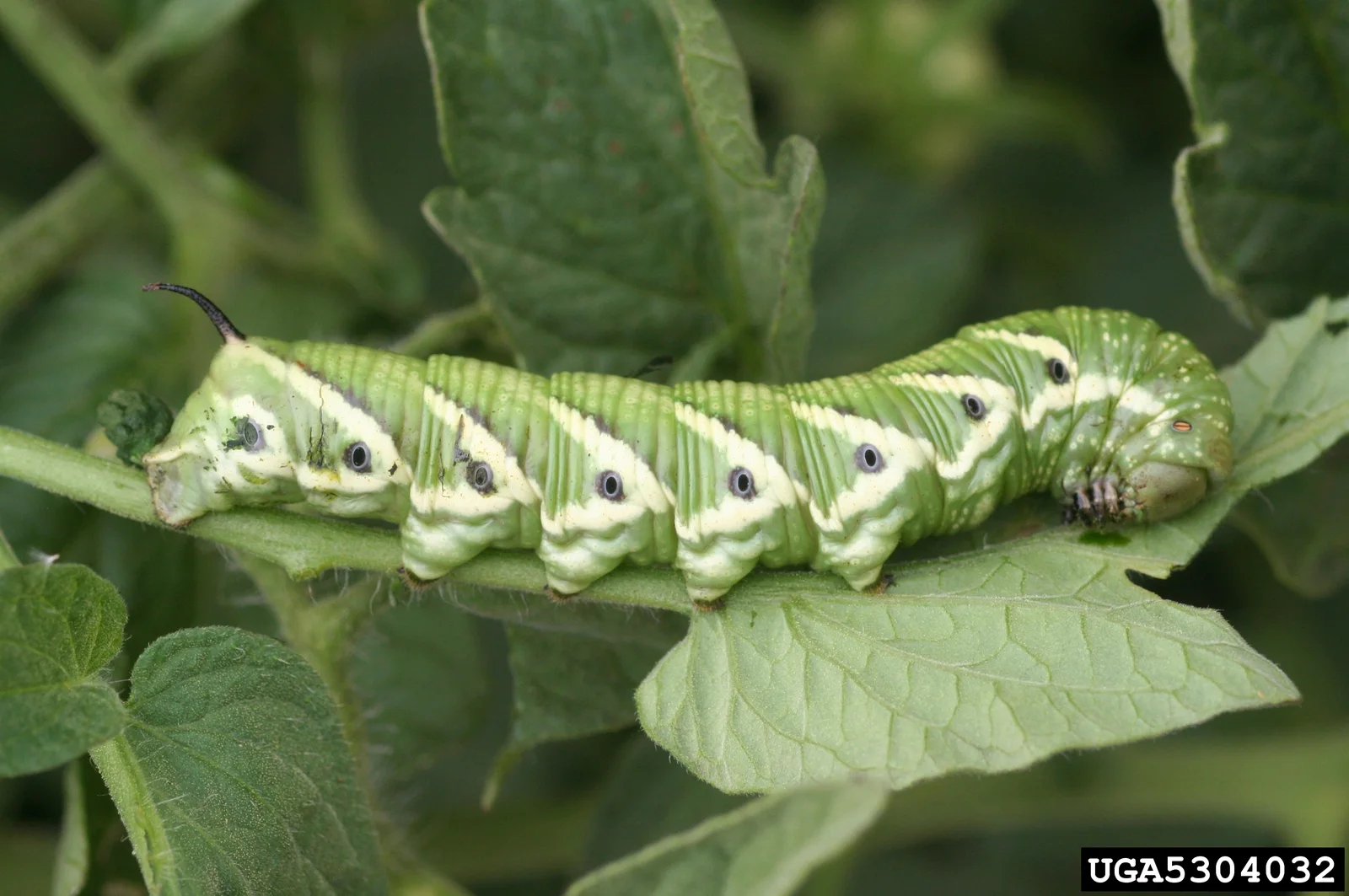
Remember diagonal red for the usual tobacco-hornworm pattern, connected V and dark for the usual tomato-hornworm pattern. Real observations still deserve a second look. A body may be partly hidden, one mark may be damaged, colors shift with light, and regional abundance changes which species is more likely. Colorado State University Extension notes that tobacco hornworms are more common east of the Rockies in many garden settings, while both species can occur together.
At the back, the projection that gives hornworms their common name works as another field mark. Photograph its color together with the side pattern rather than using the host or green body alone.
The white “eggs” are usually cocoons
Sometimes the green body carries dozens of upright white shapes. They look like grains of rice planted across the caterpillar’s back and sides. Searchers often call them eggs. By the time they are visible, though, the structures are cocoons.
Cotesia congregata, a tiny braconid wasp, is often the maker. University of Florida entomologists describe it as a parasitoid of both tobacco and tomato hornworms. “Parasitoid” means its young develop in or on one host and eventually kill that host. Several wasp larvae can develop inside a single caterpillar. When they are ready for their next stage, they emerge and spin the pale external cocoons that make the relationship visible.
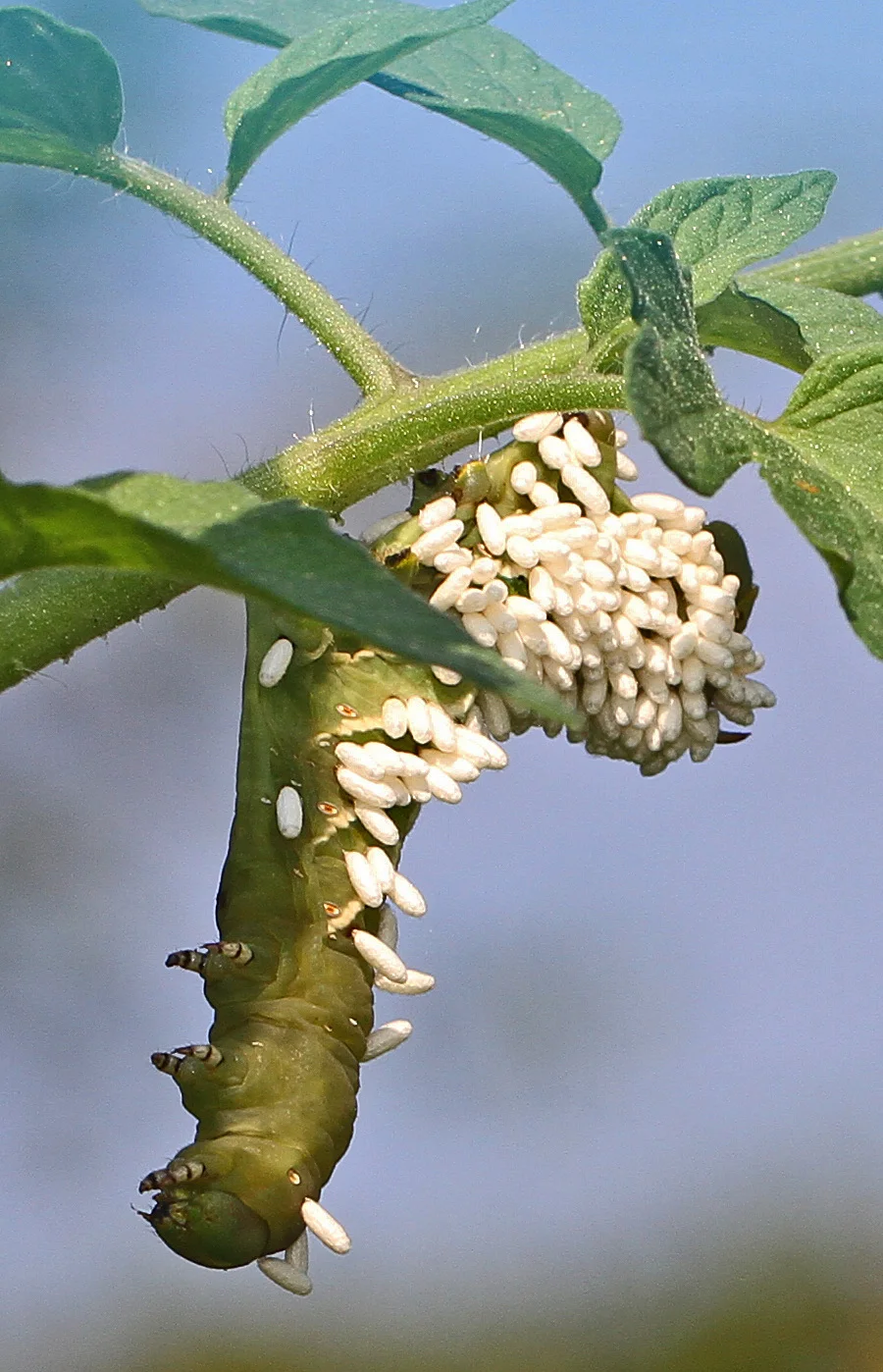
This is the article’s strangest turn. A tomato stem holds a plant eater, and the plant eater holds another insect’s nursery. What looked like decoration on one caterpillar is evidence of a three-part relationship among nightshade, moth, and wasp.
Exact photographic evidence matters here. White shapes on an unknown caterpillar should not automatically receive this species name. The Commons record for the image identifies both the tobacco hornworm and Cotesia congregata. Without that level of evidence, “parasitoid-wasp cocoons on a hornworm” is the safer label.
How a caterpillar becomes a moth
Hornworm shape belongs to the larval stage of a sphinx or hawk moth. After feeding and growing through several molts, a mature hornworm leaves the plant and enters the soil, where it forms a brown pupa. The adult that emerges is a large, strong-flying moth with narrow forewings and a thick body.
Colorado State University Extension notes an important distinction. Many sphinx moths are called hummingbird moths because they hover at flowers, but adults of the tomato-associated Manduca species usually fly after dusk. The guide to bugs that look like hummingbirds focuses on the conspicuous daytime hoverers. It is a useful family connection, not proof that every hornworm becomes the same kind of flower visitor seen at noon.
Season changes the clues. In northern regions, a pupa may pass the winter in soil. In warmer places, another generation can appear within the year. University of Minnesota Extension describes caterpillars feeding into late summer or early fall, while Penn State places tomato-field evidence from July through September. Late August is therefore a strong time to notice the largest larvae, their frass, and the gaps they leave among upper leaves.
Compare the whole scene, not color alone
Several garden caterpillars can become large and green, but host and body plan quickly separate the strongest alternatives. A mature black swallowtail caterpillar carries black crossbands and paired yellow-orange dots on dill, parsley, fennel, and relatives. The black swallowtail caterpillar guide follows those changing stages.
On citrus, a giant swallowtail larva keeps a mottled brown-and-white disguise for much of its growth. It lacks the smooth leaf-green hornworm pattern. The bird-dropping mimic on citrus guide shows how host family and disguise work together.
Even within hornworms, one field mark should not carry the full name. Useful photographs include the entire caterpillar from the side, the rear horn, several side marks, the host plant, and the surrounding stem. If white cocoons are present, one wider frame should preserve their placement and another can record their upright shape.
Make a record without changing the scene
One calm sequence can turn a surprising tomato-plant find into a useful field note.
Begin wide. Photograph the whole plant and the section with missing foliage. Then record the droppings below and the caterpillar above. Take a side view for the pale marks and rear horn. Add a host view with leaves, flowers, or fruit visible. Note the date and general region.
If the animal is partly hidden, let the uncertainty remain in the record. “Large green hornworm on tomato, diagonal side marks visible, rear horn not photographed” is stronger than forcing an exact species from memory. The family bug-observation guide uses the same rhythm: pause, frame, describe, and leave the living scene as it is.
What begins as a partly bare tomato stem can open into several lives at once. The plant turns sunlight into leaves. A caterpillar turns those leaves into a moth body. A tiny wasp may turn the caterpillar into a nursery, leaving white cocoons where its earlier stages were invisible. Below them, the soil waits for the moth’s next form.
Shift the angle and the green animal may disappear again. The clues stay: a chewed leaf, a ridged pellet, a red or dark horn, a line or a V, perhaps a small white cluster that belongs to a second story.
Sources
- Penn State Extension: Evidence of Tobacco and Tomato Hornworm on Tomatoes Accessed 2026-08-27
- University of Minnesota Extension: Tomato Hornworms in Home Gardens Accessed 2026-08-27
- Virginia Cooperative Extension: Hornworms in Home Gardens Accessed 2026-08-27
- Colorado State University Extension: Hornworms and Hummingbird Moths Accessed 2026-08-27
- University of Florida Entomology: Cotesia congregata Accessed 2026-08-27
Image credits
- Top image NatureFreak07 · CC BY 2.0
- After the tomato and tobacco hornworm comparison Whitney Cranshaw, Colorado State University, Bugwood.org · CC BY 3.0 US
- After the parasitoid-wasp explanation Judy Gallagher · CC BY 2.0
More Field Notes
 Praying Mantis Egg Case: How to Identify an Ootheca on a Twig
  Why Pine Cones Open When Dry and Close When Wet
  Black and Orange Fuzzy Caterpillar: Woolly Bear ID Guide
Read it. Then go find it.
Open Leafari on your next walk and see what has been waiting in plain sight.