
Why Pine Cones Open When Dry and Close When Wet
A mature pine cone can fold its scales inward in damp air and spread them again as it dries. The movement comes from the cone's layered structure, not muscles or new growth.

At a glance
Why do pine cones open and close?
Many mature pine cones open as they dry and close as they absorb moisture. Each woody scale contains tissue layers that swell by different amounts. Dampness makes the scale bend inward; drying bends it outward again. The response is passive, so even a fallen mature cone can keep moving through repeated wet and dry changes.
After a damp night, a mature pine cone can look clenched. Its scales overlap tightly, and the dark gaps between them nearly vanish. Return after dry weather and the outline has changed: each scale leans outward, turning the compact cone into an open lattice.
Many mature pine cones open as they lose moisture and close as they absorb it. The motion does not need muscles, nerves, or new growth. It comes from layers inside each woody scale that change size by different amounts as humidity shifts.
A pine cone moves because each scale is a built-in moisture hinge.
Look at the wet-and-dry difference
Six Scots Pine cones collected together appear in the hero photograph. The three on the left were wetted and became tightly closed. The three kept dry on the right spread their scales. Because the cones share a source and appear in one frame, the comparison makes moisture a more useful clue than color, size, or age alone.
Look at the spaces between scales. On a dry open cone, those gaps form dark channels from the center toward the tips. On a damp closed cone, the scales overlap like roof shingles. The whole object seems to shrink, but each scale is bending inward rather than disappearing.
Scientists call this kind of response hygroscopic movement: a material changes shape as it gains or loses water from the surrounding air. Relative humidity describes how much water vapor the air holds compared with the amount it could hold at that temperature. A cone responds to its own moisture exchange, which is why its shape records the conditions around it rather than announcing the future.
How the hidden hinge bends each scale
A cone scale looks like one solid wooden piece. Under magnification, it is a layered structure. Research by Elodie Reyssat and L. Mahadevan showed that cells in one responsive tissue layer lengthen more when they take up moisture, while the neighboring layer changes less.
Because the two layers stay joined, they cannot simply grow longer side by side. Their unequal change forces the scale to curve, much as a strip made from two materials bends when one side changes length more than the other. Damp tissue bends the scale toward the cone. Drying reverses the difference and carries it outward.
Most of that bending happens near the base of the scale, where it joins the cone’s central axis. The longer outer portion acts like a lever, enlarging a small tissue-level change into a movement visible from several steps away. Multiply that hinge by dozens of overlapping scales and the cone seems to open as one object.
This mechanism also explains the strangest part of the observation: a mature fallen cone can keep moving. Its response is passive. Living cells do not have to send a signal each time the air changes. The arrangement and swelling behavior of the material are already built into the scale.
Closing and opening run on different clocks
No single timer governs the gradual change. Species, cone size, scale thickness, starting moisture, temperature, airflow, and local humidity all affect the pace.
In a laboratory time-lapse reported by Reyssat and Mahadevan, a Norway Spruce cone closed over about two hours when immersed, while a cone opening in ambient air took about four days. Those figures describe particular samples under particular conditions, not a schedule for every cone outdoors. They show why a return visit can reveal more than a few minutes of watching.
Water can reach a scale quickly, while drying depends on moisture leaving through the exposed surface. The outer scales may open first and uncover the next layer, producing a slow wave from one end of the cone toward the other.
Open scales change the path for seeds
A pine cone is a reproductive structure, not a fruit. Its seeds rest with the woody scales rather than being sealed inside a fleshy or dry fruit wall. The broader tree seed-pod identification guide shows how cones differ from samaras, nuts, capsules, and true pods before this moisture mechanism enters the story.
For many pines, dry open scales create a route for mature winged seeds to leave. The USDA Forest Service reports that Monterey Pine cones can open and release seed during warm, dry periods, then close rapidly as temperature drops and relative humidity rises. Repeated changes can spread seed release across more than one weather window.
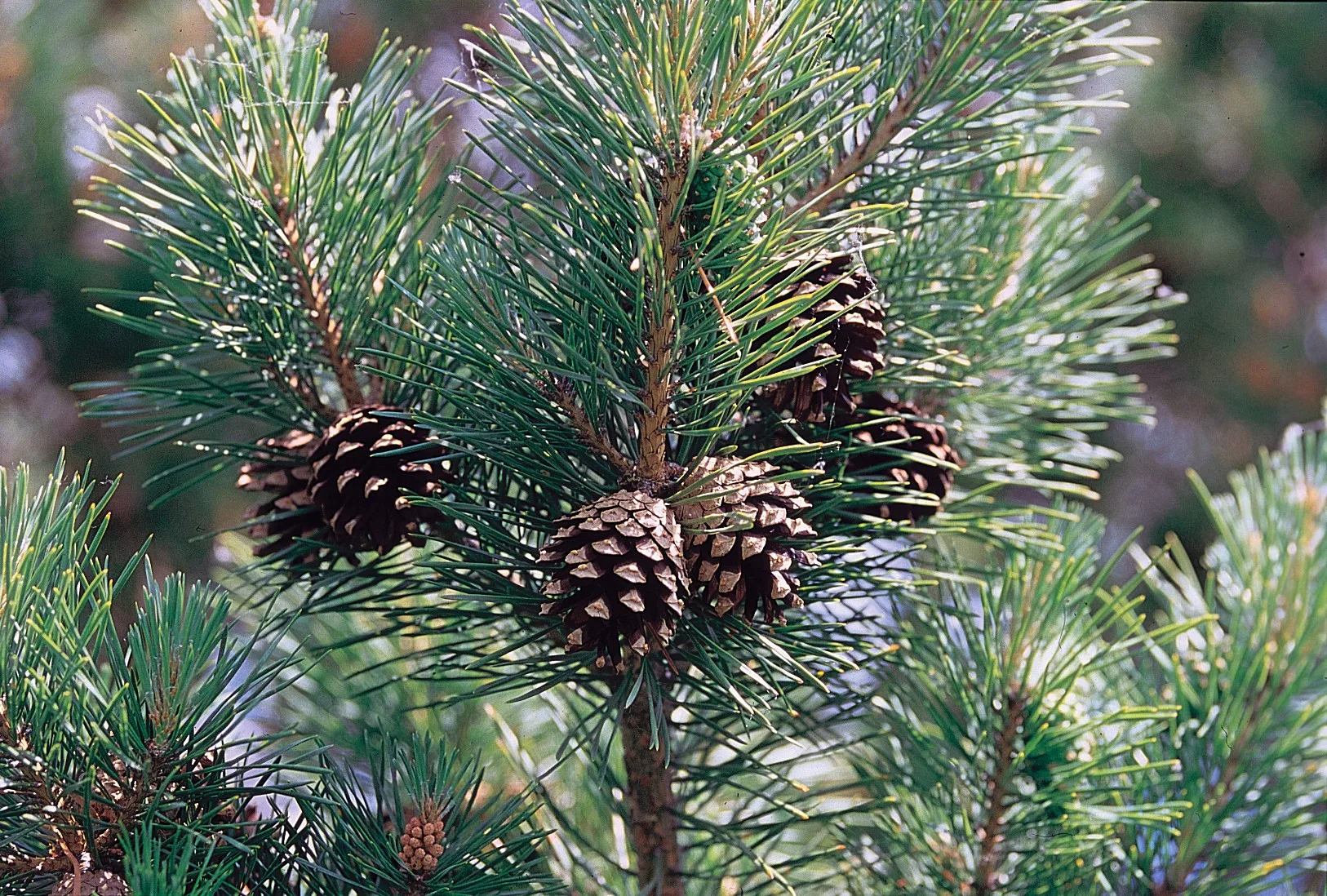
That pattern is useful for wind travel, but it is not a promise about every seed in every cone. Pine species differ, and individual cones vary with maturity and condition. An open cone supports a moisture-and-release story; it does not prove that all its seeds have already gone.
Some cones wait for more than dry air
Fire-adapted forests add an important exception. Some pines produce serotinous cones, whose scales are held shut by a resinous bond even after the cone matures. In many lodgepole pines, sufficient heat breaks that seal. Only then are the scales free to respond hygroscopically and release stored seeds.
Serotiny turns “pine cones open when dry” from a universal rule into a starting pattern. One species may carry both open and serotinous cone forms, and the balance can vary among forests. Austrian Pine offers another pine-cone reference, while Nootka Cypress is a reminder that other conifers build cones with different shapes and schedules.
Careful field conclusions stay close to the visible evidence: this mature cone is open or closed now. Its species, maturity, weather history, and resin can explain why.
A cone is a material lesson in plain sight
Pine-cone scales have inspired engineers because they link tiny structural differences with movement at a much larger scale. Recent work at MIT describes the chain from moisture-sensitive cellulose fibers to tissue layers and finally to the opening or closing seen across the cone.
That hierarchy matters for materials designed to respond without motors or electronic controls. A small change can travel through an organized structure and become a useful motion. The cone arrived at that solution as part of reproduction; engineers study the principle for adaptive surfaces and other moisture-responsive designs.
More remarkable than the machine comparison is the material itself: ordinary plant tissue already contains the rules for movement.
Build a patient weather record
Photograph a mature cone where it lies or hangs, including enough of the scene to preserve shade, sun, and surrounding plant clues. Return after a clear change from damp to dry weather. Frame the second photograph from the same angle and compare the gaps between scales.
Record the time and recent conditions. A tighter cone after fog and a wider cone after a dry afternoon can support the moisture response. One cone by itself cannot measure exact humidity, identify a species, or forecast tomorrow’s rain.
Quiet evidence is often the strongest: no sudden snap, only a series of scales changing their angle. Dampness enters the layered tissue. Each hinge curves. Dry air reverses the bend, and the whole cone opens a little farther into the day.
Sources
- Reyssat and Mahadevan: Hygromorphs, from Pine Cones to Biomimetic Bilayers Accessed 2026-09-29
- PLOS ONE: A Biologically-Inspired Symmetric Bidirectional Switch Accessed 2026-09-29
- MIT Civil and Environmental Engineering: Adaptive Materials Inspired by Pine Cones Accessed 2026-09-29
- USDA Forest Service: Monterey Pine Accessed 2026-09-29
- USDA Forest Service: Lodgepole Pine Accessed 2026-09-29
Image credits
- Top image Tangopaso · Public domain
- After the seed-release section USDA-NRCS PLANTS Database / Herman, D.E. et al. · Public domain (USDA)
More Field Notes
 Praying Mantis Egg Case: How to Identify an Ootheca on a Twig
  Black and Orange Fuzzy Caterpillar: Woolly Bear ID Guide
  Tiny Red Bugs on Concrete? Clover Mites vs. Sidewalk Mites
Read it. Then go find it.
Open Leafari on your next walk and see what has been waiting in plain sight.