
Holes in Acorns? Meet the Weevil Inside the Shell
A small round hole in an acorn often marks a weevil larva's exit. Follow the hidden life cycle from oak canopy to seed interior to soil.

At a glance
Why do some fallen acorns have small round holes?
A small, clean round hole through an acorn shell was likely made by an acorn or nut weevil larva as it left the seed. The pale, curved grub developed inside after an adult female placed an egg in the growing acorn. The hole can support a Curculio-level identification, but it usually cannot reveal the exact weevil species by itself.
In late August, the ground beneath an oak begins to gather small brown records of the canopy above. Most acorns are smooth and sealed. One has a dark circle in its side, as round as a mark made with a tiny paper punch.
That circle is not the doorway an adult used to enter. It is usually the doorway a young weevil made from the inside while leaving.
An acorn’s round hole is the doorway a young weevil chewed from the inside.
Read the hole before naming the insect
The strongest first clue is shape. Iowa State University Extension describes the familiar opening as a small round hole in the side of a fallen acorn. University of Minnesota Extension adds the late-summer timing: this kind of damage is often visible in August and September.
Look for an opening that passes cleanly through the shell. Its edge may be a little rough under magnification, but the overall outline stays circular. A long split, a crushed side, or a broad missing piece does not carry the same signal. Many events can crack or break an acorn, so an irregular gap should remain an irregular gap in the notes.
Even the neat circle earns careful wording. “Likely made by an acorn or nut weevil larva” is stronger than assigning an exact species. The Missouri Department of Conservation lists about 30 Curculio species north of Mexico. Several use acorns or other nuts, and their larvae can leave similar evidence.
In the hero photograph, documented Curculio glandium exit holes teach the shape of the clue. They do not mean an acorn found in Maryland, Missouri, or California belongs to that European species.
The “worm” inside is a beetle larva
Sometimes the maker is already visible beside a fallen nut. It is pale, curved, and plump through the middle, with a small brown head and no obvious legs. Searchers often call it a worm. Biologically, it is a beetle larva, also called a grub.
NC State Extension describes acorn-weevil larvae as short, cylindrical, legless, and curved. That body is built for a life inside a compact food chamber, not for walking across the outside of the shell. The larva feeds as the acorn develops around it.
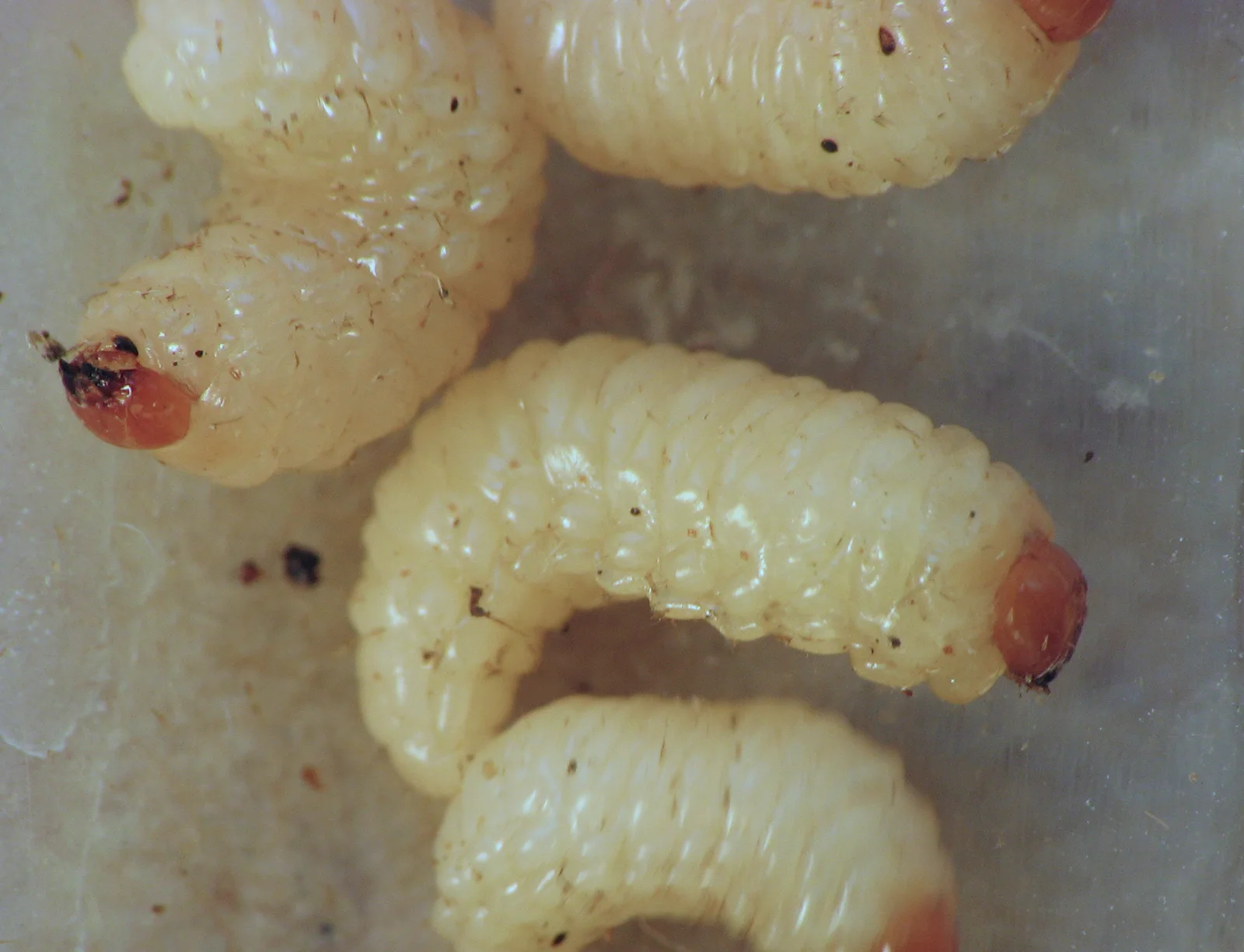
For the larva image, the safest label is genus level. The photographed grubs came from a Chinese chestnut in Pennsylvania and were identified as Curculio, probably C. sayi. Their shape helps explain a grub already in view, but larval appearance alone does not settle every species question.
The adult starts the story in the canopy
Rewind from the hole and the story climbs back into the tree. In summer, a female acorn or nut weevil visits a developing nut. Her most striking feature is a long narrow snout called a rostrum. The chewing mouthparts sit at its tip.
Missouri’s field guide explains that a female uses the rostrum to bore a tiny opening, then places an egg in the developing nut. The larva that hatches feeds inside. This first puncture and the later exit hole are different marks made by different life stages in opposite directions.
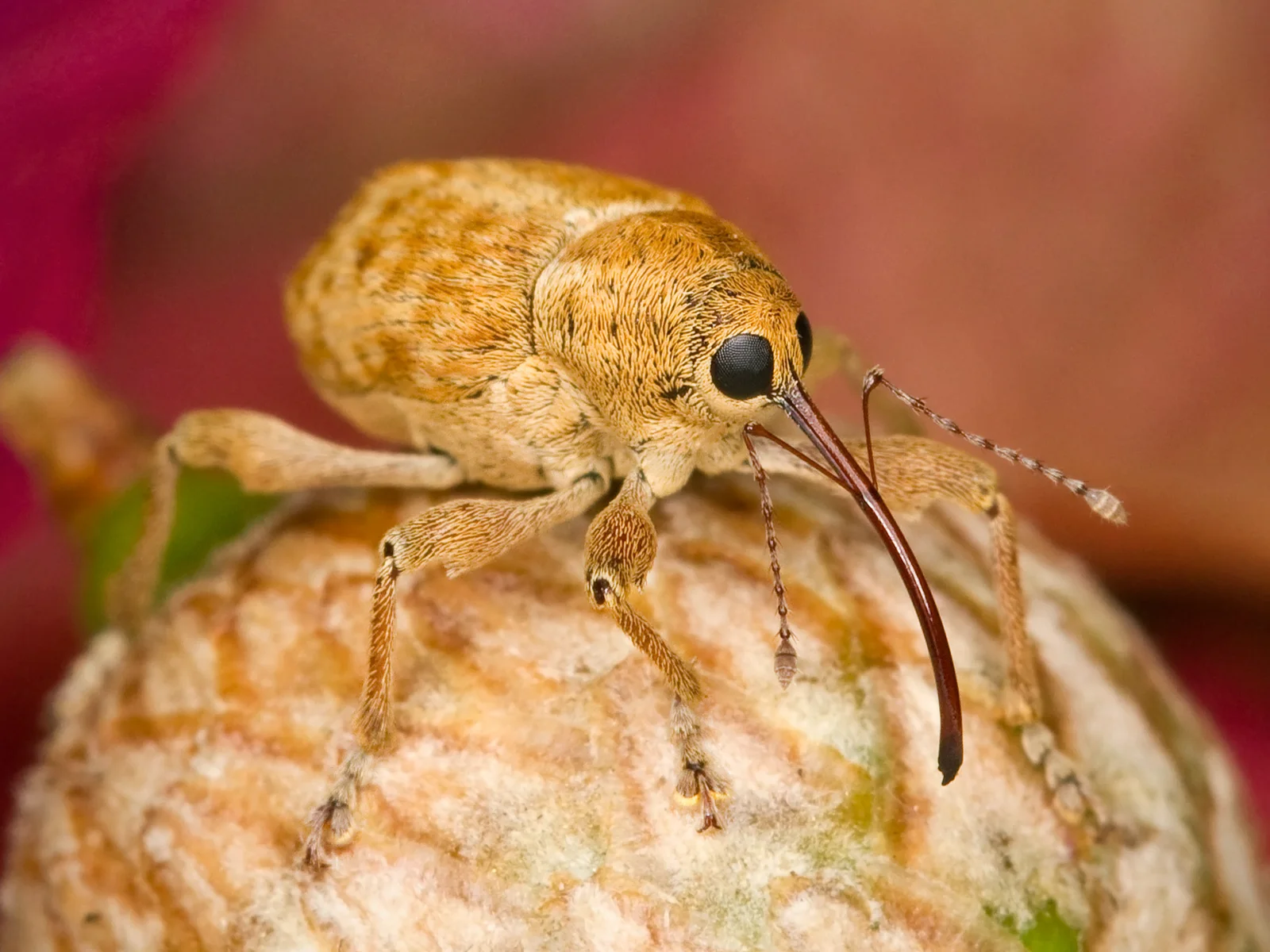
At first, the rostrum looks too delicate for the work. In the photograph it curves forward like a fine probe, with the antennae attached partway along it. Yet this slender tool gives the adult access to the seed before the shell becomes the hard object seen on the ground in fall.
One life moves through three places
An acorn weevil’s life can be read as a change of address.
It begins in the canopy, where the adult works at a growing acorn. It continues inside the seed, where the larva feeds out of sight. When the acorn drops and the grub is fully grown, the larva chews through the shell, leaves the round opening behind, and enters the soil.
Underground timing varies by species and place. NC State Extension describes a soil period of one to two years in the life cycle it profiles before pupation and adult emergence. That is a useful reminder not to compress every weevil into one annual calendar. The hole may mark the end of the acorn stage while much of the insect’s development still lies ahead below ground.
This canopy-to-seed-to-soil route is the article’s oddest turn. The adult begins the story high in the oak. The larva writes the most visible clue from inside the shell. Then the living insect disappears again, this time into earth.
The oak is a host clue, not a species label
Finding the parent tree improves the record. Acorns establish an oak relationship, and leaves, bark, buds, and the whole crown can help identify which oak produced them. The Willow Oak Species Showcase is one example: its narrow willow-like leaves may hide the oak identity until small acorns appear below.
That host name still does not name the weevil. Different Curculio species use different oaks, hickories, chestnuts, and other nuts, with overlaps that vary by region. A Willow Oak acorn can tell us about the tree and the kind of fruit. It cannot, by itself, turn a round hole into one exact beetle species.
Adult structure, place, season, host, and expert comparison may narrow the insect further. Without that packet, “acorn or nut weevil” is not a weak answer. It is the answer the evidence supports.
Hole, puncture, gall, or break?
Several marks can compete for attention around an oak. Sorting them begins with the material that carries the mark.
A larval exit hole passes through the hard shell of the fruit and keeps a nearly round outline. The female’s earlier egg-laying puncture is much smaller and was made while the acorn was still developing on the tree. A crushed or jagged shell lacks the clean exit shape and may have more than one possible cause.
A gall belongs to a different process. It is plant tissue that grew into an altered shape after a tiny organism changed the plant’s development. Some galls eventually show exit openings too. The field guide to bumps and galls on leaves shows why the host tissue around a hole matters. A dark opening in a swollen leaf base is not the same object as a circle through an acorn shell.
This comparison keeps one attractive clue from doing too much work. Roundness matters, but so do the object, its edges, the nearby tree, and the season.
What to notice without changing the scene
Start with a wide photograph of the fallen acorn beneath its likely parent tree. Add a close frame that shows the hole edge and enough of the shell to preserve scale. A third image of leaves, twigs, bark, and the tree’s overall shape can support the oak identification.
Record the date and general region. If a grub or adult is already visible, photograph it where it is rather than opening, probing, or carrying the acorn to produce another view. The family bug-observation guide offers the same patient rhythm: pause, photograph, describe, and let the evidence remain part of its place.
Useful notes can be short. “Small circular opening through one fallen acorn, under a narrow-leaved oak, August 25” preserves more than “bug hole.” It separates what the camera shows from what research later suggests.
A finished record may never reach species. It can still preserve a complete natural-history connection: oak, acorn, beetle larva, exit, soil. A mark no wider than a few millimeters becomes the visible hinge between three habitats and two very different bodies.
After the grub has gone below, the acorn stays on the surface. Its dark round opening is both absence and evidence, a small piece of the canopy’s summer carried into the soil story of fall.
Sources
- Iowa State University Extension: Small Round Holes in Acorns Accessed 2026-08-25
- NC State Extension: Acorn Weevil Accessed 2026-08-25
- University of Minnesota Extension: Oak Holes in Acorns Accessed 2026-08-25
- Missouri Department of Conservation: Nut Weevils Accessed 2026-08-25
Image credits
- Top image Slimguy · CC BY 4.0
- After the larva section Beatriz Moisset · CC BY-SA 4.0
- After the adult section Ryan Kaldari · CC0
More Field Notes
 Praying Mantis Egg Case: How to Identify an Ootheca on a Twig
  Why Pine Cones Open When Dry and Close When Wet
  Black and Orange Fuzzy Caterpillar: Woolly Bear ID Guide
Read it. Then go find it.
Open Leafari on your next walk and see what has been waiting in plain sight.