
Praying Mantis Egg Case: How to Identify an Ootheca on a Twig
A tan, foam-like lump on a twig in fall or winter is often a mantis egg case. Compare Chinese, Carolina, and European cases and see what happens in spring.

At a glance
What is the hard, foam-like case on a twig in fall or winter?
A tan, hardened, foam-like lump on an outdoor twig or stem from fall into spring is often a praying mantis egg case, called an ootheca. Eggs wait inside until spring. In much of the eastern United States, rounded cases suggest Chinese mantis; slender cases suggest Carolina or European mantis. Shape alone cannot confirm a species. Photograph outdoor cases and leave them in place.
On a dry stem at the edge of a meadow in late October, a tan lump clings to one side, about an inch and a half across. It looks manufactured. The surface is ridged like packing foam that set hard while it was still being poured, and one edge wraps partly around the stem as if it had been molded there.
That lump is most likely a praying mantis egg case, called an ootheca. University of Maryland Extension describes it as a hardened, straw-colored, foam-like mass attached to small stems and twigs, with dozens to hundreds of eggs that spend the winter inside its walls and hatch in spring.
Adult mantids blend into summer foliage, and their egg cases blend in too. Once the leaves drop, though, a case stays put on its twig all winter, and its shape carries real clues about which mantis made it. In much of the eastern United States, three species account for the cases people find: the native Carolina mantis and the introduced Chinese and European mantises. Maryland and Kentucky extension entomologists list all three.
Look for hardened foam on a stem or twig
Start with texture. A mantis egg case is firm and dry, fixed tightly to whatever it was built on, and its surface looks like foam that has set. Illinois Extension describes the cases people find in fall and winter as light brown, about 1.5 inches wide, and looking like foam insulation.
Then check where it sits. Mike Raupp, an entomologist writing the University of Maryland’s Bug of the Week, notes that a female deposits one or more cases on upright vegetation such as tree branches and meadow plant stems. Colorado State University Extension adds rocks, buildings, fences, and trees. Illinois Extension says a female Chinese mantis needs only a surface that will support her weight and is somewhat vertical, which is why brick siding and fence posts work as well as twigs.
Season is the third clue. A hard tan case found from late fall into early spring fits the mantis calendar: the foam goes on in autumn, and the eggs wait inside until warm weather returns.
How a female builds the case
Each case begins as a liquid. After mating in fall, a female lays her eggs in a frothy secretion that hardens into a Styrofoam-like case, according to University of Wisconsin-Madison Extension. Colorado State University Extension explains that the foamy material covers the case as it is produced, then hardens to protect and insulate the eggs.
Egg counts vary widely. University of Kentucky entomologists give a range of 12 to 400 eggs per case, and Wisconsin Extension notes that the number depends on the species and conditions. Raupp describes more than 100 siblings chilling out together through the winter inside one case.
A mantis egg case is a foam nursery that can carry more than a hundred mantises through winter on a single twig. The female does not see it open. Wisconsin Extension notes that adults die a few weeks after mating and egg laying, and Illinois Extension says the mother dies shortly after her case hardens.
Chinese mantis: a puffy, rounded case
Chinese mantis, Tenodera sinensis, is the largest of the three, 3 to 5 inches long as an adult. Some extension pages list it as Tenodera aridifolia sinensis. Its case is the one people describe as a ball. Clemson’s Home and Garden Information Center calls it a ball-shaped foam ootheca usually attached to small twigs or branches, and Purdue Extension says it resembles the shape of a toasted marshmallow. The case at the top of this page, recorded in Rock Creek Park in Washington, D.C., wraps around a dry stem in that rounded, bell-like form.
This mantis is not native. Raupp recounts that it was discovered on October 16, 1897, resting on a tomato vine in Mt. Airy, near Philadelphia, and that a nearby nursery imported many plants from China and Japan. Whether it arrived as an egg case on nursery stock remains a guess. Clemson adds that egg cases sold for biological pest control are usually this species.
Carolina mantis: slender and striped
Carolina mantis, Stagmomantis carolina, is the native species of the three and the smallest, about 2 to 2½ inches long. South Carolina named it the state insect in 1988, and Raupp gives its range as New Jersey south to Florida and west to Arizona.
Its case is long and narrow. University of Maryland Extension notes that the Carolina mantis ootheca is longer and narrower than the Chinese mantis case, and Clemson describes it as slender and elongated, attached to surfaces and bark. Illinois Extension calls the cases smaller and flatter, almost resembling a fossilized trilobite, and says they commonly sit on flat vertical surfaces. Colorado State University Extension points to a distinctly light-colored stripe down the center.
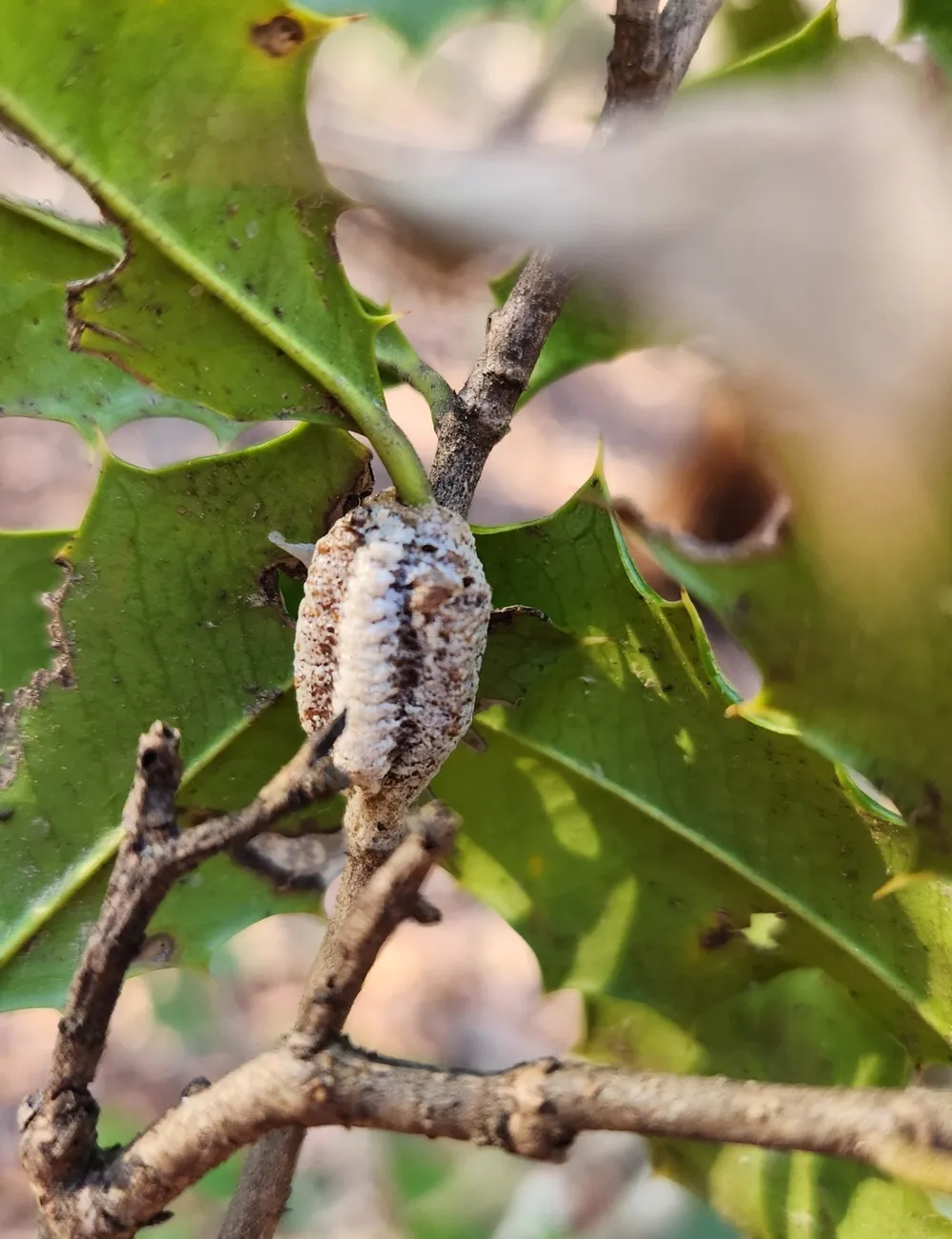
European mantis: long and plain tan
European mantis, Mantis religiosa, sits between the other two at about 3 inches long, and adults carry a black-ringed white spot on the inside of each front leg. Raupp writes that it was introduced to North America in the 1890s and now ranges east of the Mississippi and north into Canada. Colorado State University Extension reports it well established in much of that state as well.
Its case is also elongated, which makes it the easiest to confuse with a Carolina case. Colorado State University Extension describes the European mantis ootheca as larger, with a fainter stripe or a solid tan color, where the Carolina case shows a distinct pale center stripe.
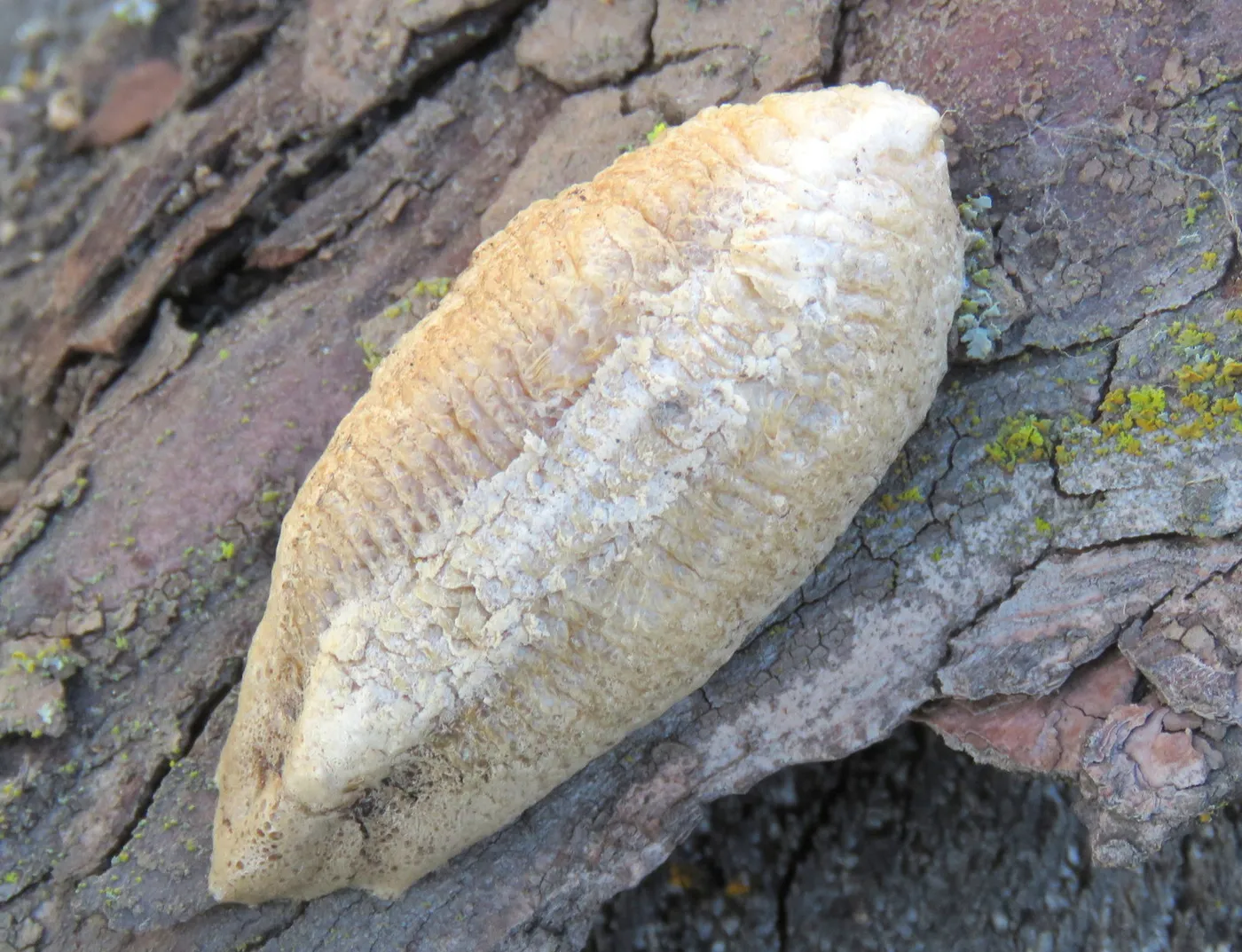
Shape narrows the list without settling every case. These extension descriptions are tendencies rather than fixed rules, and the three species share ground across much of the East. When a case falls between the descriptions, “mantis egg case” is an honest label until a clearer photograph or an adult nearby adds evidence.
Why the case waits outside all winter
Every mantis that hatches next spring spends the coming winter as an egg. Colorado State University Extension says mantids there survive winter only in the egg stage, and Kentucky entomologists note a single generation each year. The eggs are not simply waiting for warmth, either. Purdue Extension entomologist Timothy Gibb described their winter state as diapause, a physiologically induced delay in development, and Colorado State University Extension notes that the eggs need a chill period of a few months before they hatch.
That timing explains a holiday surprise. Clemson notes that egg cases are often attached to branches of Christmas trees, and the mantids hatch when the tree is brought indoors. Raupp writes that a case on the bough of a cut tree can fill it with hundreds of tiny mantises before New Year, with no prey for them inside. Purdue Extension adds that growers usually run trees through a shaker that removes dead needles along with egg cases.
Outdoors, the case is one of several insect signs that sit through the cold in plain sight. A woolly bear caterpillar spends the same months partly frozen in leaf litter, while the mantis generation waits as eggs inside hardened foam.
When the eggs hatch in spring
Purdue Extension says the eggs hatch with warming spring temperatures into nymphs, smaller versions of the adult. Colorado State University Extension places the hatch in late spring, and Raupp ties it to the return of warm weather and small insects. In Maryland, the Chinese mantis case below was photographed mid-hatch on May 14.
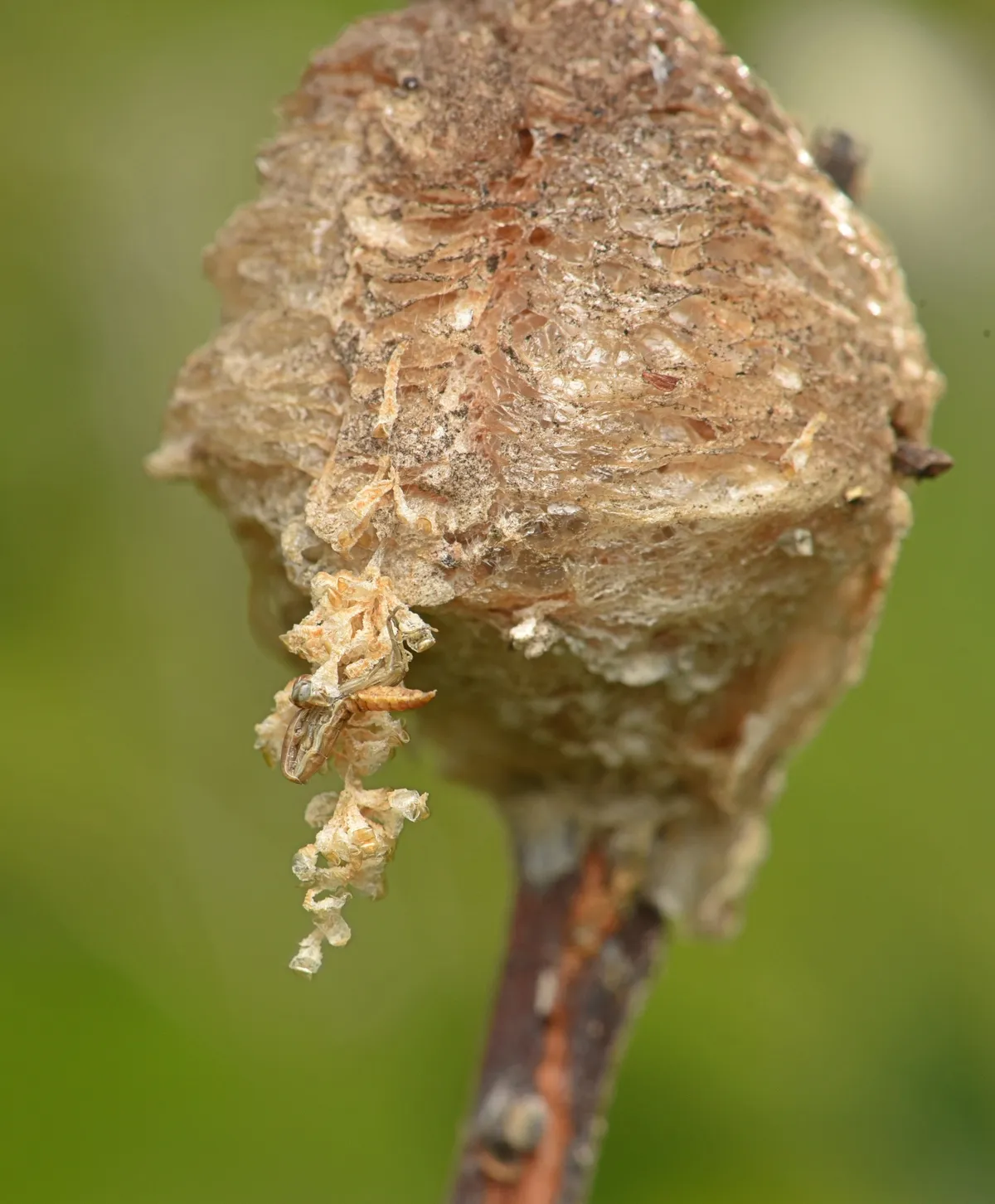
Life outside the case starts hard. Kentucky entomologists note that a young mantis’s first meal is often a sibling, and Illinois Extension says most of the mantises that hatch from one case die from starvation or cannibalism. Survivors need the whole growing season to reach adulthood, and Wisconsin Extension notes that wings appear as they become adults in late summer or fall. By then the females are looking for stems and branches again.
Egg masses that are not mantis cases
Other insects winter as eggs on the same twigs and bark, and each mass has a different texture.
Eastern tent caterpillar eggs form a shiny, black, varnish-like band that encircles a twig about pencil-size or smaller, according to University of Kentucky entomologists, with 150 to 400 eggs in each band. Penn State Extension notes that the smooth, shiny band can share a black cherry tree with black knot, a rough, knotty fungal growth. The caterpillars hatch around the time buds open and spin silk tents in branch forks, a different structure from the late-summer webs in the fall webworm guide.
Spongy moth eggs look soft rather than foamy. University of Minnesota Extension describes a fuzzy, pale-yellow mass laid in late summer to early fall on almost any protected surface, from bark crevices and the undersides of branches to mailboxes and campers. The name spongy moth replaced gypsy moth in 2022, and Minnesota’s agriculture department monitors it as an invasive species.
Single eggs are another strategy entirely. Green lacewings set each egg at the tip of its own hair-thin stalk, as the lacewing egg guide shows, rather than sealing a crowd into one case.
Make an outdoor record and leave it in place
A good record takes a minute and no contact. Photograph the case from the side so its full length and outline show, then from one end to show how thick it is and whether it wraps the stem or lies flat against a surface. Include enough of the twig, bark, or wall to show the setting, and note the date and general place.
For a case outdoors, leave it where the female put it. Illinois Extension warns that eggs in a case left on the ground are lost to ants.
A case already indoors on a cut tree is a different situation: indoor warmth can bring an early hatch with no prey. Ask a local extension office for advice specific to that case.
Then check back in spring. A case that looked inert all winter may show pale remnants trailing from one edge by May, with young mantids nearby hunting gnats and other small insects.
Sources
- University of Maryland Extension: Praying Mantid (Mantis) Accessed 2026-10-01
- Clemson Home and Garden Information Center: Praying Mantids Accessed 2026-10-01
- Purdue Extension, Whitley County: I Found Something Strange in My Garden Accessed 2026-10-01
- Illinois Extension: Fall Finds, Praying Mantis Egg Cases Accessed 2026-10-01
- Colorado State University Extension: Mantids of Colorado Accessed 2026-10-01
- University of Wisconsin-Madison Extension: Praying Mantids Accessed 2026-10-01
- University of Kentucky Entomology: Praying Mantids (EF418) Accessed 2026-10-01
- Bug of the Week (Michael J. Raupp, University of Maryland): Surviving Winter, Part III, Egg Cases of Three Mantises Accessed 2026-10-01
- University of Kentucky Entomology: Eastern Tent Caterpillar (EF423) Accessed 2026-10-01
- Penn State Extension: Eastern Tent Caterpillar Accessed 2026-10-01
- University of Minnesota Extension: Spongy Moth Accessed 2026-10-01
Image credits
- Top image Katja Schulz / iNaturalist · CC BY 4.0
- In the Carolina mantis comparison Bracken Palustris / iNaturalist · CC BY 4.0
- In the European mantis comparison swells / iNaturalist · CC0
- In the spring hatch section David Stutzman / iNaturalist · CC BY 4.0
More Field Notes
 Why Pine Cones Open When Dry and Close When Wet
  Black and Orange Fuzzy Caterpillar: Woolly Bear ID Guide
  Tiny Red Bugs on Concrete? Clover Mites vs. Sidewalk Mites
Read it. Then go find it.
Open Leafari on your next walk and see what has been waiting in plain sight.