
A Bug That Looks Like a Hummingbird: Clearwing Moth Clues
A hummingbird moth can hover like a tiny bird. Learn to spot antennae, six legs, a coiled feeding tube, a fuzzy body, and clear wing panels.

At a glance
What is the bug that looks like a hummingbird?
A fast flower visitor that resembles a tiny hummingbird may be a hummingbird moth. Look for two antennae, six visible legs, a fuzzy segmented body, and a long feeding tube instead of a bill. Clearwing species also show transparent wing panels edged in dark scales.
A bronze-green blur stops beside a purple flower. Its body hangs in open air while wings flicker too quickly to follow. A long tube reaches into the blossom. For a moment, everything about the visitor says hummingbird: the hover, the rapid shift backward, even the soft hum in the air.
Then the blur turns. Two antennae point ahead. Six thin legs gather beneath a fuzzy, segmented body. Sunlight passes through broad wing panels bordered in reddish brown. This is not a tiny bird. It is a hummingbird clearwing moth, Hemaris thysbe, performing one of the garden’s most convincing resemblances.
More than one species shares the nickname “hummingbird moth,” so a fast view rarely settles the exact name. The useful first question is simpler: does the hovering animal have an insect body or a bird body? Stop the motion with a photograph, and the answer often appears in the details.
Stop the blur into five visible clues
Begin at the head. A moth has a pair of antennae. A hummingbird has one narrow bill and no antennae. The moth’s flexible feeding tube, called a proboscis, may extend far beyond its head at a flower, then coil when it is not in use. A bird’s bill stays rigid.
Count what the flower visit briefly reveals. An insect has six legs, although several may overlap beneath the body. A bird has two. Look behind those legs for the body surface. Hummingbird moths are furry-looking because their bodies carry dense hair-like scales. Hummingbirds are feathered, with recognizable wings and a tail even when their outline is blurred.
Now watch the wings. A hummingbird clearwing has transparent areas crossed by veins and edged with scales. A bird wing is a layered feather surface. A clearwing may appear to have almost no wings against a bright background, which makes the suspended body look especially strange.
Size helps only after those structural clues. University of Wisconsin Extension gives the hummingbird clearwing a wingspan of roughly 1.5 to 2.25 inches. A hummingbird may still seem small when distance removes scale. Antennae, legs, feathers, and wing material travel better across a photograph than a guess about inches.
One flower, two very different bodies
At nectar-rich flowers, the similarity is strongest. Both animals can hold position beside a bloom and reach beyond short floral visitors. That shared task creates the same first impression even though moth and bird arrived there along very different evolutionary paths.
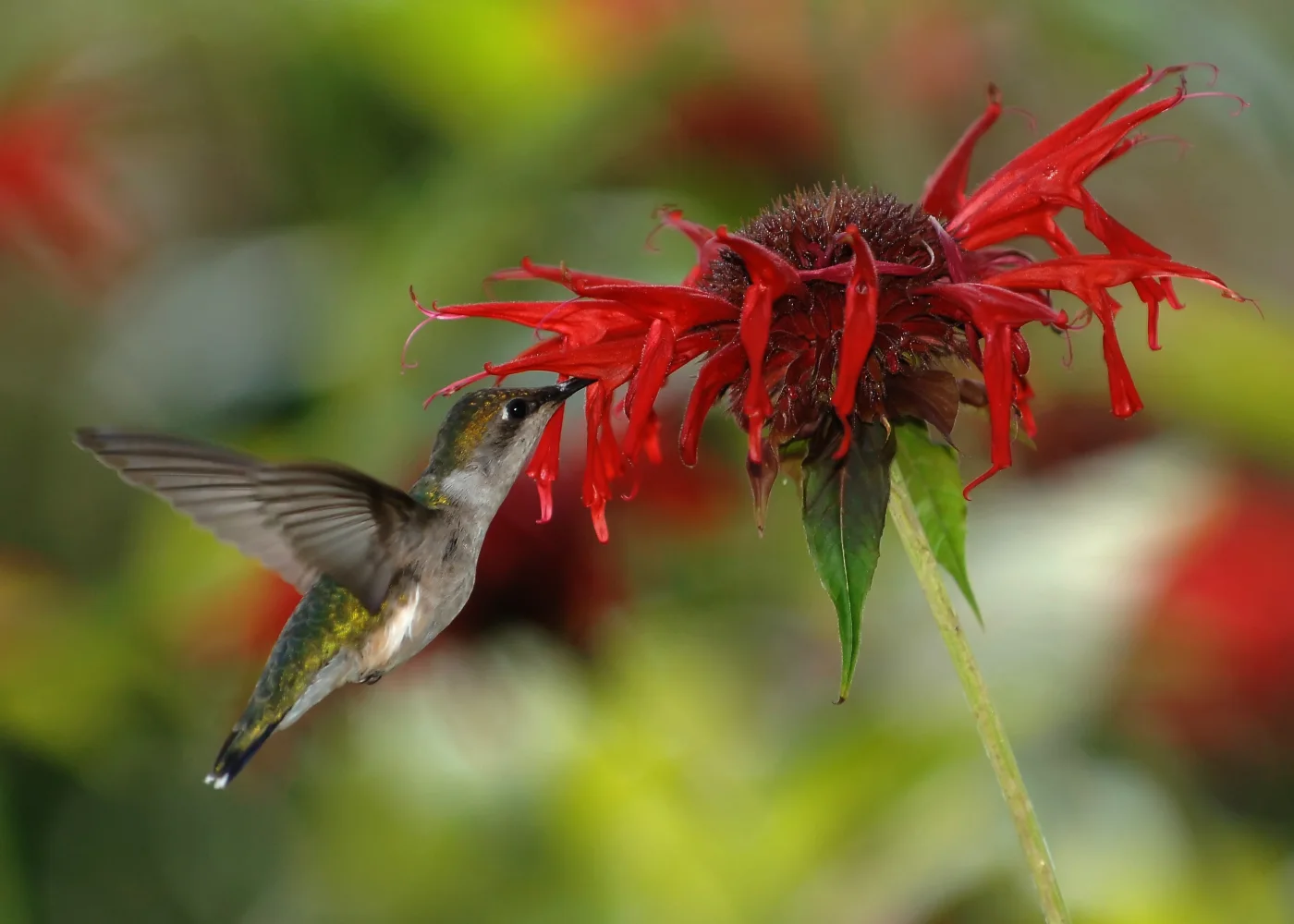
In the bird photograph, the bill enters a tube of Scarlet Beebalm. The wing is soft-edged but clearly feathered. The folded tail forms a small fan behind the body. Nothing projects from the head above the bill.
Return to the moth in the hero photograph. Its antennae are separate from the feeding tube. The legs trail below. Transparent wings carry dark veins. Those traits remain insect traits no matter how perfectly the flight recalls a hummingbird.
Flowers provide another clue without deciding the species. Hummingbird clearwings fly during the day and visit many blooms. University of Wisconsin Extension lists bee balm among them, while Penn State Extension includes phlox and thistles. A patch of Smooth Phlox may bring a hovering visitor into good view, but the flower name cannot replace the animal’s body clues.
Hummingbird moth is a family nickname
Several sphinx moths can create the same surprise. The exact animal pictured in the hero image is Hemaris thysbe, the hummingbird clearwing. Its fuzzy body is often olive, tan, or reddish brown, with a broad darker band across the abdomen. Its wings have clear centers and reddish borders.
A second species, the snowberry clearwing, Hemaris diffinis, uses a similar day-flying hover. Its yellow and black body often recalls a bumblebee more strongly than a tiny bird. The two Hemaris species share transparent wing panels, a sturdy body, and a long proboscis, yet their color patterns are visibly different.
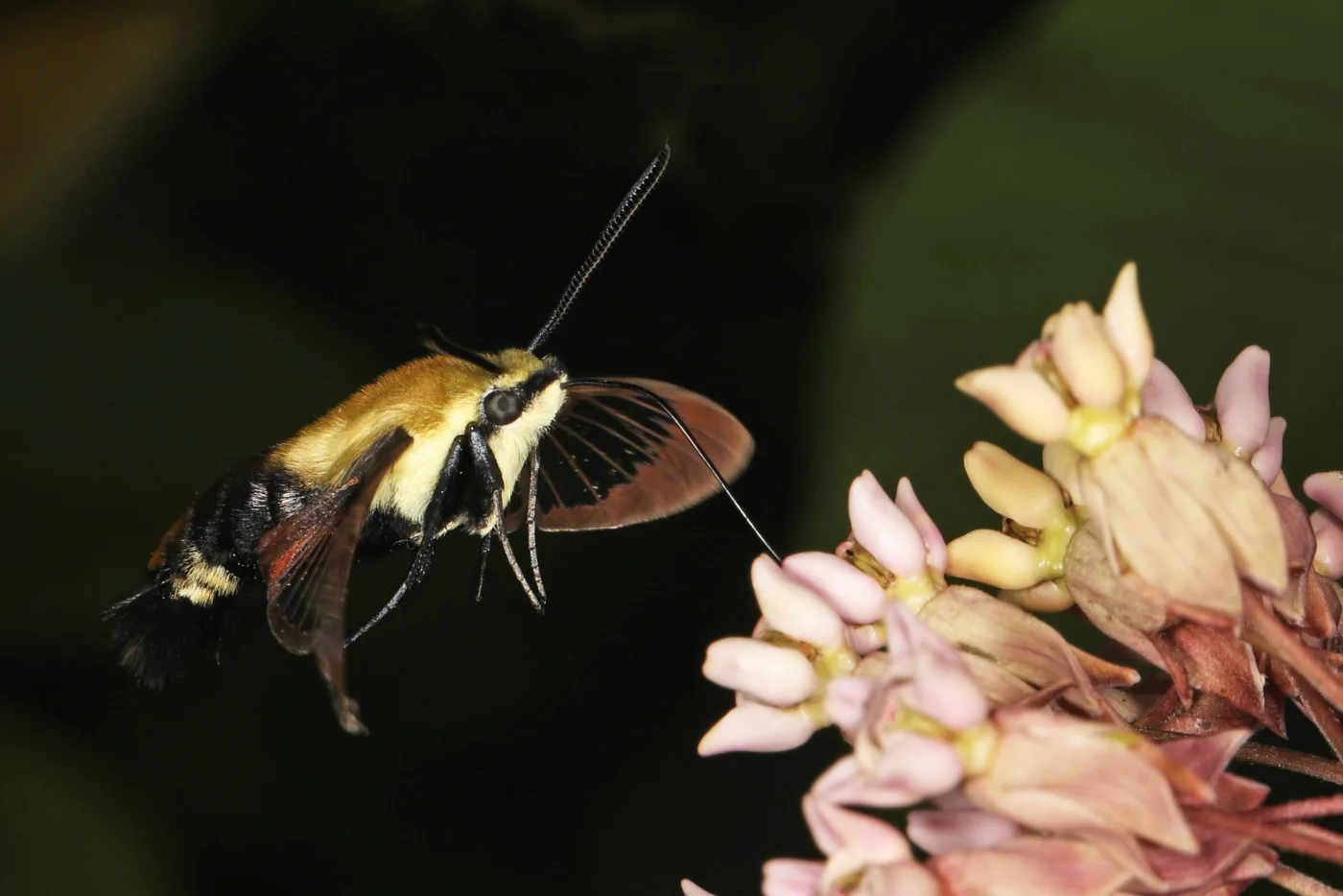
A white-lined sphinx, Hyles lineata, can hover at flowers too. It is larger-bodied, and its forewings remain fully covered with scales. A pale stripe runs along each brown forewing. University of Wisconsin Extension describes it as mainly active around dusk or at night, although it may appear by day. In low light, that hovering shape can also be mistaken for a hummingbird.
Tomato-associated sphinx moths often enter the story earlier as a large green hornworm on a tomato plant. That guide follows two similar caterpillars through side marks, soil pupation, and the adults that usually fly after dusk.
These comparisons are more useful than treating every hummingbird-like moth as one creature. First decide insect or bird. Then ask whether the wings are broadly transparent or fully scaled. After that, use body color, wing markings, region, date, and several angles to narrow the moth.
Why clear wings look like small windows
On Hemaris thysbe, much of each wing surface lacks the dense covering of colored scales seen on many moths. Scales remain along the borders and veins, drawing a dark frame around the transparent center. Against leaves or sky, those centers borrow the background color and nearly disappear.
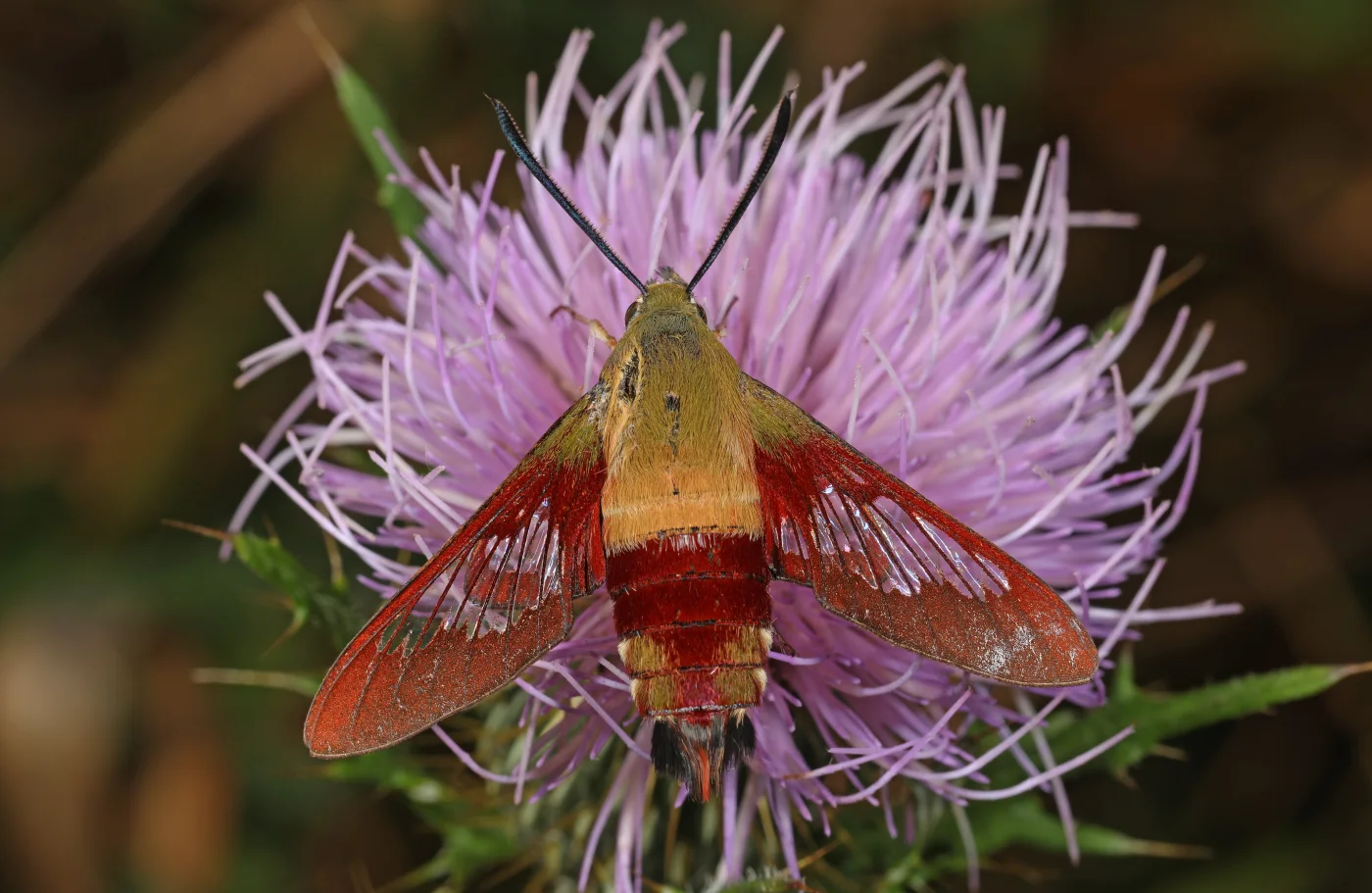
This close view also corrects the illusion of a smooth bird-shaped body. The abdomen is divided into segments. A tuft spreads at the rear. Paired antennae curve from the head, while slender legs sit along the flower. The wing borders are not a miniature set of feathers. They are part of an insect wing plan revealed by stillness.
That is why one sharp frame can do more than a long distant view. Motion hides anatomy. A photograph gives the eye time to separate the proboscis from the antennae and the legs from the flower stems.
The hover is part of a flower relationship
Hummingbird moths are not merely mimicking a bird for an audience. Hovering lets them remain beside a flower while the proboscis reaches inward. Pollen can move as the animal visits the next bloom. Penn State Extension includes hummingbird and clearwing moths among diurnal, or daytime, moth pollinators.
Brief as the visible meeting is, both participants shape it. A deep floral tube holds nectar where a long mouthpart or bill can reach it. A broad flower patch offers many stops without a long flight between them. The moth arrives with one body plan, the hummingbird with another, and the flower turns their movements into a striking comparison.
Other visitors read the same landscape differently. The story of ants at flowers begins much closer to the stem and petal surface. Looking across those scales of movement, from walking ant to hovering moth to bird, makes one flower patch feel less like decoration and more like a busy intersection.
Build a four-frame field record
Start wide. Make one photograph that includes the flower patch and the animal’s position above it. That frame preserves habitat, bloom shape, and approximate scale. A second frame from the side may separate antennae from proboscis and show how the legs sit beneath the body.
Use a third frame for the wings. Bright side light or a darker leafy background can reveal transparent panels, veins, or a fully scaled surface. A final view of the back or abdomen records bands, tufts, and wing borders. A short burst of images may capture these clues even when no single view holds them all.
Write down the date, time, flower, and general setting. Daylight activity supports a clearwing comparison, but it is not proof by itself. Exact identification becomes stronger when motion, anatomy, markings, place, and season agree.
For families, the bug observation guide offers a simple photo-first routine for sharing the discovery. The essential move is patience: let the visitor return to its route through the flowers, and let the camera bring small structures closer.
When the bronze blur lifts away, the surprise remains. A moth and a bird can solve the same floral problem with a hover and a long reach, yet each carries its own history in plain sight. Stop the wings, and the tiny hummingbird becomes an insect again: antennae forward, six legs folded, clear windows flashing around a fuzzy body.
Sources
- University of Wisconsin Extension: Hummingbird Moth, Hemaris thysbe Accessed 2026-07-30
- University of Minnesota Extension: Hummingbird Clearwing Accessed 2026-07-30
- Penn State Extension: Moths, the Forgotten Pollinators Accessed 2026-07-30
- University of Wisconsin Extension: White-lined Sphinx Moth Accessed 2026-07-30
- University of Wisconsin Extension: Hummingbirds in the Garden Accessed 2026-07-30
Image credits
- Top image Wildreturn · CC BY 2.0
- After the bird comparison Joe Schneid · CC BY 3.0
- After the clearwing comparison Judy Gallagher · CC BY 2.0
- After the wing-window section Judy Gallagher · CC BY 2.0
More Field Notes
 Praying Mantis Egg Case: How to Identify an Ootheca on a Twig
  Why Pine Cones Open When Dry and Close When Wet
  Black and Orange Fuzzy Caterpillar: Woolly Bear ID Guide
Read it. Then go find it.
Open Leafari on your next walk and see what has been waiting in plain sight.