
Bird-Poop Caterpillar on Citrus? Meet the Giant Swallowtail
Use the brown-and-white disguise, citrus-family host plant, region, and changing life stages to identify a bird-poop caterpillar without disturbing it.

At a glance
What is the bird-poop caterpillar on my citrus tree?
A brown-and-white caterpillar on lemon, orange, lime, or another citrus-family plant is a strong match for a giant swallowtail larva, often called an orangedog. Confirm the mottled pattern, host plant, region, and a clear side view because several caterpillars use a similar bird-dropping disguise.
A glossy lemon leaf holds a mark that seems too wet and irregular to be part of the plant. Brown runs through cream. One end shines almost white. Then the narrow shape bends along the leaf’s midrib, and the supposed bird dropping turns its head.
On lemon, orange, lime, or another member of the citrus family, that moving mark is a strong clue for a giant swallowtail caterpillar. Its brown-and-white disguise gives rise to two common search names: bird-poop caterpillar and orangedog. Neither name settles the identification by itself. Pattern, host plant, region, and a clear side view should agree before the name becomes more than a good possibility.
Start with three clues in one photograph
First, look at the body pattern. Giant swallowtail larvae are mottled dark brown, black, olive, cream, and white. A pale saddle lies across the middle, with another creamy patch toward the rear. The colors do not form the clean rings of a striped caterpillar. They break into wet-looking patches, the visual trick that makes the animal resemble something a bird left behind.
Second, include the plant. The giant swallowtail’s larval hosts belong to the citrus family, Rutaceae. Cultivated citrus provides a familiar setting, but the family reaches beyond orchards and patios. Hop tree, prickly ash, and Hercules-club are documented native hosts in different parts of eastern North America.
Third, save the location and date. A photograph from a southern citrus garden carries different regional evidence than one from the western United States, where a similar western giant swallowtail is now recognized separately. Location cannot replace visible marks, but it can prevent one familiar name from being stretched across every brown-and-white caterpillar.
A useful field record therefore includes three frames: the full plant, the caterpillar from the side, and one closer view of the saddle pattern. The plant frame may prove more valuable than the closest portrait.
A disguise that lasts through growth
Many caterpillars resemble bird droppings when they are tiny, then trade that pattern for green camouflage as they grow. The giant swallowtail takes a different route. UF/IFAS describes five growing stages, called instars, and all five keep some version of the bird-dropping effect.
Young larvae are dark and knobby, with a crisp pale saddle. Their small size makes the disguise especially convincing on the upper surface of a leaf. Older larvae lose much of the bristly outline and become larger, mottled forms that often rest along stems or leaf stalks. The colors shift, yet the central trick remains.
The caterpillar that looks like a bird dropping can become a butterfly wider than your hand. The disguise is not a brief costume worn at hatching. It carries the animal through the entire feeding part of its life.
That persistence helps separate it from a young black swallowtail. Early black swallowtail larvae can also look dark and dropping-like, but later stages become green with black crossbands and paired yellow-orange dots. Their usual hosts belong to the parsley family, including dill, parsley, and fennel. The black swallowtail caterpillar guide shows that change in exact photographs.
Host plant and growth pattern work together here. A dark young larva on dill points toward one branch of the swallowtail family. A mottled older larva holding its dropping-like pattern on citrus points toward another.
Why the citrus leaf matters
A host plant is the plant on which a butterfly’s young develop and feed. Adult butterflies may visit many kinds of flowers, but their caterpillars often depend on a narrower plant group. For giant swallowtails, that relationship centers on Rutaceae.
Sweet orange and Persian lime make the family visible in a garden: glossy evergreen leaves, fragrant oil glands, flowers, and citrus fruit. A lemon leaf in a photograph is therefore more than scenery. It is independent evidence that supports the body pattern.
Farther north, native relatives carry the relationship through woods, thickets, and edges. Missouri and Illinois sources name hop tree and prickly ash as important hosts. The butterfly can appear well beyond commercial citrus country because its plant relationship is older and wider than the orchard.
Orangedog grew as a common name from the crop setting, not from the caterpillar’s color. It eats orange leaves; it is not orange. That small mismatch is a useful reminder that common names often preserve a human encounter with an animal rather than describe its body precisely.
From citrus leaf to barklike chrysalis
Larval feeding ends with another visual reversal. A mature individual may leave its leaf and secure itself to a twig, fence, stem, or another upright surface. Its rear end attaches to a silk pad. A fine silk girdle holds the front of the body near the support.
Inside that suspended shape, the larval body reorganizes. The outer chrysalis can look gray, green, tan, or brown, with angles and lines that resemble a broken twig or rough bark.
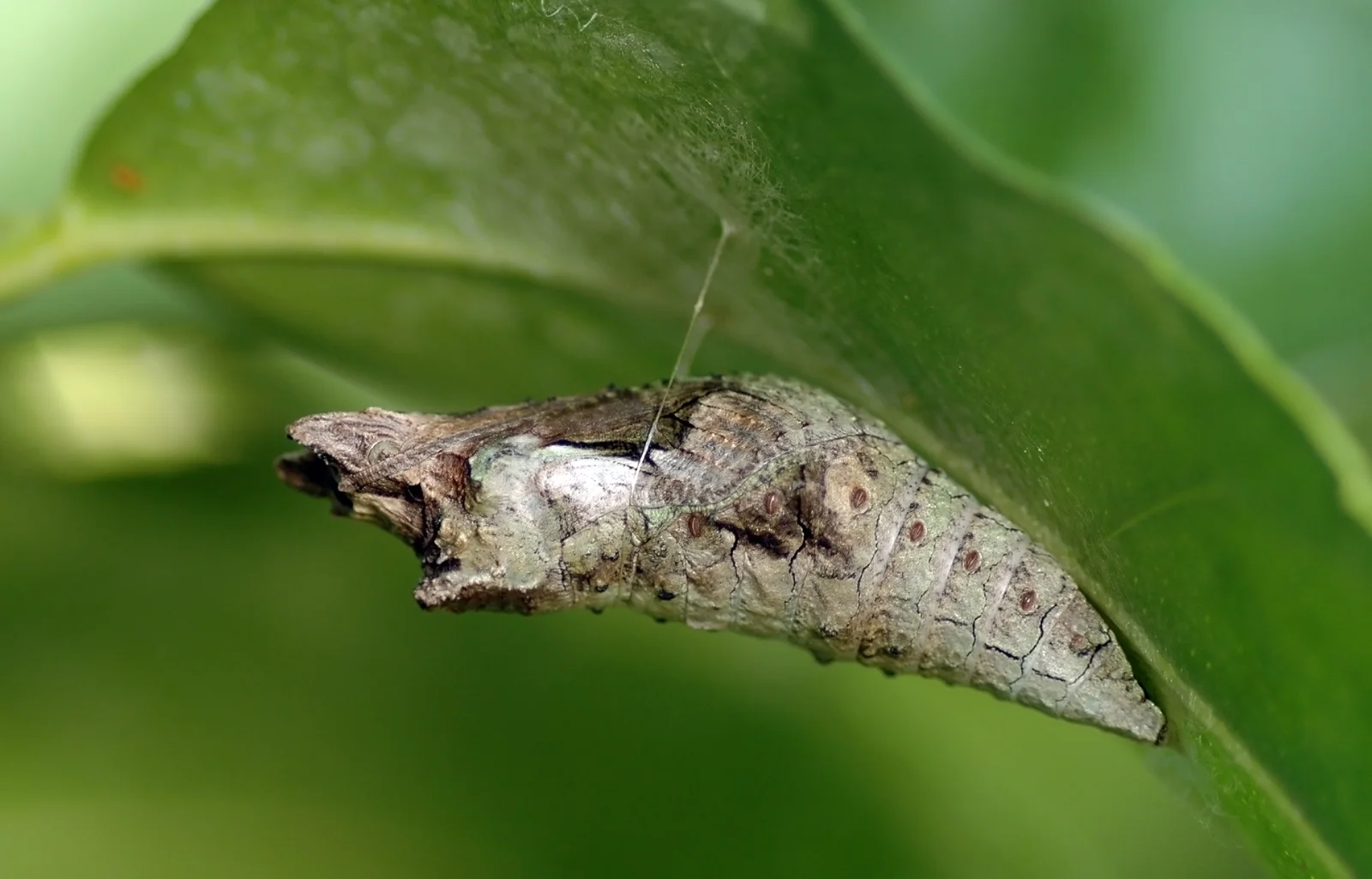
Timing changes with latitude. Illinois records adults from spring into fall and the chrysalis as the overwintering stage. Florida can support multiple generations in a year and activity through much more of the calendar. A late-summer caterpillar may therefore be one chapter in a local brood or the last feeding stage before a long winter pause.
The butterfly hidden inside the pattern
When the adult emerges, almost none of the larva’s dropping-like palette remains. The upper wings are dark brown to black. A broad diagonal yellow band crosses each forewing, and yellow marks continue across the hindwings. Long tails extend from the rear wings, each marked with yellow.
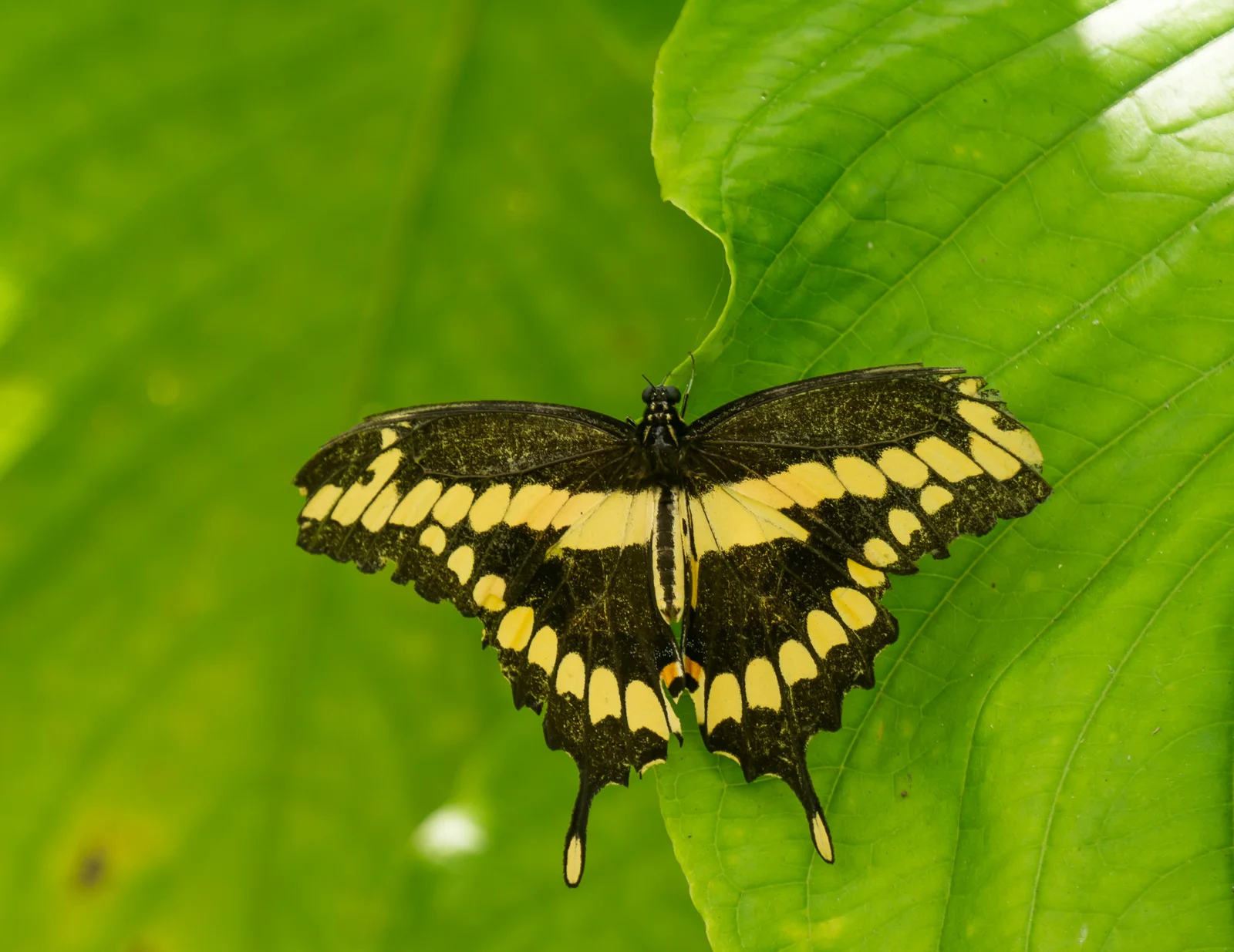
With its wings closed, the balance reverses and the underside appears mostly yellow with dark lines and small blue and reddish marks near the hindwings. Open and closed views can look surprisingly different, much as the larva and adult seem unrelated until the chrysalis connects them.
After the transformation, adult females return to suitable citrus-family hosts and place eggs singly on leaves or twigs. A small egg starts the sequence again: dark larva, persistent disguise, suspended chrysalis, yellow-banded wings.
Make the next look more useful
If the caterpillar is still present, let the camera gather the evidence. Begin with the entire branch. Move to a side view that shows the pale saddle and rear patch. Finish with the leaf, fruit, flowers, or stem features needed to identify the host plant. A calm bug-observation routine can help families make those frames without touching or collecting the subject.
Then compare the clues as a set. Does the plant belong to the citrus family? Does the larva keep a blotchy brown-and-white pattern rather than clean green-and-black bands? Does the location fit an eastern giant swallowtail, or does it call for a regional lookalike check? If one piece is missing, keep the identification tentative.
The first photograph may record something that looks lifeless. A later one may hold a twiglike chrysalis. Weeks or months afterward, a dark butterfly may cross the same patch of leaves with a yellow road drawn over its wings. One citrus branch can contain all three shapes, though rarely at once.
Sources
- UF/IFAS Extension: Giant Swallowtail, Orangedog Accessed 2026-08-18
- Mississippi State Extension: Orange Dog Accessed 2026-08-18
- Missouri Department of Conservation: Eastern Giant Swallowtail Accessed 2026-08-18
- Illinois Department of Natural Resources: Giant Swallowtail Accessed 2026-08-18
- Butterflies and Moths of North America: Giant Swallowtail Accessed 2026-08-18
Image credits
- Top image Patins162 · CC0
- After the chrysalis explanation Ianaré Sévi · CC BY-SA 3.0
- Near the adult field-mark section Spaully · CC BY-SA 4.0
More Field Notes
 Praying Mantis Egg Case: How to Identify an Ootheca on a Twig
  Why Pine Cones Open When Dry and Close When Wet
  Black and Orange Fuzzy Caterpillar: Woolly Bear ID Guide
Read it. Then go find it.
Open Leafari on your next walk and see what has been waiting in plain sight.