
Caterpillar on Dill? Meet the Black Swallowtail
Use the host plant, yellow-dotted black bands, changing young stages, and a focused monarch comparison to identify a caterpillar on dill or parsley.

At a glance
What is the caterpillar on my dill?
A green caterpillar on dill or parsley with black crosswise bands and paired yellow-orange dots is a strong match for a black swallowtail. Younger larvae look dark and bristly with a pale saddle, so combine body pattern with the parsley-family host plant and a clear side view before settling on the name.
A green caterpillar curls around a dill stem, gripping a ribbed branch below the threadlike leaves. Black bands cross its body from side to side. Inside each band, paired yellow dots catch the light. The pattern looks bold enough to name at once, yet the plant beside it may be the most useful clue in the frame.
When those yellow-dotted bands appear on dill, parsley, fennel, carrot, celery, or another documented member of the parsley family, a mature black swallowtail larva is a strong match. Keep the identification conditional until several clues agree. Body pattern, plant, season, size, and a clear side view make a sturdier case than color alone.
What to notice on dill or parsley
Start with the black bands. On a mature black swallowtail larva, each crosses a green or yellow-green body and carries a row of yellow-orange spots. The spots sit within the dark band like pairs of small windows. Pale green gaps separate one band from the next.
Compared with many bristly garden larvae, the body is smooth. Short fleshy points may be visible along the sides, but the overall outline is rounded. A fully grown individual can approach two inches, according to University of Minnesota Extension. A photograph that includes the leaf or stem makes that scale easier to judge later.
Plant structure belongs in the same record. Dill and fennel divide into fine, narrow threads. Parsley and carrot carry broader, divided leaves. Their shapes differ, but all belong to the parsley family, Apiaceae. Black swallowtail females place single eggs on selected plants in this family, giving a newly emerged larva its first growing place.
One matching leaf does not settle the question. A clipped sprig can lose its garden context, and many green larvae cross plants while searching for the next stage. Photograph the whole plant, a close side view, and the surrounding bed. Those three frames preserve more evidence than one tight portrait.
Why the same caterpillar can look different
Green bands arrive late in the larval story. Black swallowtails pass through five growing stages called instars, shedding the old outer skin between them. During the first three instars, University of Wisconsin Extension and UF/IFAS describe a mostly black, bristly caterpillar with a pale saddle across its middle.
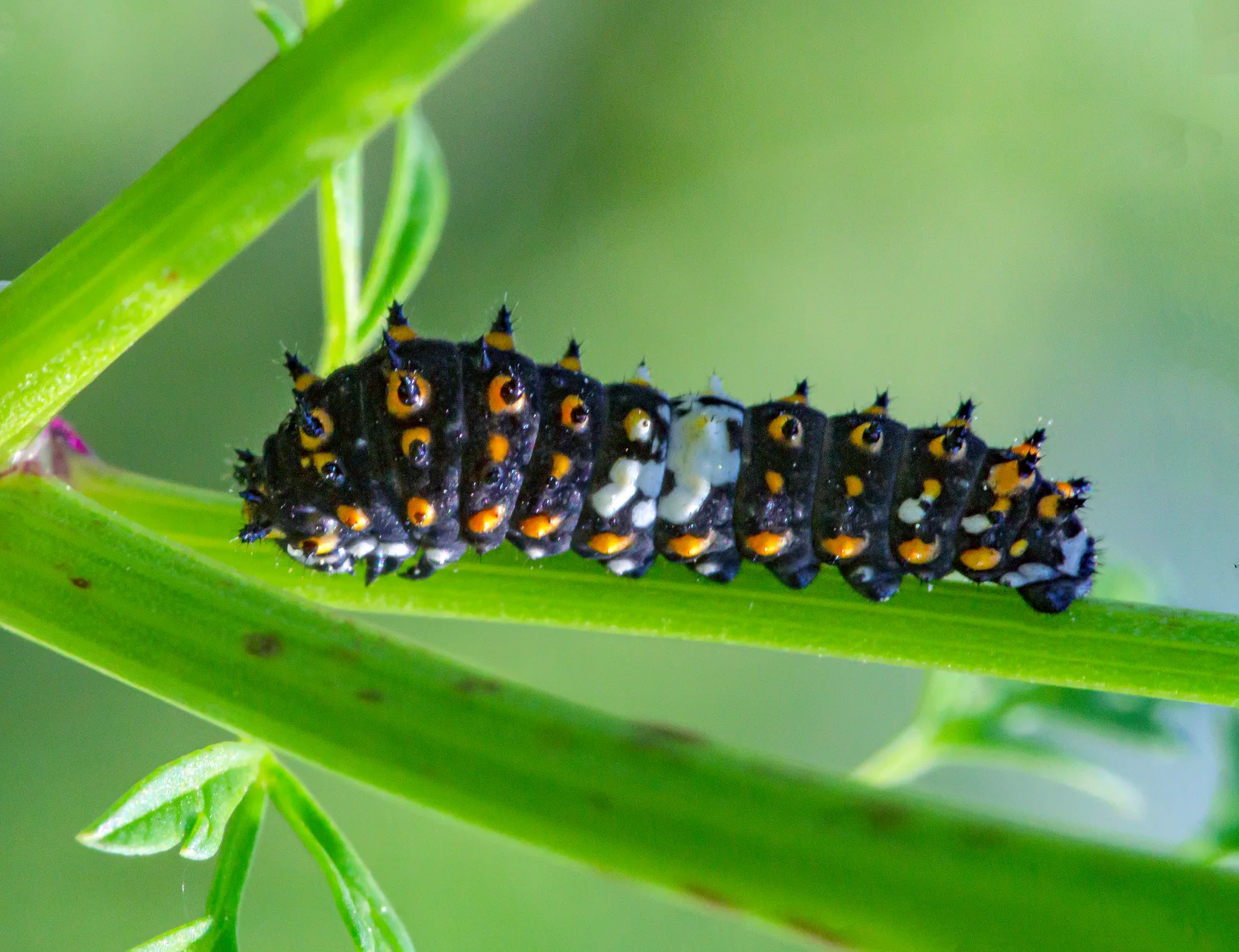
That early shape resembles a small bird dropping against a leaf. It is a disguise built from outline and contrast. After later molts, the body shifts toward green, the pale saddle disappears, and yellow-dotted bands become the dominant pattern.
One black swallowtail caterpillar can look like two different insects as it grows. That change explains why a row of small dark larvae and one large striped larva may occupy the same dill plant without looking related. Size alone does not create the difference. Each molt reveals a new outer pattern.
Across those changes, the host relationship stays steady. A young black larva and a mature green one can both belong to the same species when they share the correct plant context and the marks expected for their stage.
Black swallowtail or monarch caterpillar?
Black, white, yellow, and green occur on both black swallowtail and monarch larvae. From a few feet away, that shared palette can blur into the same striped impression. A closer view separates the way those colors are arranged.
On a mature black swallowtail, yellow dots break up broad black crossbands. A monarch carries narrower, more continuous bands of black, white, and yellow around the body. It also has two pairs of long black filaments, one near the head and one near the rear. Those flexible filaments are absent from the black swallowtail pattern.
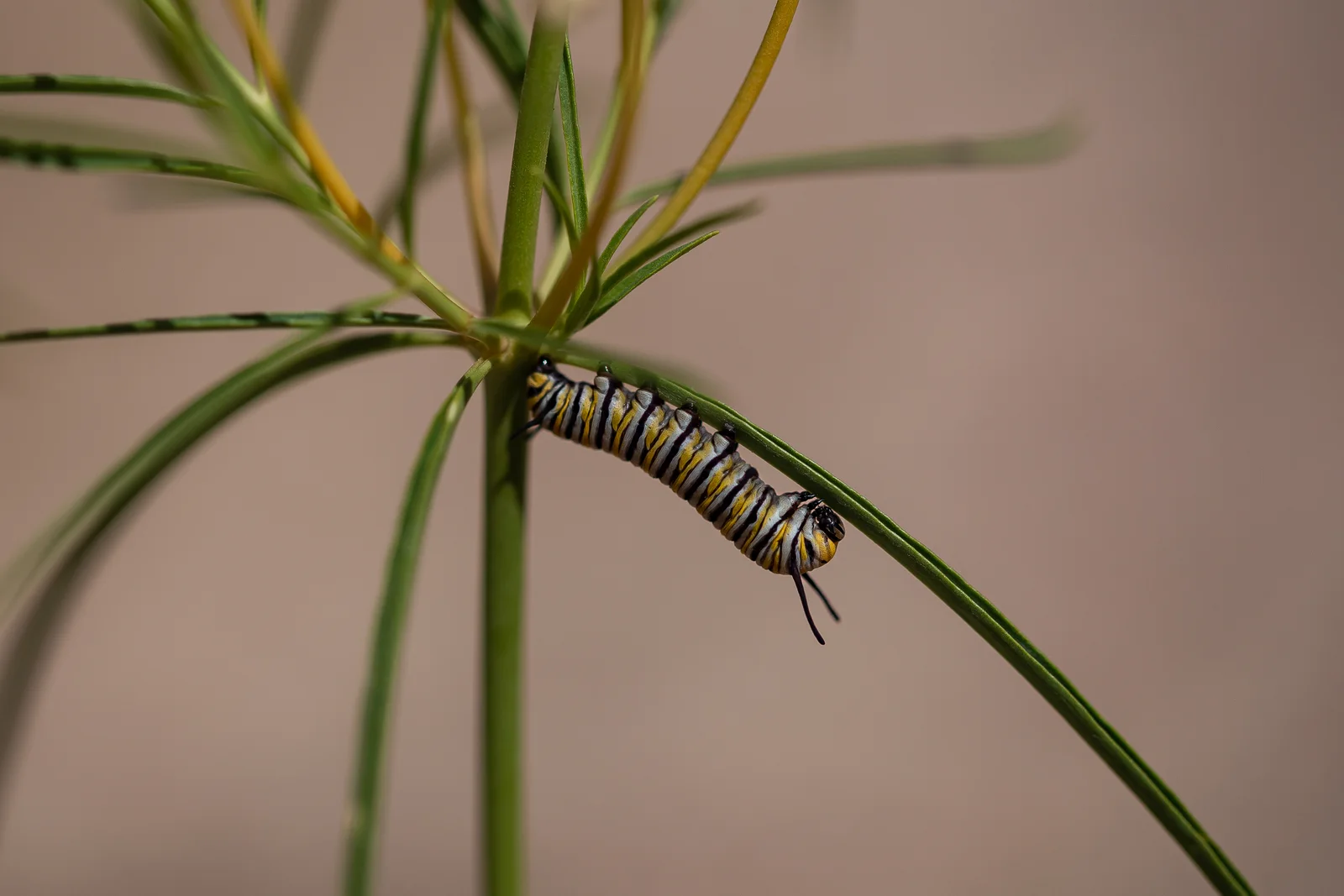
Host context often settles the comparison faster. Monarch larvae develop on milkweeds. Black swallowtail larvae develop on selected parsley-family plants. A striped caterpillar woven through dill leaves points one direction; the same first impression beneath a broad milkweed leaf points another.
Use pattern and plant together. A damaged leaf or awkward camera angle may hide a filament, while yellow spots can blur into stripes in bright light. Two independent clues reduce the chance that one missing detail controls the whole identification.
If the plant is citrus and the larva keeps a mottled brown-and-white bird-dropping pattern as it grows, follow the separate giant swallowtail caterpillar guide instead.
How the host plant narrows the name
Here, a host plant means more than the leaf underneath an insect. It is a species or plant group that supports the immature stage. Adult butterflies may visit many flowers, but their larvae often grow on a narrower set of plants.
For black swallowtails, university and museum sources repeatedly name parsley-family plants such as dill, parsley, fennel, carrot, celery, and Queen Anne’s lace. The plant family becomes part of the identification because the relationship is repeated across the butterfly’s range.
Leaf shape can introduce the family without proving a host record. Coriander shows the flat pale flower clusters and divided leaves of a familiar garden relative. Spreading Hedgeparsley carries the pattern into a field edge. Neither family resemblance nor a common name should replace a documented host list.
That distinction keeps the clue honest. Finding a larva on dill is strong context. Finding a similar larva near any finely divided plant is only a prompt to look again. Flower arrangement, stem, leaves, location, and a photograph of the entire plant can help confirm which relationship is actually present.
The season behind the garden clue
Timing changes by latitude and weather. In Minnesota, Extension records adults appearing in May and June, another generation beginning in midsummer, and larvae remaining visible into September. Wisconsin reports two generations in much of the upper Midwest, with an additional flight period farther south.
Mid-August therefore brings two scales of time into one herb bed. The caterpillar changes skin over days and weeks. The population moves through eggs, larvae, chrysalises, and adults across the warm season. What looks like one still green body is a brief stage inside both clocks.
When larval growth is complete, the caterpillar leaves the host plant and becomes a chrysalis attached to a support by silk. It is a chrysalis rather than a cocoon. Later in the season, that stage may remain through winter before the adult appears.
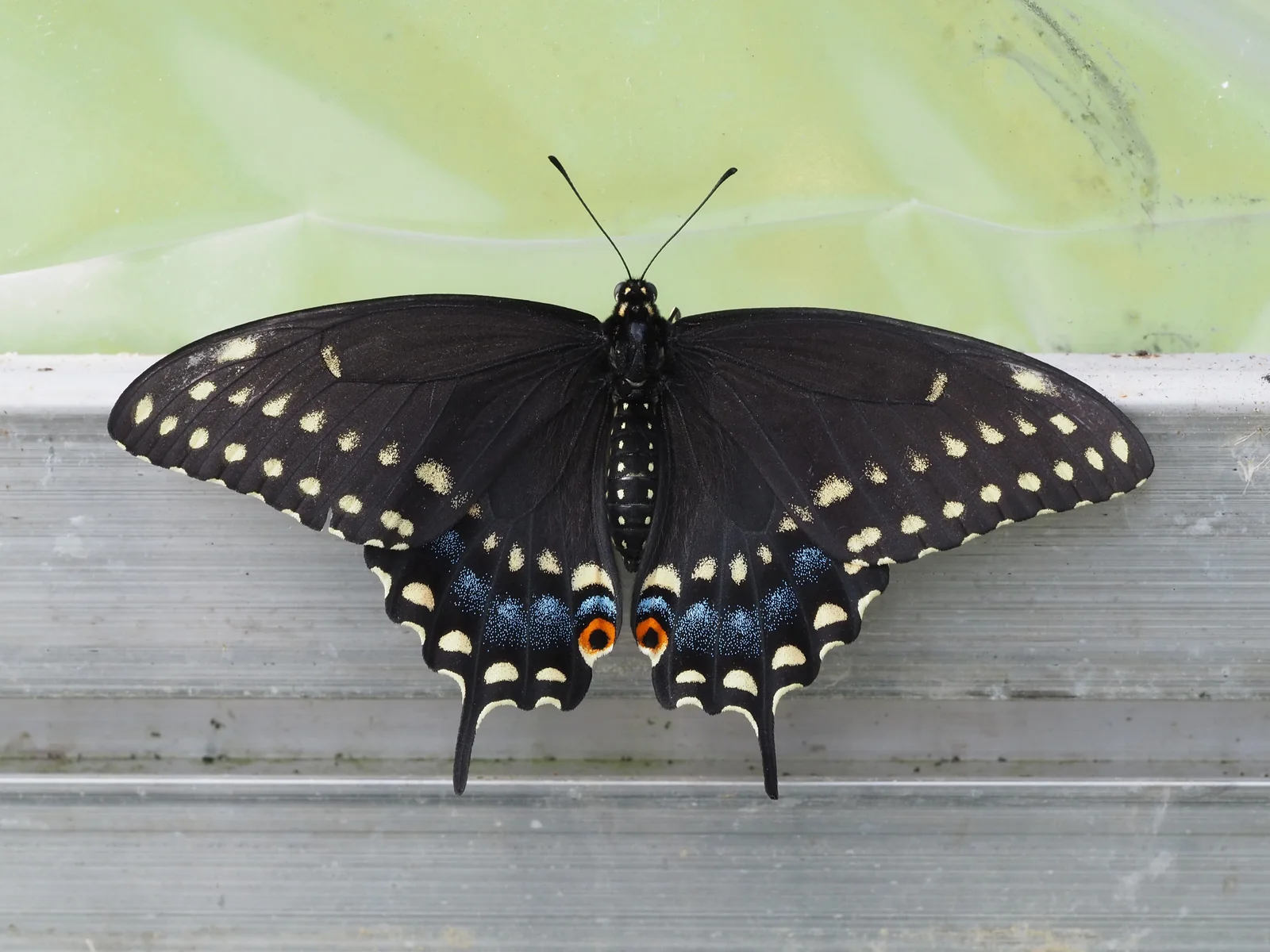
Winged adulthood seems to reverse the garden scene. A slow larva once followed one stem. The butterfly now crosses open yards, fields, parks, roadsides, and flower patches. The parsley-family plant remains the place where the next small egg begins the cycle again.
A three-frame watch outside
Begin at plant distance. Photograph the full dill or parsley stem and enough of the bed to remember the setting. Next, make a side view that shows several body segments. Finish with one closer frame of a black band, yellow dots, or the dark-and-pale pattern of a young instar.
Then compare the frames as a set. Does the plant fit a documented parsley-family host? Do the marks fit the larva’s apparent stage? Are long monarch filaments present or absent? If the evidence remains incomplete, a family-level or tentative record is more useful than a confident wrong name.
Families can use a calm bug-observation routine to turn those three views into a repeatable field record. The related small white garden butterfly guide uses the same idea with a moving adult: plant context and several visible marks work better together.
On the next look, the caterpillar may be larger, greener, or gone from the stem. The photograph keeps one stage still. The dill keeps growing around it, holding the evidence of a relationship that lasts longer than any single pattern.
Sources
- University of Minnesota Extension: Caterpillars on Ornamental Plants Accessed 2026-08-15
- University of Wisconsin Extension: Black Swallowtail Accessed 2026-08-15
- Florida Museum: Eastern Black Swallowtail Accessed 2026-08-15
- UF/IFAS Extension: Black Swallowtail Caterpillar Identification Accessed 2026-08-15
- Mississippi State Extension: Three Common Butterfly Caterpillars Accessed 2026-08-15
- National Park Service: Milkweed and Monarchs Accessed 2026-08-15
Image credits
- Top image Agdipasquale · CC0
- After the changing-stage explanation WanderingMogwai · CC BY-SA 4.0
- In the monarch comparison Carmen Aurrecoechea / Joshua Tree National Park · Public domain
- Near the closing life-cycle section Kaldari · CC0
More Field Notes
 Praying Mantis Egg Case: How to Identify an Ootheca on a Twig
  Why Pine Cones Open When Dry and Close When Wet
  Black and Orange Fuzzy Caterpillar: Woolly Bear ID Guide
Read it. Then go find it.
Open Leafari on your next walk and see what has been waiting in plain sight.