
How to observe bugs safely with kids
A good family bug walk begins with distance, patience, and a few simple tools. The goal is to notice more while disturbing less.

At a glance
How can kids observe bugs safely?
Use a no-contact rule for unknown insects, keep an adult close, move slowly, watch from a comfortable distance, and use tools like a notebook, camera, or magnifier. Leave nests, webs, and hidden spaces undisturbed.
The bug appears before the plan does. A child sees a tiny shape moving across a leaf, a line of ants at the edge of the path, or a beetle disappearing under a piece of bark. The first impulse is often to rush closer. That is exactly the moment when a good bug walk can begin.
Safe observation is not about making bugs scary. It is about giving curiosity a boundary. A child who learns to pause, watch, draw, and ask better questions will often see more than a child who runs after every moving thing.
Use one simple rule: unknown bugs are for looking, not contact. Make that the family default before the walk starts. Then the outdoor activity becomes calmer. Nobody has to decide in the moment whether a fast-moving insect is fine, delicate, defensive, or better left alone. The rule has already decided.
Start with the pause
Before naming the bug, pause. Ask where it is, what it is doing, whether it is moving alone or with others, and whether it is eating, resting, visiting a flower, crossing the path, or hiding. Those prompts turn the scene into observation instead of pursuit.
Phipps Conservatory’s guide to bug observation emphasizes watching where bugs live and what they are doing. That is the heart of a family field note. The behavior is often more interesting than the name.
Try a ten-second quiet watch. Count slowly. Let the child describe the bug without reaching toward it: color, size, speed, number of legs if visible, wings if visible, body shape, and where it goes next. If the bug leaves, that is still data. “It went under the leaf” is an observation.
Set the no-contact boundary
Say the rule in positive language: “We watch first. We give unknown bugs space. We do not disturb nests, webs, or hidden homes.” Children need rules that are short enough to remember while excited.
Some insects can sting. Some can bite. Some are fragile. Some are important because they are nesting, feeding, or guarding a place. A family walk does not need to sort every risk in the moment. Distance protects the child and the insect at the same time.
Utah’s Observe Wildlife Challenge uses a clear wildlife-watching principle: keep distance and leave living things as found. That principle works at bug scale too. A beetle under a log, an ant trail, a spider web, and a bee at a flower are all part of a working outdoor scene.
This is especially important around nests, hives, webs, rotting logs, deep leaf litter, and dark crevices. Those places may be homes. They may also hide insects the family has not seen yet. A good observer does not need to open every door.
Build a small observation kit
A useful kit is simple: notebook, pencil, camera, magnifier, water, and an adult who keeps the activity slow. A magnifier is for looking at leaves, shed cicada shells, tracks, empty cases, or insects that are already visible from a comfortable distance. A camera lets children study a moment after the bug has moved away.
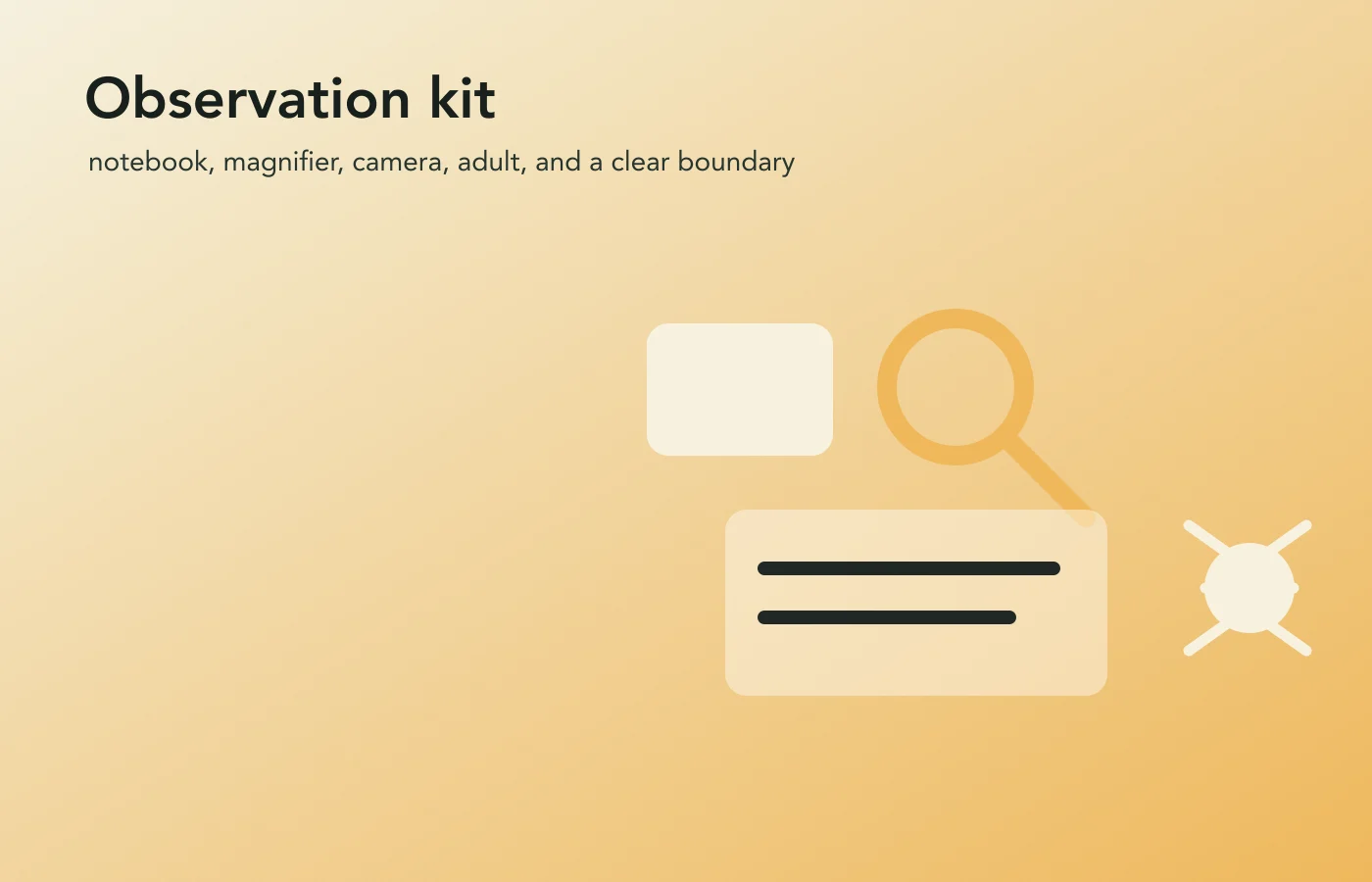
California Academy of Sciences includes close observation and drawing in its insect investigation lesson plan. That is a good model for families: record what you see before trying to identify it. Draw the body as a shape. Mark where the wings are. Add legs only after looking again. Put a tiny arrow showing which way it moved.
For younger children, use prompts instead of formal names. It may move like a dot, a dash, or a tiny machine. It may stay on the flower, walk under the leaf, travel alone, or join a line.
Choose better places to look
Flowers are good places to watch because insects often arrive there on their own. Stand back and look for bees, flies, butterflies, beetles, and ants visiting blooms. Leaf edges are good too. So are tree trunks, fence posts, garden stones, and the top of soil after rain.
Leaf undersides reward a side view. NC State Extension’s childcare garden guide pictures lacewing eggs as tiny pale balls suspended above a plant. When individual threads appear beneath those ovals, the guide to tiny white eggs on stalks shows how a photograph can preserve the strongest clue.
Avoid making the walk a contest to find the biggest or strangest bug. That can push children toward risky places. Instead, make the goal behavior: find one insect walking, one insect resting, one insect visiting a flower, one insect carrying something, or one insect hiding.
NC State Extension’s childcare garden guide treats insects as part of garden learning. That matters. Bugs are not only objects to collect. They are pollinators, decomposers, predators, plant eaters, seed movers, and food for other animals. When children learn roles, they begin to see a yard as a community.
Make a bug map
Choose a small area: one flower bed, one tree, one sidewalk crack, one patch of clover. Draw it as a simple map. Mark where each bug appeared. Use symbols instead of names: circle for a flying visitor, line for an ant trail, star for an insect on a flower, square for a hidden place you did not disturb.
When the smallest moving shapes look like red pinpoints on pavement, the guide to tiny red bugs on concrete shows how scale, movement, surface, and nearby plants become clues without turning color into a verdict.
After ten minutes, look at the map. Some places will show more activity than others. Bugs may cluster around flowers, shade, damp soil, bark, or grass. The map turns a short walk into a pattern.
This is also a gentle way to teach uncertainty. If you cannot name the insect, write “small black beetle-like insect” or “tiny green insect on stem.” A careful description is more honest than a rushed label.
How to keep the ending kind
End the walk by leaving the scene intact. No nest moved, no web broken on purpose, no hidden space pulled apart for one more look. Children can say goodbye to the spot and choose one thing they learned: “Ants follow edges,” “Bees need room at flowers,” “Some bugs freeze when shadows pass,” or “Drawing made me notice antennae.”
Good bug safety does not make children afraid of bugs. It makes them fluent in a better first response: pause, watch, wonder, record, and leave the small world working.
That habit will help with every future Field Note. A milkweed patch, a yellow flower in the lawn, an ant on a blossom, a beetle on bark: each one becomes easier to understand when the observer starts with respect.
Sources
- California Academy of Sciences: Nature Play, Insect Investigation Accessed 2026-07-04
- NC State Extension: Introducing Children to Insects in Childcare Center Gardens Accessed 2026-07-04
- Phipps Conservatory: A Guide to Nature Observation, Bugs Accessed 2026-07-04
- Utah Outdoor Recreation: Observe Wildlife Challenge Accessed 2026-07-04
Image credits
- Top image Ryan Hagerty, U.S. Fish and Wildlife Service · Public domain (U.S. Fish and Wildlife Service)
- After the observation kit section Leafari original illustration · Leafari original illustration
More Field Notes
 Praying Mantis Egg Case: How to Identify an Ootheca on a Twig
  Why Pine Cones Open When Dry and Close When Wet
  Black and Orange Fuzzy Caterpillar: Woolly Bear ID Guide
Read it. Then go find it.
Open Leafari on your next walk and see what has been waiting in plain sight.