
Tree Seed Pod Identification: A Shape-First Field Guide
Identify tree seed pods, samaras, nuts, capsules, and cones by structure, then confirm the match with leaves, bark, season, and the parent tree.

At a glance
How can you identify a tree from a seed pod?
First sort the object by structure: winged samara, true pod, nut or husk, woody capsule, cone, or fleshy fruit. Then check how it was attached and compare it with the same tree's leaves or twigs, bark, whole form, season, and location. One loose object rarely proves a species.
A small brown acorn stands point-up among curled leaves and pine needles. Its cap is shallow and scaly. Its smooth body narrows to a tiny tip. Those marks are clear, but the branch that made it is outside the frame.
That missing branch is the central problem in tree seed pod identification. Wind, animals, street sweepers, and rolling feet can separate an object from its source. The object still carries clues, but it is an incomplete return address.
Start by sorting the structure, not naming the tree. Is it a winged samara, a true pod, a nut with a cap or husk, a woody capsule, a cone, or a fleshy fruit? Then compare it with the same tree’s leaves or twigs, bark, whole form, season, and location. One loose object rarely proves a species.3
First, look at the structure
“Seed pod” is a useful everyday phrase, but it bundles together several different designs. A seed is the young plant and its stored provisions. A fruit develops around one or more seeds in a flowering plant. A cone carries seeds between scales rather than enclosing them in a fruit.12
Use this quick visual key before color:
- Thin wing: a samara. Note whether the wing is single, paired, or round.
- Long case with seams or chambers: a pod or another dry fruit. Check its cross-section and attachment.
- Hard rounded body with a cap or outer husk: a nutlike fruit. Compare the cap, husk, shell outline, and cluster.
- Woody body with holes or top valves: a capsule. Look for openings rather than a long splitting seam.
- Overlapping woody scales: a cone. Pair it with needle arrangement.
- Soft outer layer: a fleshy fruit. Shape alone may not reveal how it developed.
Each wing, cap, seam, valve, or scale can turn a nameless object into a much smaller set of possibilities.
Winged “helicopter seeds” are samaras
Botanists call a dry winged fruit a samara. Its spin or glide slows the fall and lets air carry it away. Maple, ash, and elm all make samaras, but the word helicopter does not point to just one tree.2
Maple samaras commonly meet in pairs, with two wings spreading from a joined center. Ash makes a slimmer paddle: the seed body sits toward one end of a single wing. Elm often makes a flatter round or oval wafer with the seed nearer the center.
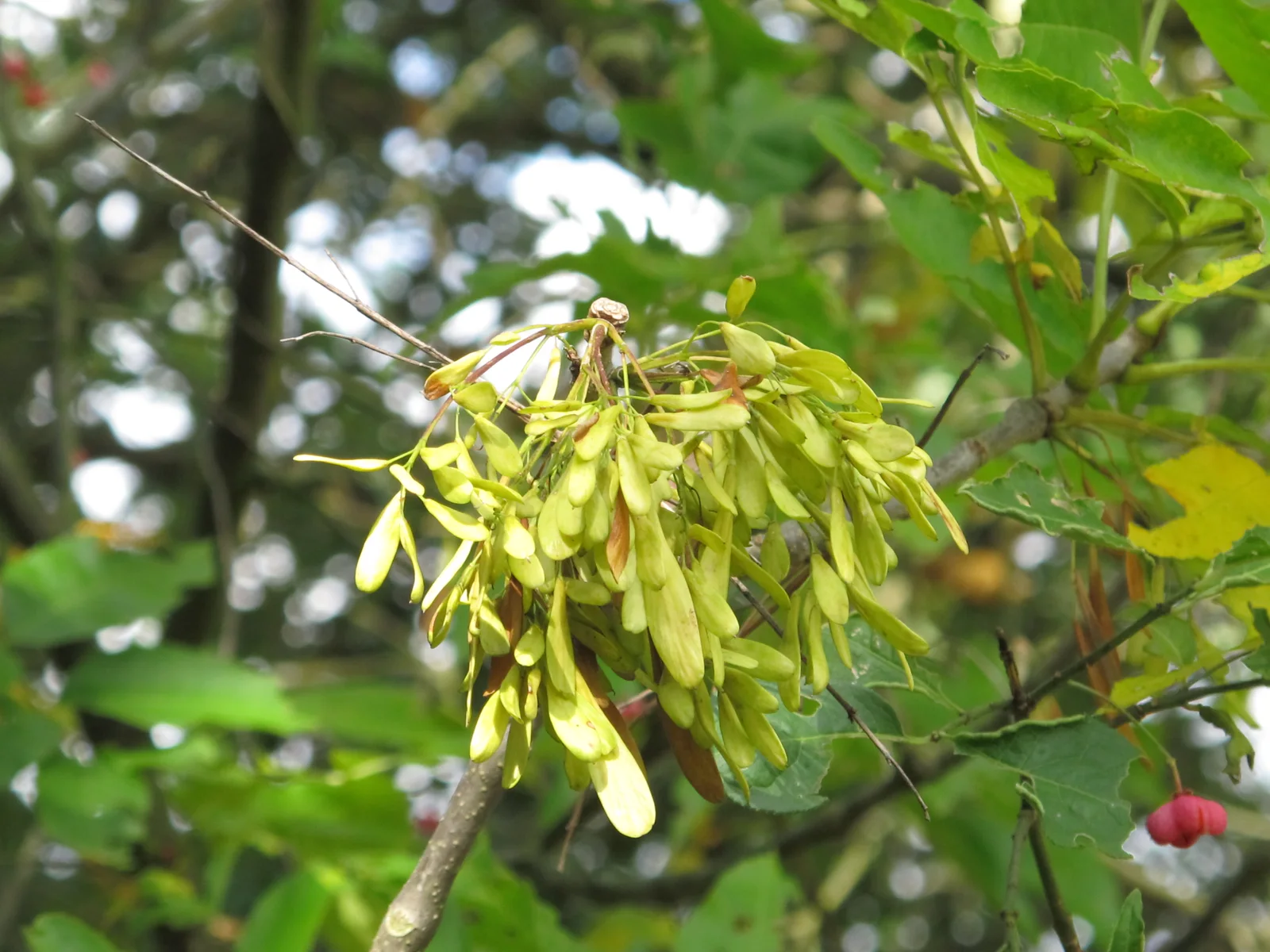
On Green Ash, narrow samaras can hang in clusters from late summer into fall. Opposite branches and pinnately compound leaves support the match.4 Siberian Elm offers the round-wafer comparison. Record the wing outline, the seed’s position inside it, whether units are paired, and how the cluster joins the twig.
Long brown structures may be true pods
In botanical terms, a true pod is the fruit of a legume. Many have two long seams and a row of seed chambers. Yet not every legume opens at maturity, so an intact closed cylinder can still be a pod.1
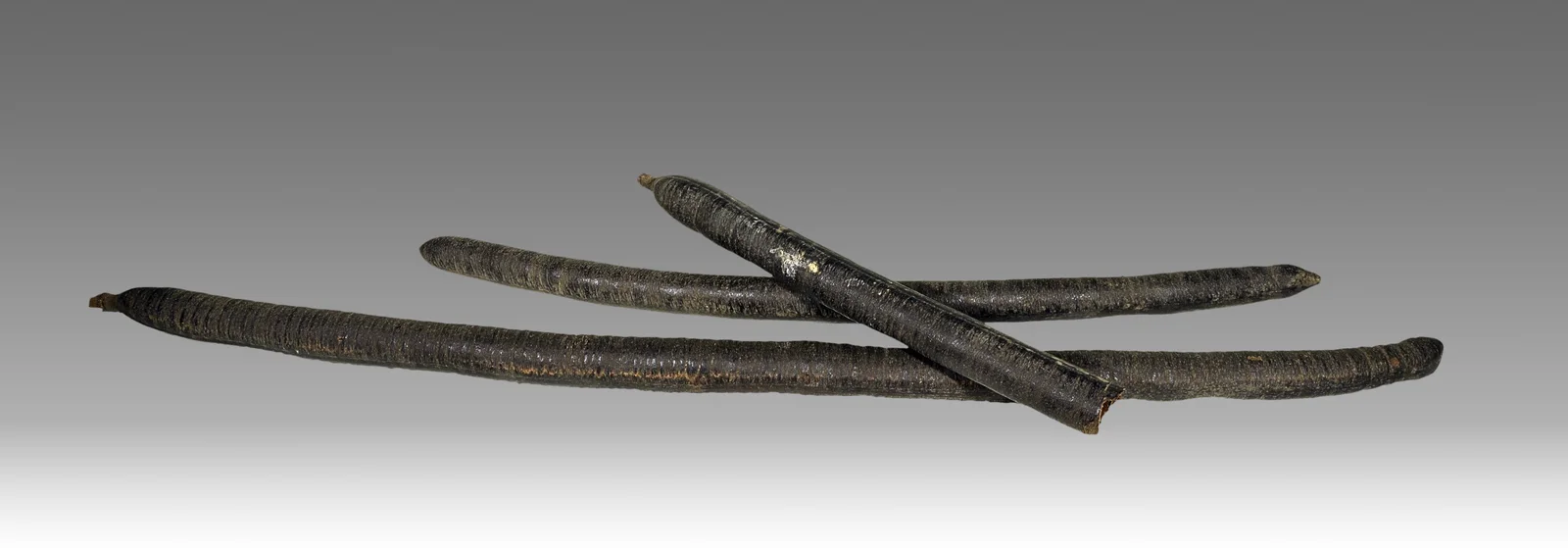
Golden Shower Tree makes hard cylindrical pods roughly 20 to 50 centimeters long. They change from green to dark brown or black and remain closed rather than splitting along the length.7 Its even-pinnate leaves and hanging yellow flower clusters add stronger parent-tree evidence.
Other trees make flatter pods, beadlike pods, or twisted pods. Photograph the tip, base, seams, and any visible chamber pattern. A generic long-brown-pod search can produce lookalikes from different climates, so location and the living leaves deserve equal weight.
Caps and husks point toward nutlike fruits
An acorn combines a hard smooth body with a textured cup. Cap depth, scale pattern, size, and whether acorns grow singly or in pairs can narrow the oak. The hero image shows a Willow Oak acorn only about half an inch wide in a shallow scaly cap. The tree’s narrow willowlike leaves are the more surprising confirming clue.5
Walnuts begin with a different outer shape. What first looks like a smooth green ball contains a hard wrinkled shell. As the fruit matures, the outer husk changes color.
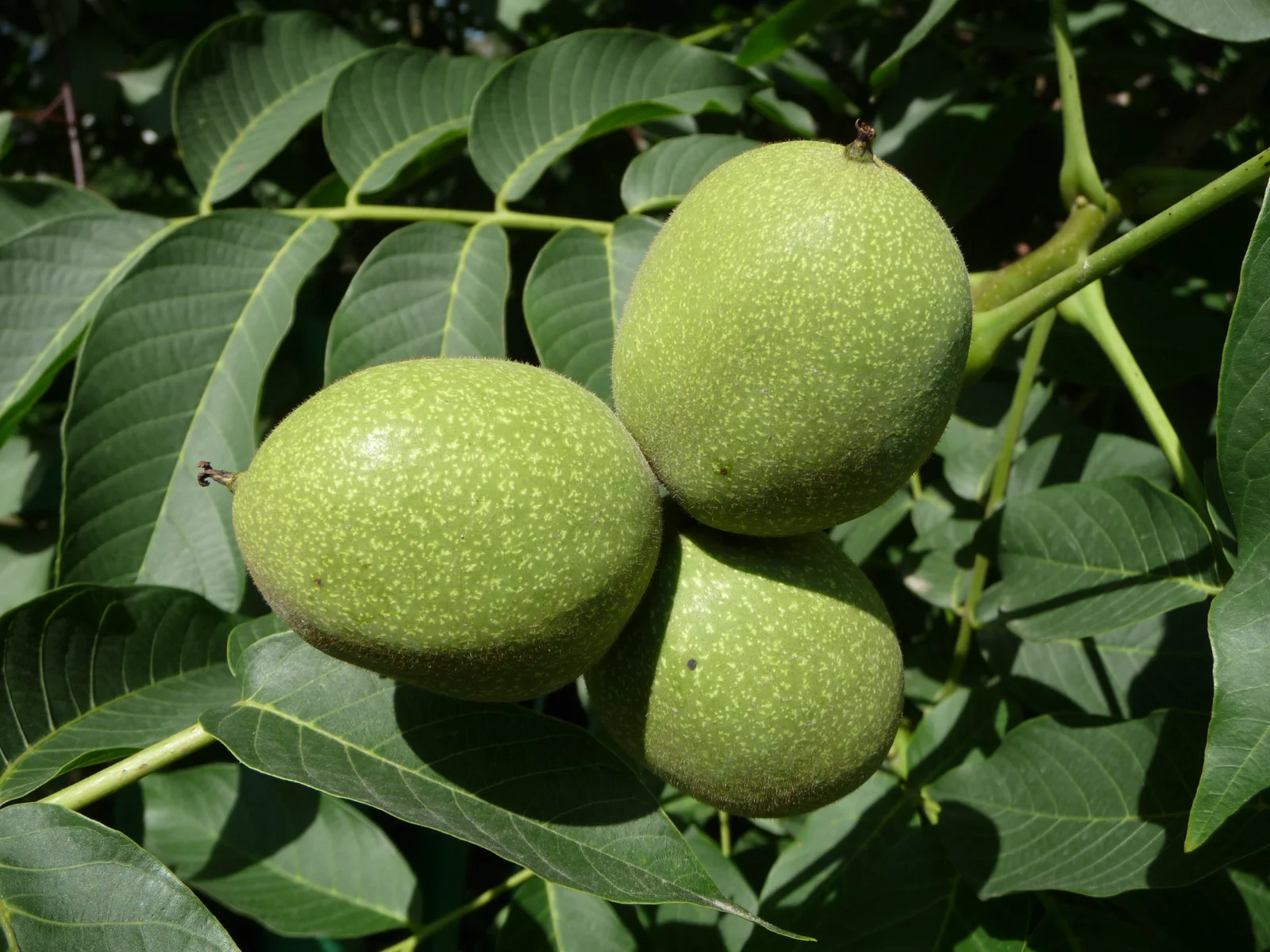
English Walnut pairs those round husks with alternate pinnately compound leaves and increasingly ridged gray bark.6 For both walnuts and acorns, the outer covering and the branch arrangement often say more than the brown shell alone.
Spiky balls and woody capsules need a closer view
Round and prickly describes a shape, not an identification. A sweetgum ball is a cluster of many capsules, each opening through small holes. A sycamore ball is a packed head of many small dry fruits. Their silhouettes overlap while their units and openings differ.1
Capsules can also look like little wooden cups. Tasmanian Blue Gum makes clustered woody fruits whose valves open at the top, leaving a starry pattern around the rim.
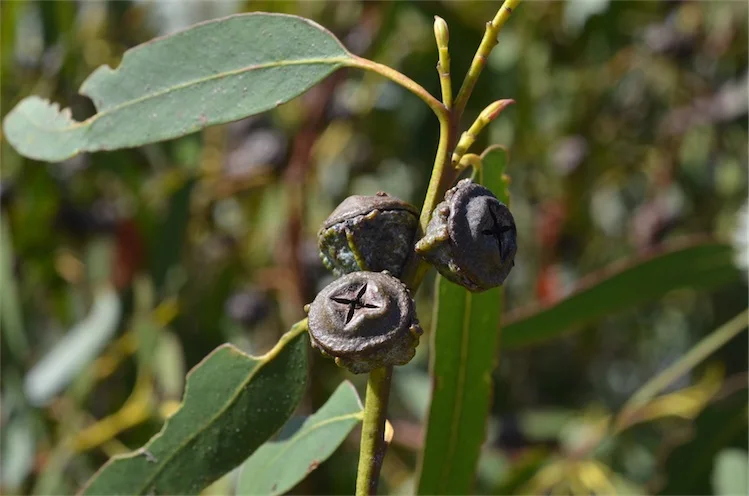
The adult leaves of Tasmanian Blue Gum are narrow, glossy, and often curved, while younger growth can carry broader blue-gray leaves. That change with age is a reminder to compare more than one twig.9
Cones are a different seed-bearing design
Conifers carry seeds on cone scales rather than enclosing them inside fruits. A woody cone belongs in the same field search, but calling it a pod hides the most useful feature: the overlapping scales.2
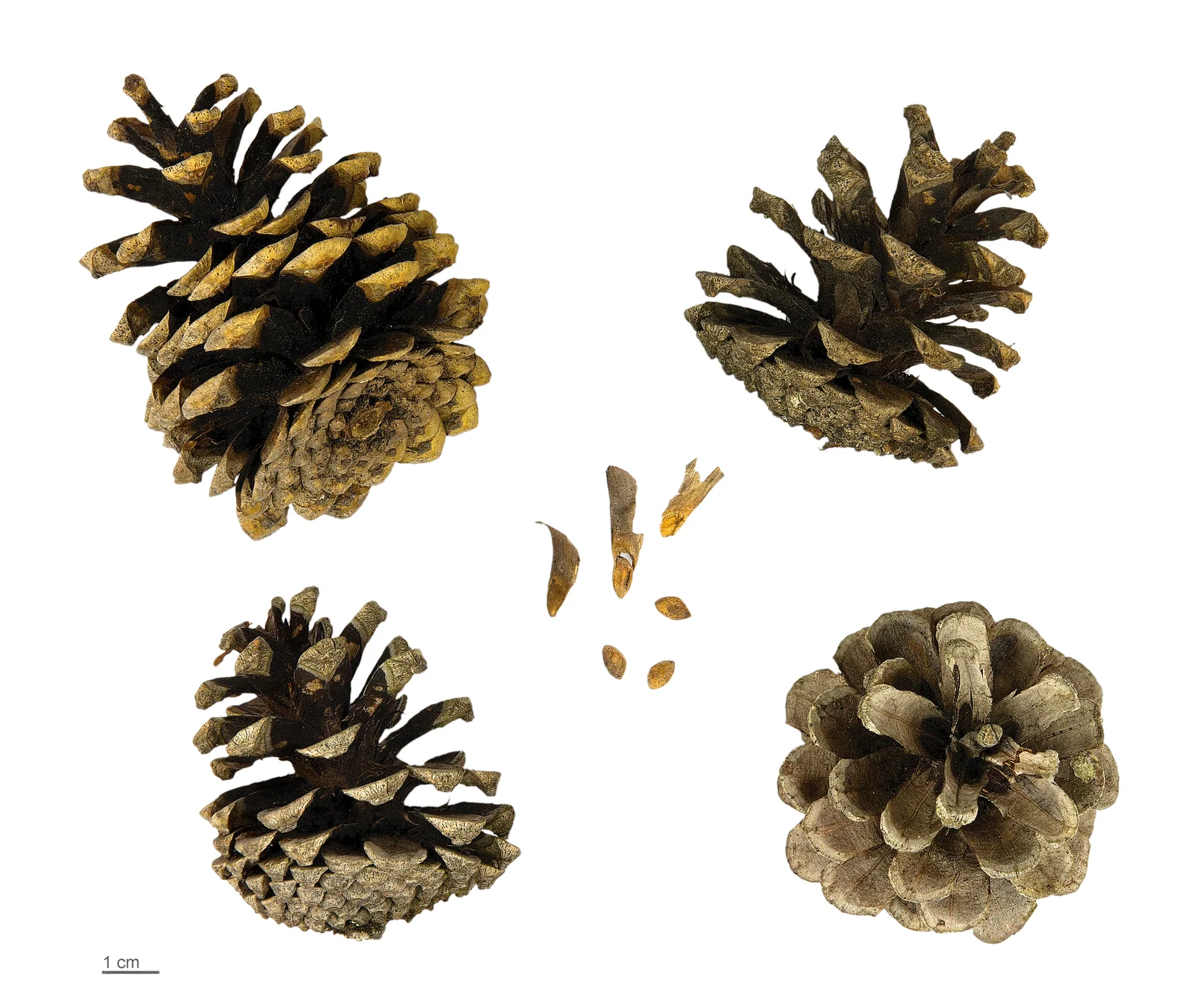
Mature Austrian Pine cones are oval, hard, and brown, about 2.5 to 3 inches long. Their scales end in blunt short points. The tree strengthens the case with stiff needles grouped in pairs.8
For another pine, record cone length, overall symmetry, scale tips, stalk, and whether the cone hangs or stands upright. Then count needles per bundle and compare needle length. Cone and needle evidence should converge on the same answer.
Fleshy fruit can hide several architectures
Softness and color are quick clues, but they do not create one botanical group. Cherries are drupes with a hard inner stone. Apples are pomes. Magnolia structures gather many small fruits from one flower, while mulberries gather fruits produced by many flowers.1
Describe what is visible before choosing a term: one smooth unit or many, a crown at the tip or none, single fruit or cluster, short stalk or branching stem. A photograph of the same tree in flower can later reveal how the structure began.
How to reconnect the object to its parent tree
Once the structure group is clear, step back. UF/IFAS recommends combining range and habitat with bark, leaves, twigs, flowers, fruits, and seeds. It also cautions that fallen fruit must be connected to the suspected tree before it becomes firm evidence.3
Build a useful record at four distances:
- Photograph the object from the side and top with a familiar scale nearby.
- Show its attachment or the remaining cluster on the twig when visible.
- Record a leafy twig and a patch of bark.
- Include the whole tree and a little of its setting.
Add the date and broad location. Season can explain why one guide shows green husks while the sidewalk holds brown ones. Geography can rule out an attractive online match that grows on another continent. On a planted street or in an arboretum, however, native range becomes a weaker filter.
The strongest identification is a pattern of agreement. A narrow wing agrees with opposite compound leaves. A shallow acorn cap agrees with willowlike oak leaves. A woody scaled cone agrees with needles in pairs. Each clue reduces the number of plausible trees.
The acorn in the leaf litter no longer has to carry the whole answer. Its cap and point begin the search. A nearby leaf changes the direction. Bark, branching, season, and place finish the route back to the tree that made it.
Sources
- Virginia Tech Dendrology: Basics of Tree ID, Fruit Accessed 2026-09-05
- USDA Forest Service: The Woody Plant Seed Manual Accessed 2026-09-05
- UF/IFAS: How to Identify a Tree Accessed 2026-09-05
- NC State Extension Plant Toolbox: Green Ash Accessed 2026-09-05
- NC State Extension Plant Toolbox: Willow Oak Accessed 2026-09-05
- NC State Extension Plant Toolbox: English Walnut Accessed 2026-09-05
- Kew Plants of the World Online: Cassia fistula Accessed 2026-09-05
- NC State Extension Plant Toolbox: Austrian Pine Accessed 2026-09-05
- Australian National Botanic Gardens: Tasmanian Blue Gum Accessed 2026-09-05
Image credits
- Top image Cossey25 · CC BY-SA 4.0
- After the winged-fruit section Katrin Schneider / korina.info · CC BY-SA 4.0
- After the long-pod section Didier Descouens · CC BY-SA 3.0
- After the nuts and husks section George Chernilevsky · Public domain
- After the capsule section Murray Fagg · CC BY 3.0 Australia
- After the cone section Roger Culos · CC BY-SA 4.0
More Field Notes
 Praying Mantis Egg Case: How to Identify an Ootheca on a Twig
  Why Pine Cones Open When Dry and Close When Wet
  Black and Orange Fuzzy Caterpillar: Woolly Bear ID Guide
Read it. Then go find it.
Open Leafari on your next walk and see what has been waiting in plain sight.