
Black and Orange Fuzzy Caterpillar: Woolly Bear ID Guide
Read a woolly bear's black-rust-black bands and even bristles, learn why so many cross paths in fall, and compare the fuzzy caterpillars that look similar.

At a glance
What is the black and orange fuzzy caterpillar crossing my path?
A fuzzy caterpillar with black ends, a rust-orange middle band, and dense bristles of nearly even length is usually a banded woolly bear, the larva of the Isabella tiger moth (Pyrrharctia isabella). Many cross paths in fall looking for winter shelter. Compare the pattern and bristles with giant leopard moth and milkweed tussock caterpillars, and observe any unidentified fuzzy caterpillar from a distance.
A caterpillar hurries across a gravel trail on a cool October afternoon. From a step away it looks like a short bottle brush: black at both ends, rust-orange through the middle, every bristle cut to about the same length. It does not stop at the grass on either side. It seems to be going somewhere.
That pattern usually belongs to a banded woolly bear, the caterpillar of the Isabella tiger moth, Pyrrharctia isabella. The Missouri Department of Conservation describes woolly bears as fuzzy with dense, stiff hairs, usually black on the ends and rusty red or brownish in the middle. In autumn they are commonly seen crossing roads.
Fuzzy is a texture, though, not a species name. Several caterpillars wear black and orange hair in late summer and fall, and they differ in bristle length, tufts, host plant, and behavior. A reliable name comes from pattern, texture, place, and season together.
Look at the bands and the bristle length
Start with the layout of color. A classic woolly bear has three blocks: black at the head end, a rust or orange-brown band across the middle segments, and black again at the tail. University of Missouri Extension describes full-grown caterpillars as a little over an inch long, covered with small bumps from which stiff hairs of about equal length arise.
That even length is one of the most useful clues in a photograph. The body reads as a neat, clipped brush. It has no long pencils of hair reaching past the rest, no pale tufts along the back, and no branching spines.
Band width is far less dependable. Missouri Extension notes that hair color and band width are highly variable, and that black hairs, especially at the rear, are often replaced by orange ones as the caterpillar matures. An older woolly bear may be mostly rust with only a small dark tip.
When disturbed, woolly bears commonly roll into a tight ball. That curl is a defense. It adds little to an identification, so there is no reason to cause it. A side view of the walking caterpillar preserves far more evidence.
Why woolly bears cross paths in fall
Woolly bears feed on a wide variety of plants. The Missouri Department of Conservation lists maples, elms, grasses, sunflowers, and clovers, while Missouri Extension names dandelion, dock, aster, goldenrod, plantain, and some grasses. A caterpillar near an elm such as Siberian elm, a patch of clover like suckling clover, or a rosette of blackseed plantain is in plausible company. A menu that broad means the nearest plant rarely settles the name.
The autumn walk has a different purpose. Grown caterpillars are searching for sheltered places to spend the winter, and the Missouri Department of Conservation notes that they wander again in spring when they look for food plants. University of New Hampshire Extension adds an honest caveat: why so many cross roads and driveways is still not well understood.
Their destination is usually close to the ground. Researchers describe the species overwintering in leaf litter, and a University of Maine Extension garden writer described a late-fall woolly bear exploring a perennial bed, looking for the right spot among fallen leaves.
Winter is where the story turns strange. Missouri Extension explains that woolly bears produce glycerol, a natural antifreeze that allows the body to freeze while keeping the fluid inside the cells unfrozen. In laboratory work published in the Journal of Experimental Biology, caterpillars given 18 weeks to acclimate to cold all survived a full week of continuous freezing at −20°C (−4°F). As the weather warms, the caterpillar spins a cocoon made with its own hairs and later emerges as a moth.
So the caterpillar hurrying across the trail in October may spend much of the winter partly frozen under leaves, then thaw and finish growing up in spring.
The band records the past, not the next winter
Folklore reads the rusty band as a forecast. In the version the Missouri Department of Conservation describes, a wide rust band promises a mild winter and a narrow one warns of a severe winter.
Biology tells a different story. Bruce Barrett, then a professor of entomology with University of Missouri Extension, explained that the pattern changes each time the caterpillar sheds its skin, and it molts several times. The black tips shrink with each molt, so a woolly bear spotted early in its development shows a narrow rust band, while one spotted later shows a wide band. An early spring gives the caterpillar a head start on feeding and growth. The Extension article concludes that the band may say more about the previous winter and spring than about the coming winter.
Missouri’s conservation department adds more factors. Wetter than average weather tends to lengthen the black bands, older caterpillars tend to carry longer rust bands, and individual genetics plays a role. Two woolly bears on the same sidewalk can easily disagree.
The rust band on a woolly bear’s back reflects its age, its weather and its genes, not the winter ahead. That makes it a better question than a forecast: how far along is this caterpillar, and what kind of year has it had?
Giant leopard moth caterpillar: black bristles over red rings
A larger fuzzy caterpillar can turn up on the same paths in fall. The giant leopard moth caterpillar, Hypercompe scribonia, grows to about 3 inches, according to UF/IFAS Extension. It is black and covered in shiny, stiff black bristles, with red breathing pores (spiracles) along its sides and red skin between the segments.
Those red rings are the key. On a walking caterpillar they show as thin bands between tufts of black bristles, and they become much easier to see when it curls. A woolly bear is broad blocks of black and rust hair; a giant leopard moth caterpillar is black hair over red skin.
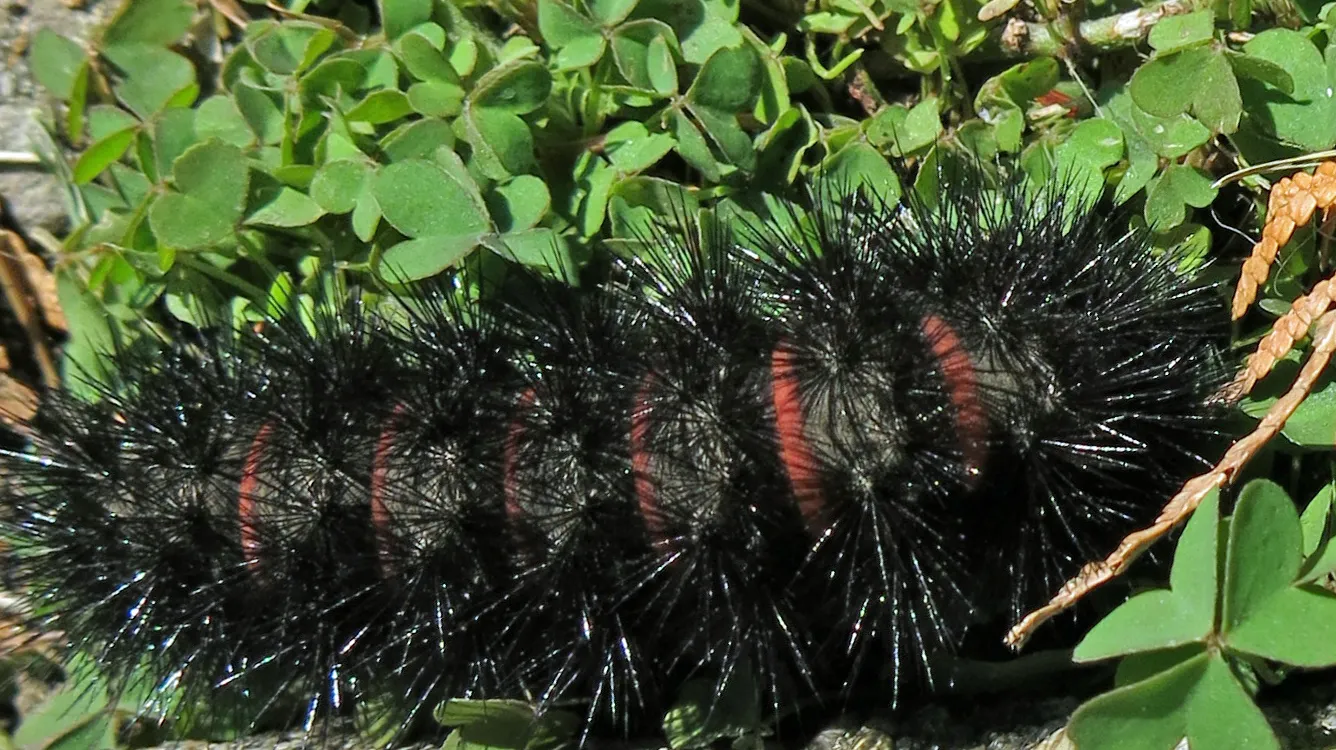
UF/IFAS Extension notes that these caterpillars also cross roads in fall while seeking winter sites, and turn up under leaves or in woodpiles during yard work. Their range runs from southern Ontario south to Florida and west to Minnesota and Texas. Their adult looks nothing like the caterpillar: a large white moth with black spots, many of them hollow rings, over an abdomen marked with iridescent blue and orange.
Milkweed tussock caterpillar: tufts instead of bands
On milkweed leaves in late summer, a black, orange, and white caterpillar tells a different story. The milkweed tussock moth, Euchaetes egle, specializes in milkweeds and dogbanes, according to Clemson University’s Home and Garden Information Center. Its late-stage caterpillar is covered in dense tufts of black, orange, and white, and Clemson notes that the bold colors advertise cardiac glycosides the caterpillar stores from its milkweed food.
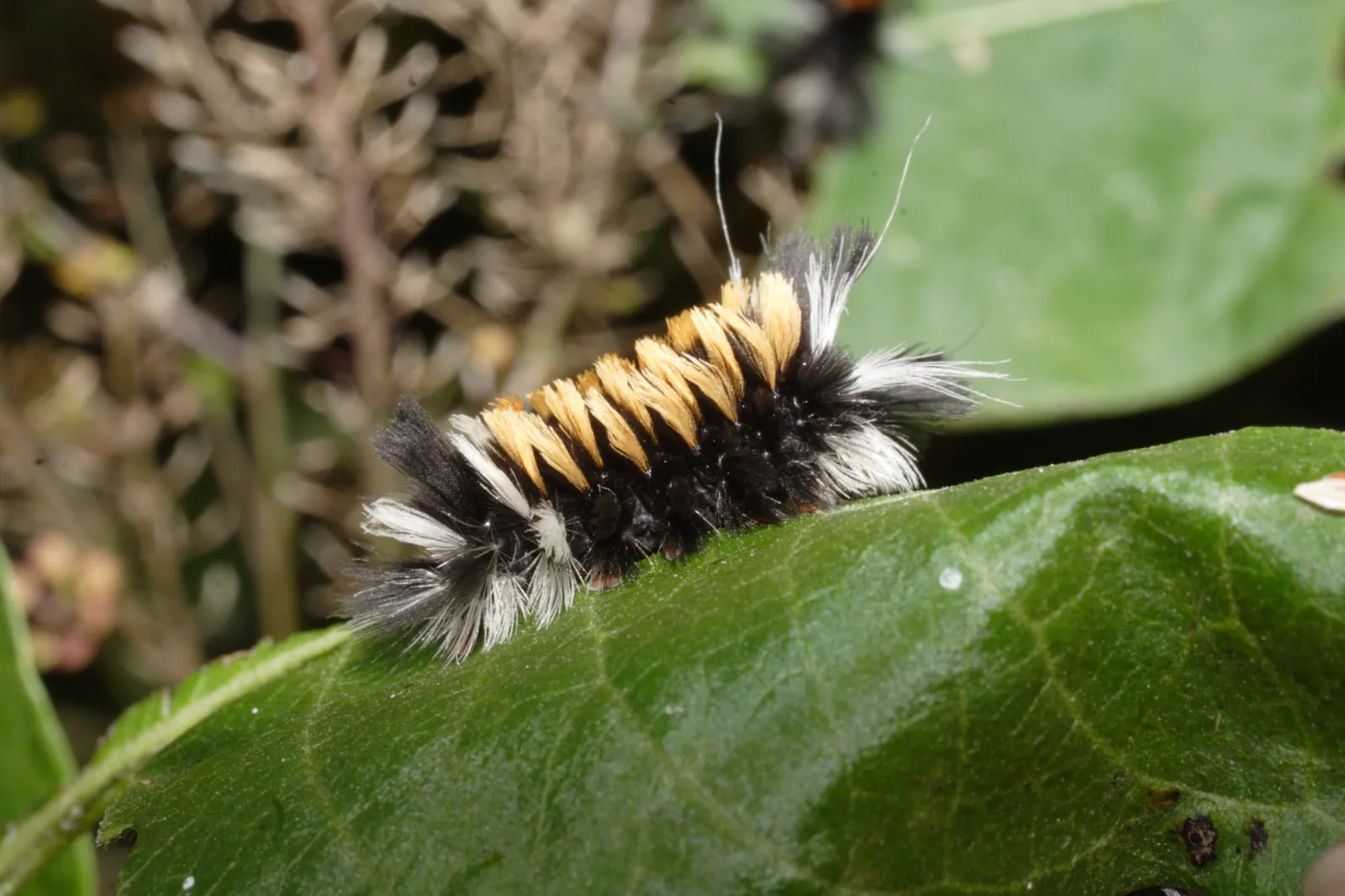
Clumps against an even brush separate the two quickly. Location helps too: Clemson notes that young milkweed tussock caterpillars feed in groups, while a woolly bear crossing a path is usually alone.
Yellow woolly bear: similar shape, different palette
Another relative can blur the picture. Utah State University Extension describes yellow woollybear caterpillars, Spilosoma virginica, as densely haired, though less densely than other woollybears, and ranging from rust-brown through yellow to white. University of New Hampshire Extension notes that they vary so much they are often identified by elimination.
An evenly rust-colored caterpillar with no black ends may be a yellow woollybear or an older banded woolly bear that has lost most of its black. Hair density and several clear photographs help, but some individuals are best left at “tiger moth caterpillar” until a clearer record turns up.
Do woolly bears sting?
For the banded woolly bear, the published answers are consistent and limited. University of Missouri Extension says the bristles do not inject venom but may cause dermatitis, a skin irritation, in some people, and it discourages handling. The Missouri Department of Conservation says most people do not get a rash from this species but some do, since sensitivity varies from person to person.
Those statements describe one confirmed species. They do not cover every fuzzy caterpillar. Clemson warns that milkweed tussock caterpillars carry irritating hairs that can cause an uncomfortable rash. The Missouri Department of Conservation notes that some tiger moth caterpillars have stinging hairs and that, in other moth groups, hairs or spines can sting. It advises caution whenever a caterpillar’s identity, or a person’s own skin sensitivity, is uncertain.
An uncertain identification therefore has a simple default: leave the caterpillar where it is and let photographs do the work. This guide covers identification and natural history, not skin reactions or medical questions.
From woolly bear to Isabella tiger moth
The adult surprises people who know only the caterpillar. According to the Missouri Department of Conservation, the Isabella tiger moth has pointed forewings of yellow or tan, often with faint lines and small dark spots. Its hindwings are lighter, orange in females, and the bases of the front legs are reddish orange. The wingspan is about 1¾ to 2¼ inches.
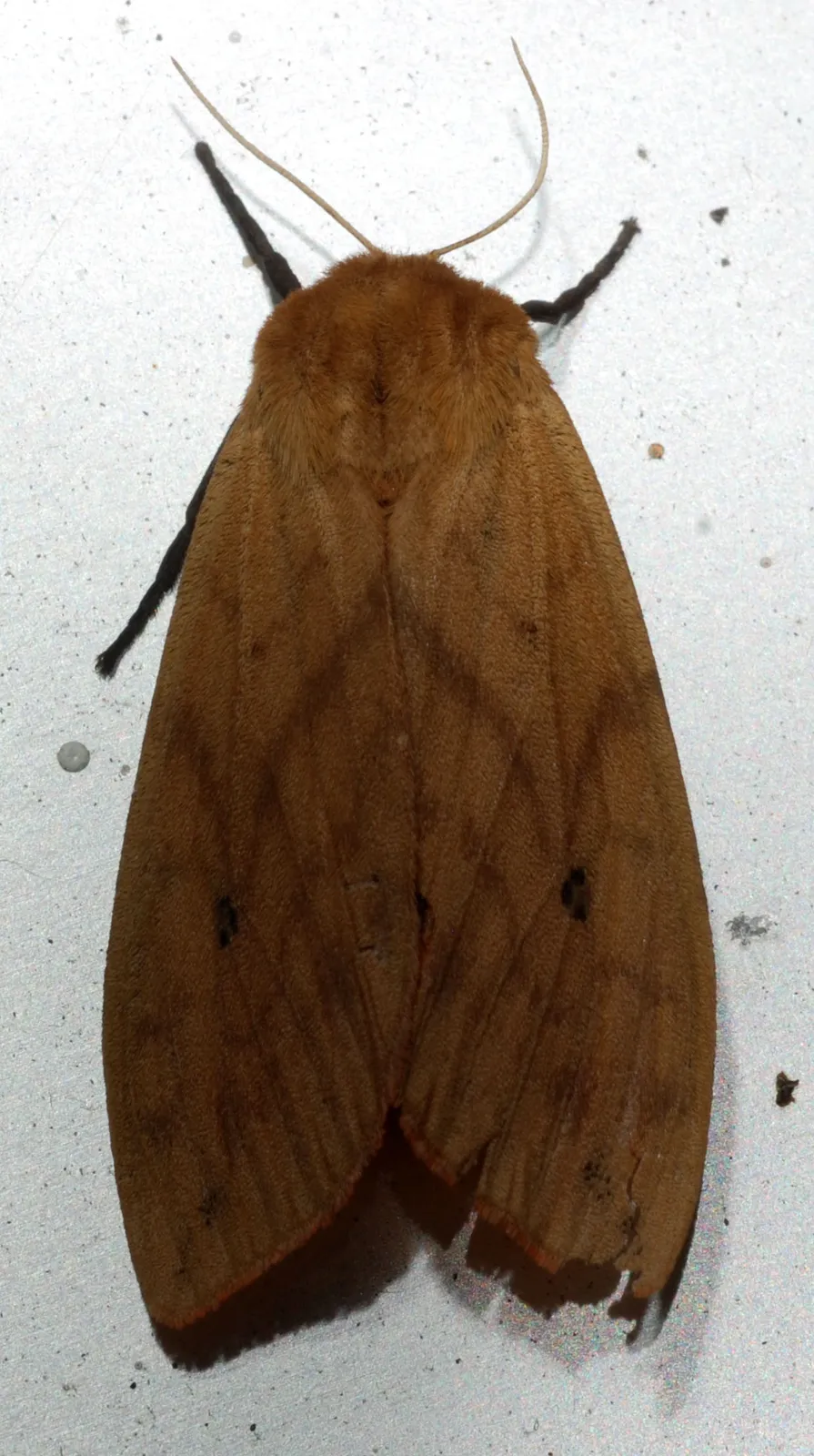
Adults often come to lights at night. Missouri Extension reports two to three generations a year in the southern United States and one in Canada, across a range from northern Mexico to southern Canada. Tiger moths as a group can hear the ultrasonic pulses of hunting bats, and some answer with clicks that jam bat sonar, according to the Missouri Department of Conservation.
Pairing each caterpillar with its adult shows why larva color cannot predict the moth. A black-and-rust brush becomes a plain tan moth. A black caterpillar with red rings becomes a white moth covered in spots.
Make a field record without contact
A short photo sequence settles most of these comparisons. Frame the whole caterpillar from the side as it walks, so both ends and the middle band share one picture. Add a view from above that shows whether the hair is an even brush or separate tufts with longer strands. Include the surface or plant beneath it: a trail, a milkweed leaf, a leaf pile. Note the date and general region.
Caterpillars that live together read differently. Fall webworms are tiger moth relatives too, but they feed as a group inside silk at branch tips. A large smooth caterpillar with a rear horn on a tomato plant is a different animal entirely, as the hornworm guide shows.
Then let the caterpillar keep walking. Somewhere past the edge of the trail is a drift of leaves where it can wait out the cold, its rust band already carrying a record of the year behind it.
Sources
- Missouri Department of Conservation: Isabella Tiger Moth (Woolly Bear; Woolly Worm) Accessed 2026-09-26
- University of Missouri Extension: Caterpillars in Your Yard and Garden, Banded Woollybear (IPM1019) Accessed 2026-09-26
- University of Missouri Extension: Can the Woolly Bear Caterpillar Predict the Weather? Accessed 2026-09-26
- Missouri Department of Conservation: Tiger and Lichen Moths Accessed 2026-09-26
- Missouri Department of Conservation: Giant Leopard Moth Accessed 2026-09-26
- UF/IFAS Extension: Giant Woolly Bear, Giant or Great Leopard Moth (EENY599) Accessed 2026-09-26
- Clemson Home and Garden Information Center: Milkweed Tussock Moth Caterpillars Accessed 2026-09-26
- Utah State University Extension: Yellow Woollybear Accessed 2026-09-26
- University of New Hampshire Extension: What Are the Caterpillars Eating the Plants in My Yard? Accessed 2026-09-26
- University of Maine Cooperative Extension: Maine Home Garden News, November 2022 Accessed 2026-09-26
- Yi and Lee, Cold-hardening during long-term acclimation in a freeze-tolerant woolly bear caterpillar, Journal of Experimental Biology (2016) Accessed 2026-09-26
Image credits
- Top image Judy Gallagher · CC BY 2.0
- In the giant leopard moth caterpillar comparison Jacy Lucier · CC BY-SA 4.0
- In the milkweed tussock caterpillar comparison Kristof Zyskowski and Yulia Bereshpolova · CC BY 2.0
- In the adult moth section Robert Aguilar, Smithsonian Environmental Research Center · CC BY 2.0
More Field Notes
 Praying Mantis Egg Case: How to Identify an Ootheca on a Twig
  Why Pine Cones Open When Dry and Close When Wet
  Tiny Red Bugs on Concrete? Clover Mites vs. Sidewalk Mites
Read it. Then go find it.
Open Leafari on your next walk and see what has been waiting in plain sight.