
Tiny White Eggs on Stalks: Green Lacewing Clues
Tiny white eggs balanced on hair-thin stalks may belong to green lacewings. Learn the egg, larva, cocoon, and net-winged adult clues.

At a glance
What are the tiny white eggs on stalks under a leaf?
Tiny pale eggs held above a leaf on individual hair-thin stalks are a strong green lacewing clue. Confirm the shape and setting: each oval sits at the tip of its own slender thread, alone or in a loose group. Later stages look completely different, including tapered larvae and delicate adults with net-veined wings.
White ovals lean away from the underside of a leaf. At first they look like dust caught in sunlight. Move the view sideways, and each oval separates from the green surface. A thread rises beneath it, so fine that the egg seems to float.
That thread is the useful clue. Tiny pale eggs held on individual hair-thin stalks are characteristic of green lacewings, insects in the family Chrysopidae. The eggs may stand alone or form a loose group, but each one occupies the tip of its own slender support.
Color can shift with age and light. Pale green may become creamy white or gray. The stalk remains a more dependable first mark than the shade. A sharp side photograph often reveals it when a straight-down view shows only dots.
Look for the stalk before the color
Begin with structure. Is the pale oval attached directly to the leaf, or does a long thread raise it above the surface? Green lacewing eggs look like tiny grains set on pins whose shafts are almost invisible.
University extension descriptions agree on this unusual form. The University of Minnesota notes an oblong egg on a hairlike stalk. NC State describes whitish eggs laid singly or in groups on long stalks. Kansas State calls the support a hairlike silken stalk. Those details make a stronger identification than the word white by itself.
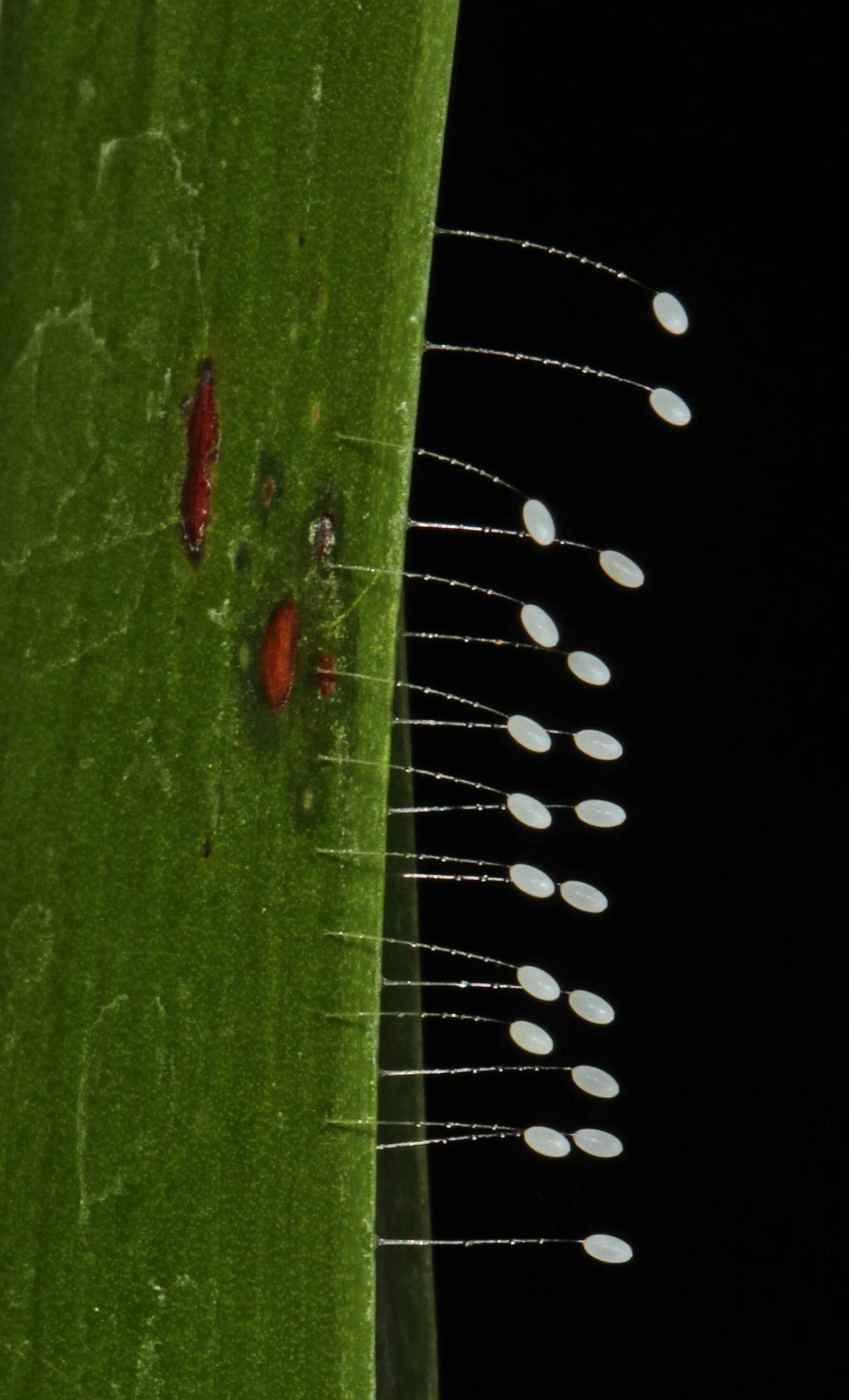
Check several eggs if the view allows. One strand could be plant fiber or webbing. Repeated ovals at the ends of repeated upright threads create the pattern. Notice whether the supports are far longer than the eggs are wide, and whether the group looks loose rather than packed into one solid mass.
Plant identity does not settle the egg identity. Lacewing eggs can appear on many kinds of vegetation. A Rose leaf is one possible setting, and NC State records green lacewing adults and larvae among organisms associated with rose aphids. The same suspended shape on another plant can carry the same family-level clue.
How these eggs differ from other pale leaf clues
Small pale marks on leaves have many origins. Some are eggs, some are plant structures, and some are bits of material caught on the surface. The goal is not to force every dot into a name. It is to ask which visible construction is present.
Whitefly eggs provide a useful comparison because they can also occupy leaf undersides and rest on small supports. University of Maryland Extension describes them as tiny, oblong, and arranged in semicircular patterns. Their supports are short. Green lacewing eggs rise on conspicuously long individual threads, creating much more empty space between egg and leaf.
Leaf galls tell a different story. In Bumps on Leaves: Plant Galls, the swelling is tissue grown by the plant. It joins the leaf continuously instead of balancing above it on a filament. Turn the light across the surface and the difference becomes architectural: mound, attached oval, or suspended oval.
Wet connected bubbles on a stem belong to another clue family. White Foam on Plants follows that froth to the spittlebug nymph sheltering inside, rather than an egg raised above the leaf.
Webbing alone is not enough. Look for the regular pairing of one oval and one stalk. A group of threads with no matched ovals calls for a wider photograph and an open identification.
Scale can be hard to judge from a phone image. Include a little surrounding leaf and a vein in the frame. Those landmarks preserve the size relationship without placing anything beside the eggs. The photo-first routine in How to Observe Bugs Safely with Kids works well here because it records the clue while the leaf stays exactly as found.
Why a lacewing starts life above the leaf
Each stalk is part of the egg’s construction, not a separate plant hair. A female lacewing places a droplet of material on the leaf, draws it into a fine thread, and leaves an egg at the end. Kansas State explains that this separation spaces the eggs away from one another.
This construction changes how the leaf reads. A flat green plane becomes a tiny vertical habitat, with the next life stage waiting at the top of each thread. In side light, the eggs can cast miniature shadows. In wind, they may lean together without losing their individual anchors.
That raised beginning is only one part of a complete transformation. Green lacewings pass through egg, larva, pupa, and adult stages. The animal does not simply enlarge while keeping the same outline. Each stage introduces a new body and a new set of visible clues.
Timing varies with species and conditions, so one photograph should not become a countdown. A sequence of photographs from the same angle can record change honestly. Date each image. Note whether an oval remains full, darkens, opens, or leaves an empty shell at the top of the stalk.
From stalked egg to lacewing larva
Newly emerged larvae are narrow, active, and tapered at both ends. Two curved mouthparts project from the head. Their bodies may be mottled in brown, cream, or gray, which can disappear visually against bark, dry leaf edges, and shaded veins.
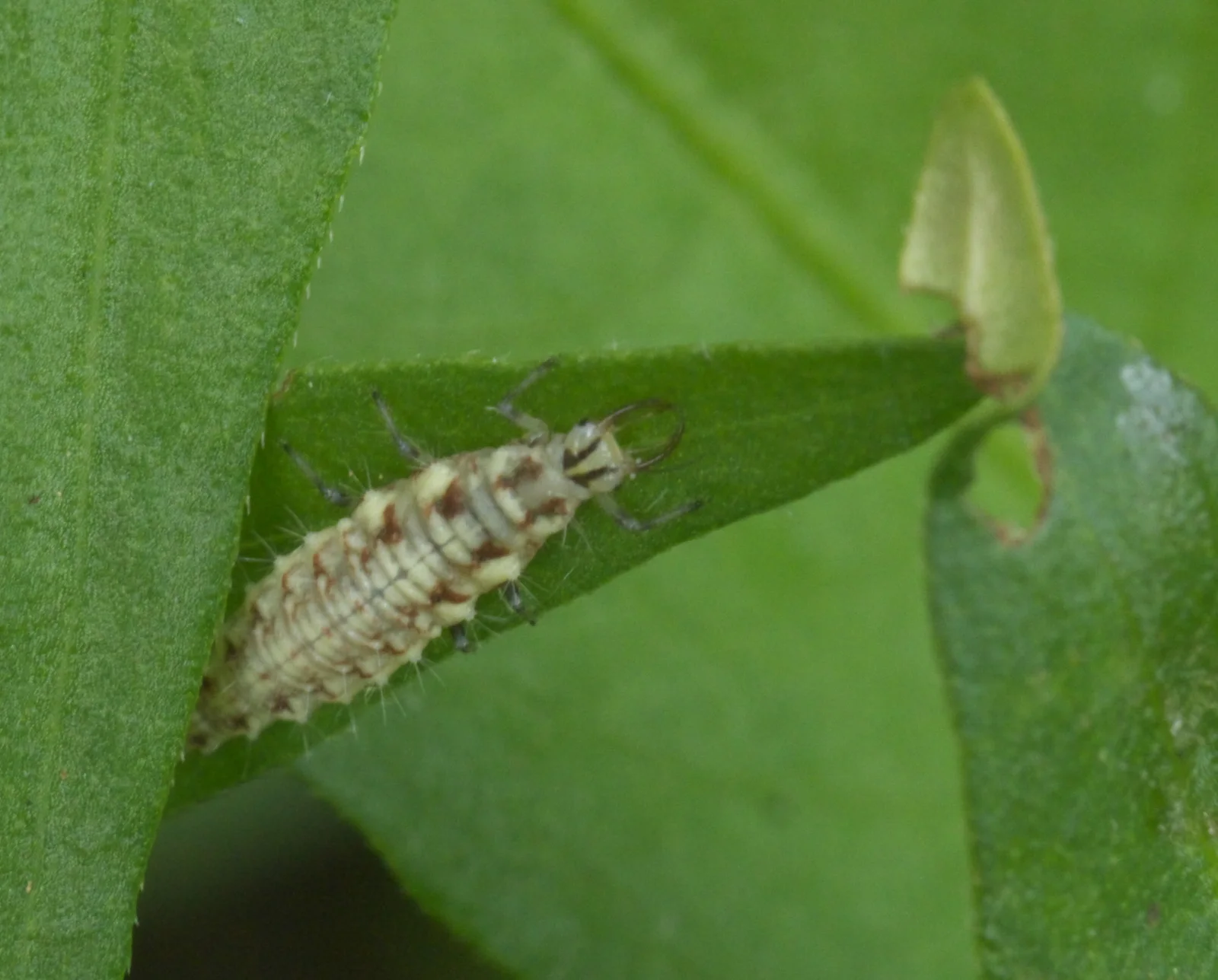
University of Minnesota describes lacewing larvae as having an elongated body and prominent paired mouthparts. NC State places them within a four-stage life cycle and notes that the mature larva forms a round silken cocoon before the adult appears. One leaf record may therefore move from upright eggs to a roaming larva and later to a pale round cocoon tucked nearby.
Exact species identification usually needs more than the stalked egg. The egg photographs on this page support the family Chrysopidae. The larval photograph supports the genus Chrysoperla. Keeping those levels separate prevents a beautiful image from making a claim it cannot carry.
Larvae may also travel beyond the original leaf. An empty stalk is evidence that something changed, not proof of where the next stage went. Search with the camera across nearby stems and leaf folds, then let absence remain part of the record.
The adult wears a roof of netted wings
An adult green lacewing seems built from different materials. Long antennae extend ahead of a slender green body. Two pairs of transparent wings rest like a low roof, and a dense network of veins gives the family its common name. Many adults also show bright metallic-looking eyes.
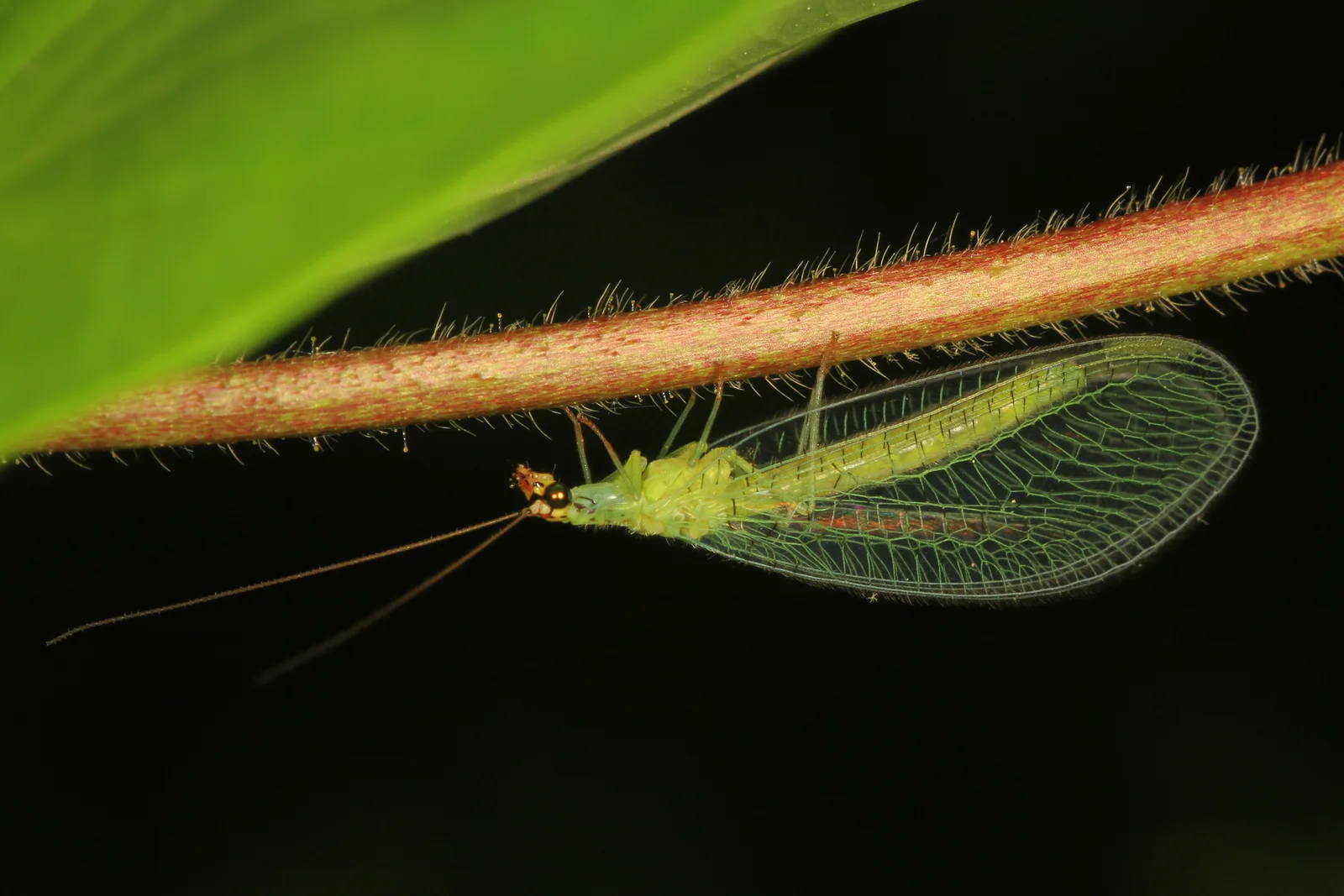
Adult form helps explain why egg-only searches can feel disconnected. An observer looking for a small green winged insect may not imagine that it began as a pale oval on a thread. Placing the stages side by side turns four separate mysteries into one life history.
Adult diets vary among green lacewings. Kansas State reports that some feed on honeydew, pollen, and nectar. Small clustered flowers such as Coriander can therefore become useful places to notice delicate winged visitors, although a flower visit by itself does not establish a lacewing identity. The netted wings, antennae, body, and several clear angles still matter.
Adults may come to lights after dark, while eggs wait quietly on foliage during the day. A record built across both settings can connect the mobile adult with the nearly motionless first stage without assuming that two sightings belong to the same individual.
Watch one leaf become a timeline
Four frames can make a strong field record. Start with the whole leaf so its orientation and surroundings remain visible. Add a side view for the stalks. Take one close image of several ovals together, then return later from the same direction.
Keep the description literal. Count visible eggs, note their color, record whether each has a separate thread, and name the plant only when that identification is secure. If the egg identity remains uncertain, write “lacewing-like stalked eggs” and preserve the question.
Over time, the sequence may end with empty stalks. It may reveal a larva on a neighboring leaf. It may simply show that the pale ovals changed color between two dates. Each outcome adds a small piece of evidence, and none requires disturbing the structure that made the observation possible.
A lacewing egg can look like a pearl balanced on a thread finer than a hair. Once that structure has entered the eye, a quiet leaf is never quite flat again.
Sources
- University of Minnesota Extension: Lacewing Accessed 2026-08-01
- NC State Extension: Lacewings Accessed 2026-08-01
- Kansas State Research and Extension: Green Lacewings Accessed 2026-08-01
- University of Maryland Extension: Lacewings Accessed 2026-08-01
- University of Maryland Extension: Whiteflies on Vegetables Accessed 2026-08-01
- NC State Extension: Pests of Rose Accessed 2026-08-01
Image credits
- Top image Luis Fernandez Garcia · CC BY-SA 2.5 ES
- After the first identification section Judy Gallagher · CC BY 2.0
- After the larva section Robert Webster · CC BY-SA 4.0
- After the adult section Judy Gallagher · CC BY 2.0
More Field Notes
 Praying Mantis Egg Case: How to Identify an Ootheca on a Twig
  Why Pine Cones Open When Dry and Close When Wet
  Black and Orange Fuzzy Caterpillar: Woolly Bear ID Guide
Read it. Then go find it.
Open Leafari on your next walk and see what has been waiting in plain sight.