
Bumps on Leaves? How to Recognize Plant Galls
Odd bumps on leaves may be plant galls. Learn how host plant, shape, placement, color, and season help separate galls from eggs and surface growths.

At a glance
What are the bumps on tree leaves?
Many bumps on tree leaves are galls: plant tissue that grew in response to an insect, mite, or another organism. Check the host plant, the bump's shape and placement, both leaf surfaces, and the season together. Those clues can support a gall match without promising an exact gallmaker.
At the edge of a maple leaf, sunlight catches a scatter of pink points. Some are no larger than grains of rice. Others rise like tiny crooked nails. They seem to be sitting on the leaf until the light shifts and reveals the stranger fact: each point grows from the green surface itself.
That is the first clue to a plant gall. The bump is plant tissue, even when an insect or mite started the change. A gallmaker alters the growth of young tissue, and the leaf builds a chamber, blister, tuft, fold, or bead around that signal.
The bug or mite starts the message, but the leaf grows the gall.
What to notice before naming a gall
Begin with the host. A round growth on an oak belongs to a different shortlist from a red point on a maple or a swelling where a poplar leaf meets its stalk. Photograph enough of the leaf to preserve its outline, veins, and attachment. If the tree is unfamiliar, include bark, branching, and the whole crown in a second picture.
Next, describe shape without rushing to a name. Try sphere, cone, blister, felt patch, fold, disk, or swollen vein. Note whether the growth rises from the upper surface, hangs beneath it, follows a vein, gathers at the leaf base, or changes the leaf stalk. That stalk is called the petiole.
Color comes later. Maple bladder galls often begin green and turn red before darkening, while other forms stay pale, hairy, or brown. Shape, host, and placement carry more information than color alone.
Finally, look for continuity with the leaf. Eggs and debris rest on a surface and keep their own edges; lacewing eggs even sit above the leaf on thin stalks. A gall often changes the tissue around it: veins bend, the blade puckers, or the swelling appears on both sides. This is a useful field distinction, not proof of an exact maker. Fungi, bacteria, nematodes, insects, and mites can all produce unusual plant growth, and several unrelated organisms can create similar forms.
Wet bubbles point somewhere else. A fresh white froth keeps a liquid edge instead of changing the leaf beneath it. White Foam on Plants: Meet the Spittlebug Inside follows that surface clue to the nymph building a shelter there.
Bumps on leaves that are not galls
Not every raised spot is a gall. The continuity test still sorts most lookalikes: did the leaf grow the bump, or is something resting on it?
Scale insects are the classic trick. University of Wisconsin Extension notes that they are often overlooked because adult females stay put and look like small bumps that might be plant parts. Their covers may be flat ovals, domes, or tiny oyster-shell shapes, usually on leaf undersides and stems. The bump is the insect, not the leaf, and many scales leave a shiny, sticky film called honeydew.
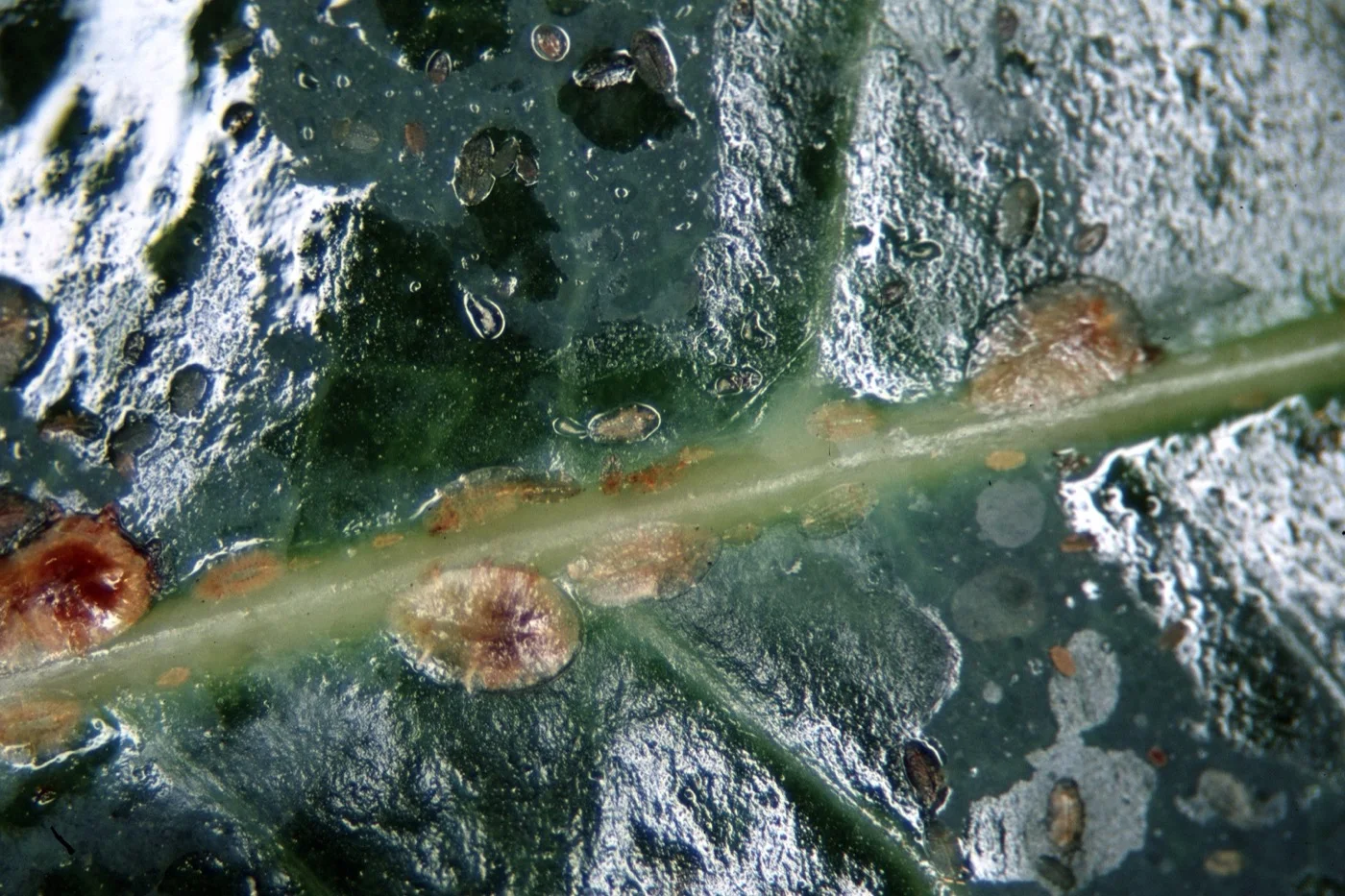
Rust shows up as bumps from underneath. University of Minnesota Extension describes raised pustules of powdery spores on the lower leaf surface, just below yellow, orange, or red spots on top. Loose, colored powder points to a rust fungus rather than a gall.
On maples, tar spot can pass for a darkened gall. The Morton Arboretum describes light green to yellow-green spots in early summer that develop black flecks and become slightly raised black patches, a cosmetic problem rather than a real health issue for trees. A maple bladder gall is a small rounded bead; tar spot spreads as a flatter patch across the blade.
Oak leaf blister comes closest, because it is also plant tissue. Penn State Extension explains that the fungus Taphrina caerulescens infects young oak leaves in spring, and cells in each spot multiply more than those around them. Illinois Extension adds that the spot bulges up on the upper surface and sinks on the lower one. The result is a buckled patch, often a quarter to half an inch across, not a separate bead.
Houseplants add a lookalike with no organism at all. University of Maryland Extension describes edema as wart-like or crusty raised bumps on lower leaf surfaces, a physiological disorder that develops when roots absorb more water than the leaves lose. Its list of prone plants includes jade, the group that holds Gollum Jade, and African violets. The bumps may turn brown and be mistaken for insect damage.
How a gall becomes part of the leaf
Most insect and mite galls begin while leaves, shoots, or flowers are growing quickly. Feeding or egg-laying introduces chemical signals that interact with the plant’s own growth system. Cells enlarge or multiply, and the altered tissue grows around the gallmaker.
Timing matters. Mature tissue is much less responsive, so the tiny architect must reach a bud or new leaf early. By the time a walker notices a hard green bead in July, its story may have begun around bud break in spring.
University of Minnesota Extension notes an even odder turn: once some galls begin, the plant tissue can keep developing after the insect has died. The visible structure and the hidden occupant do not share a simple clock.
That makes a gall more than a bump with a bug inside. It is a record of two bodies responding to each other. The gallmaker gains food and a sheltered space. The plant redirects living tissue into a new shape. What looks ornamental from a path is a small biological negotiation written in green, red, or brown.
Maple points, bladders, and velvet patches
Maples host some of the easiest galls to notice. Eriophyid mites are less than two millimeters long, but their structures can cover a leaf. Depending on the mite and host, the result may be a rounded bladder, a narrow spindle, or a felt-like patch called an erineum.
The hero photograph shows Eriophyes macrorhynchus galls on a maple. Dozens of pink fingers rise from one blade, with smaller green points among them. A quick glance might read them as eggs. The way they merge into the leaf surface tells a different story.
Penn State Extension describes maple bladder galls as small rounded growths that often appear as leaves finish expanding. They may shift from green to red and later black. That color sequence helps when the same tree is photographed more than once, though timing varies.
Elm leaves can carry spindle-like forms too. The Cedar Elm Species Showcase is useful for separating the host’s small rough leaf from the structure growing on it. Name the tree and the gall as two related observations, rather than letting one unfamiliar bump decide both.
Oak galls trade one shape for another
Oaks can hold an astonishing gallery. University of Wisconsin Extension lists warts, disks, raised patches, and large apple-like balls among the forms a walker may encounter. Many come from tiny gall wasps, with different wasps associated with different structures.
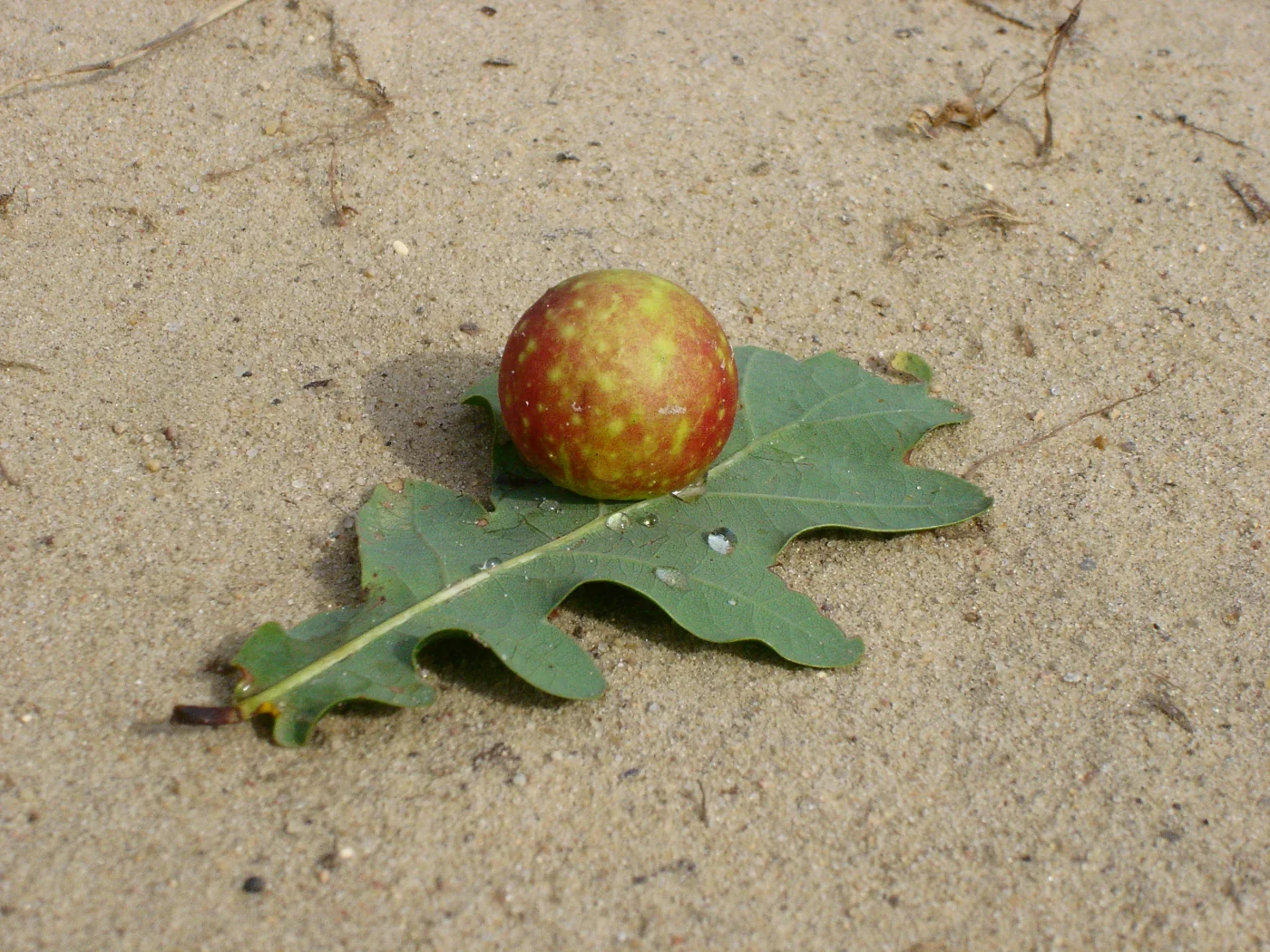
A round gall on a lobed oak leaf can look like a fruit that landed in the wrong place. The leaf around it settles the question. The ball joins the blade as living tissue, while the lobes and veins identify the host family. For a narrow-leaved oak example, the Willow Oak Species Showcase shows why acorns and the whole tree matter when familiar oak lobes are missing.
Roses are another common host group for gall wasps. A Prickly Rose Species Showcase can help establish the host from leaflets, prickles, flowers, and hips before an observer describes a separate swelling. Poplars offer yet another arrangement: aphids can produce galls on the petiole or where that stalk meets the blade. The White Poplar Species Showcase keeps the host clue visible.
These links do not turn a host name into a gall ID. They narrow the field. Gall form is often specific, but a careful identification needs region, season, detailed images, and expert comparison along with the host.
Look for the quiet exit clue
A small round opening can change the interpretation of a gall. University of Maryland Extension notes that holes may indicate the inhabitant has already left. The plant-built room remains, but its maker’s life has moved beyond it.
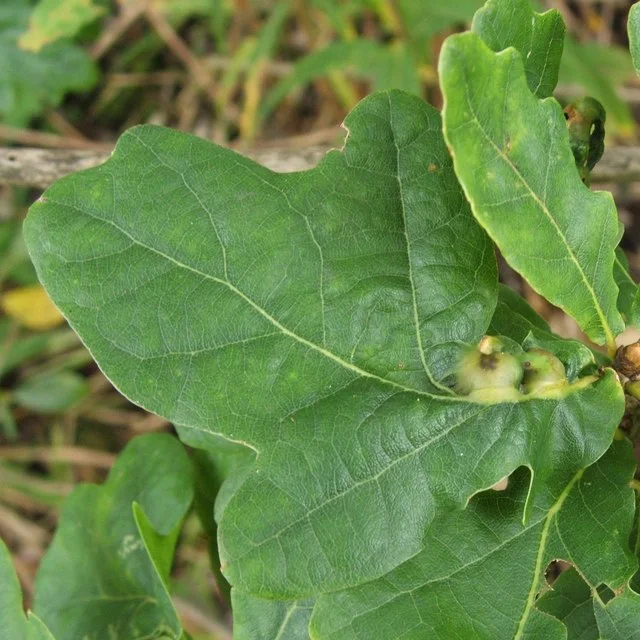
Use a zoomed photograph to preserve that clue, with a side angle showing whether the opening belongs to the gall or is ordinary chewing elsewhere. Pair it with a wider image of the full host leaf.
That opening also prevents a common assumption. A gall is not always a sealed container waiting to reveal an occupant. By the time it is most colorful or firm, the organism may have departed, yet the structure still carries evidence in its surface and placement.
Build an observation across the season
A strong record needs only a short picture set. Start with the whole tree or shrub. Add one frame of the full leaf, one close view of the growth, and one angled view showing where it joins a vein, blade, or petiole. Record the date and general setting.
Write down five visible details: host, shape, placement, color, and surface texture. For scale, use a part already in the frame, such as the leaf width or a vein.
Return later if the spot is easy to revisit. Green may become red or brown. A smooth surface may dry. An exit opening may appear. Gall numbers can also change greatly from one year to the next, so absence next summer does not erase the earlier observation.
Most insect and mite leaf galls have little effect on the health of established trees, according to the extension sources reviewed for this guide. That broad pattern has limits. Twig swellings, repeated heavy growth on a young plant, a mass near the soil line, or a plant declining for other reasons calls for a more specific diagnosis from a local extension service or qualified tree professional.
For families, the best habit is the one used in the bug observation guide: let photographs and patience do the close work. A leaf that first seemed covered in random bumps becomes a page of relationships. One shape points to a host. One opening marks a departure. One return visit adds time.
The pink points on the maple do not become ordinary once they have names. They become more precise. Each is still a tiny room made from a leaf, begun by an organism small enough to miss and preserved long enough for a walker to notice.
Sources
- University of Wisconsin Extension: Bumps & Odd Growth on Leaves Accessed 2026-07-28
- University of Minnesota Extension: Insect and Mite Galls Accessed 2026-07-28
- University of Maryland Extension: Tree and Shrub Galls Accessed 2026-07-28
- University of Wisconsin Extension: Maple Gall Mites Accessed 2026-07-28
- Penn State Extension: Leaf Galls on Maple Accessed 2026-07-28
- University of Wisconsin Extension: Scale Insects Accessed 2026-09-24
- University of Minnesota Extension: Rust in the Flower Garden Accessed 2026-09-24
- The Morton Arboretum: Tar Spot of Maple Accessed 2026-09-24
- Penn State Extension: Oak Leaf Blister Accessed 2026-09-24
- University of Illinois Extension: Oak Leaf Blister Accessed 2026-09-24
- University of Maryland Extension: Edema of Indoor Plants Accessed 2026-09-24
Image credits
- Top image hedera.baltica · CC BY-SA 2.0
- After the oak gall section Helge Busch-Paulick (Grand-Duc, Wikipedia) · CC BY-SA 3.0 DE
- After the exit-hole observation section Lairich Rig · CC BY-SA 2.0
- In the lookalikes section Whitney Cranshaw, Colorado State University, Bugwood.org · CC BY 3.0 US
More Field Notes
 Praying Mantis Egg Case: How to Identify an Ootheca on a Twig
  Why Pine Cones Open When Dry and Close When Wet
  Black and Orange Fuzzy Caterpillar: Woolly Bear ID Guide
Read it. Then go find it.
Open Leafari on your next walk and see what has been waiting in plain sight.