
White Foam on Plants: Meet the Spittlebug Inside
White foam on a plant stem often shelters a spittlebug nymph. Learn how bubble texture, placement, season, and life-stage clues support the identification.

At a glance
What makes white foam on plants?
A wet cluster of tiny bubbles on a plant stem or leaf joint often shelters a spittlebug nymph, the young stage of a froghopper. The nymph feeds on watery plant fluid and pumps bubbles into the excess, building a foam room that helps it stay moist and less exposed. Texture and placement are stronger clues than white color alone.
A white patch hangs beneath a green stem fork. From a few steps away it could be a scrap of tissue caught after rain. Closer, the surface resolves into hundreds of tiny bubbles. One clear drop gathers at the bottom while the rest cling together like a spoonful of bath foam.
That wet, bubbly texture points toward a spittlebug nymph. The animal is the young, wingless stage of a froghopper, a small relative of cicadas. It feeds from the plant and surrounds itself with foam, turning a visible white mark into a temporary room.
White color alone cannot settle the identification. Start with the surface. A likely spittlebug mass is made of connected bubbles and sits on a stem, leaf stalk, tender shoot, or the underside of young growth. A dry film lies flat. Loose fibers keep their strands. A solid bump changes the plant tissue itself.
What to look for in the bubbles
Look for a wet cluster with many small round cells. Fresh foam may shine. Older foam can sag, shrink, or collect dust, but its edge still tends to break into bubbles rather than powder or threads.
Placement adds a second clue. University extension records place spittlebug foam on stems, leaf stalks, young leaves, flowers, and low growth near a plant’s base. The exact address changes with the species, host, weather, and age of the nymph. The shared pattern is a soft part of the plant close enough for a tiny sap feeder to reach.
Compare that with a gall. A gall swells from the leaf or stem because the plant has grown new tissue around a signal. Foam sits on the surface and keeps its own wet boundary. Bumps on Leaves: Plant Galls shows how veins, puckering, and growth on both leaf surfaces reveal that difference.
Take one wide photograph that includes the host plant and one closer frame for the bubble texture. Those two views preserve more evidence than white color by itself. The same patient routine appears in How to Observe Bugs Safely with Kids, where distance and a sequence of pictures do the close work.
Meet the nymph behind the foam
The foam maker can be surprisingly small. University of Minnesota Extension describes spittlebug nymphs as soft, elongated insects up to about one-quarter inch long. Their colors can shift from orange through yellow to green as they grow. Large eyes may look reddish at the sides of the head.
Those marks support an identification when the animal is visible in a photograph. They do not turn every foam mass into one exact species. Many spittlebugs make similar shelters, and a nymph may be partly hidden, washed by light, or too young to show a familiar color.
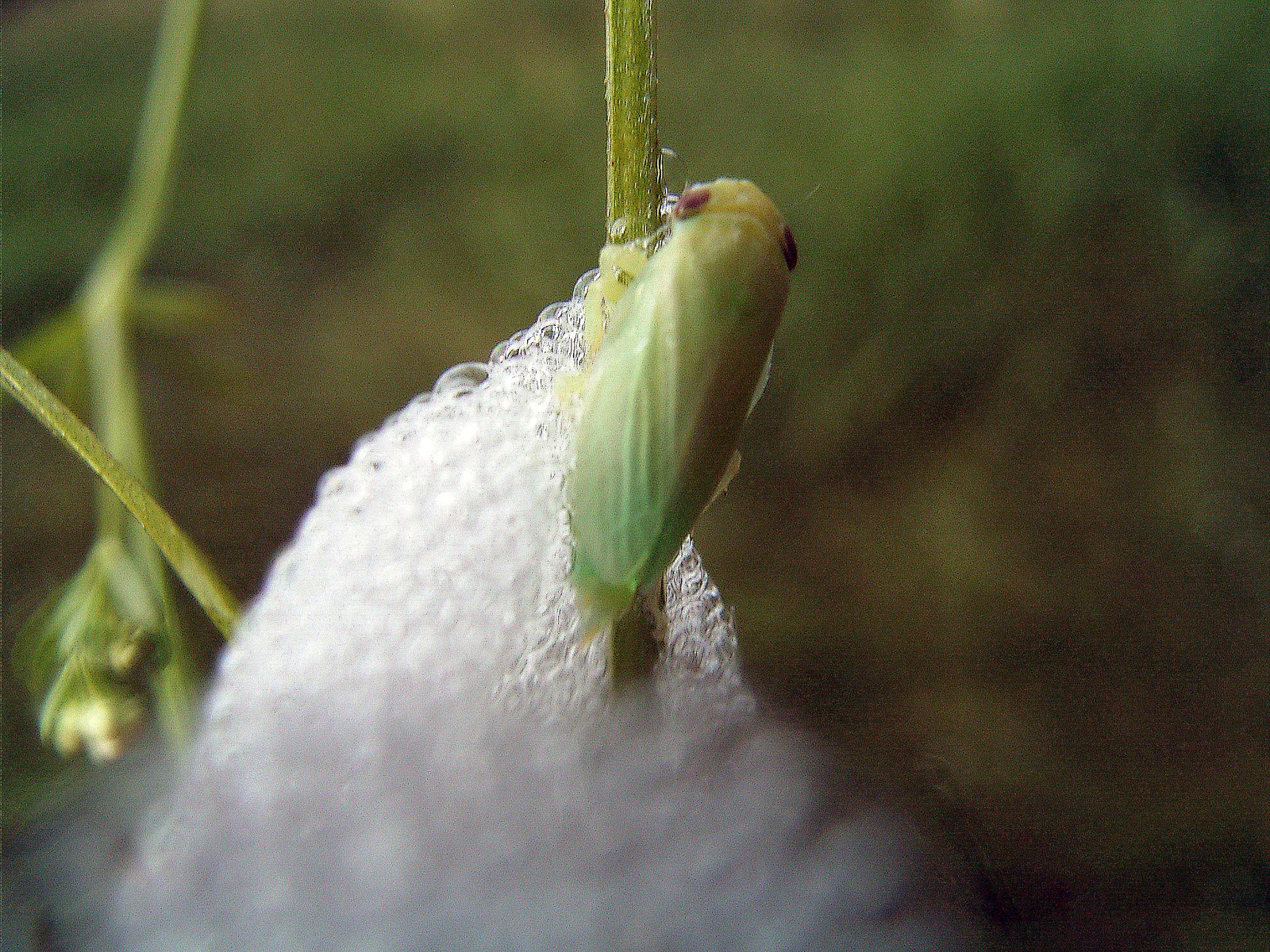
One shelter can contain more than one nymph, but the visible mass still offers only a first taxonomic clue. Record the plant, region, date, body shape, and any clear color pattern. An expert can do more with that complete packet than with a close view of foam alone.
How the plant supplies water for a bubble room
Spittlebugs feed with slender mouthparts that reach the plant’s xylem, the tissue carrying water and dissolved minerals upward from the roots. Xylem sap is watery and nutrient-poor. The nymph processes a large flow of it, then adds air to excess fluid as it leaves the body.
The tiny bug inside the foam builds its room from water moving through the plant.
That explains why the shelter can be many times larger than its maker. The nymph is not producing a solid nest piece by piece. It keeps a liquid film full of air, renewing a damp layer around its body while feeding.
Several jobs happen inside those bubbles. Extension and museum sources describe protection from drying and reduced exposure to predators. Experimental research adds another layer: the foam can buffer the nymph against temperature changes. What looks like a messy splash is a carefully maintained microclimate.
It is not sealed away from the air. Research on meadow spittlebugs has examined how a nymph exchanges gases while submerged in the foam. Each bubble helps create a wet shelter that still contains the oxygen an insect needs.
This is the article’s small surprise: a plant’s water line becomes architecture. Root, xylem, insect, and air meet in a white patch no larger than a fingertip.
The adult leaves the bubbles behind
Foam belongs to the nymphal chapter. As development continues, the young insect molts through several stages. The later adult has wings, enlarged hind legs, and a talent for jumping that explains the name froghopper.
Adult meadow spittlebugs are compact, roughly one-quarter inch long, and variable in color. Some emerge green and later become brown or gray. Their folded wings form a low roof over the back, giving them a shape that is broader and sturdier than many leafhoppers.
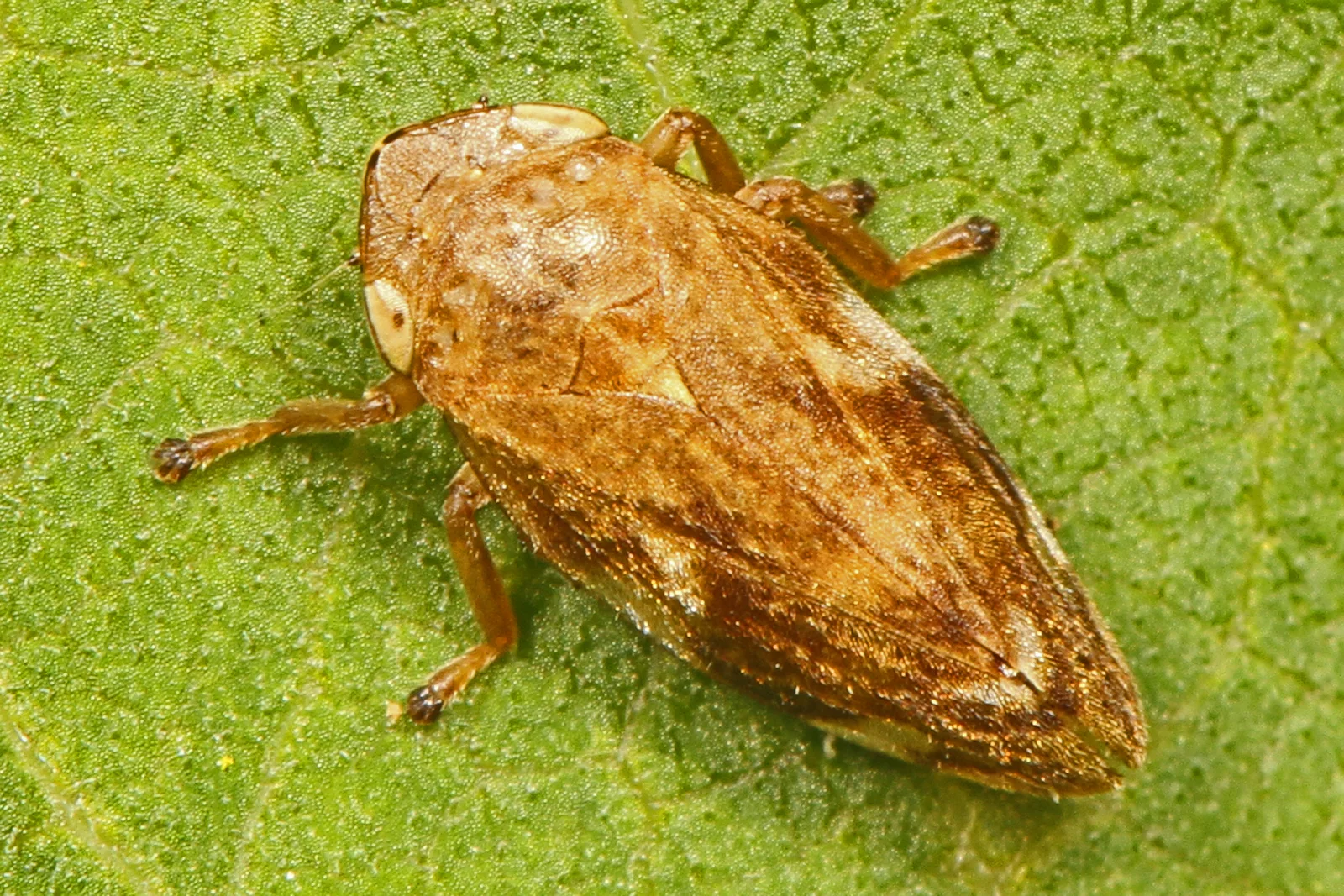
This change makes a useful seasonal record. A stem may carry fresh foam for a limited stretch, then show no trace of the shelter while small adults move through nearby vegetation. A return photograph can capture the bubble mass thinning, disappearing, or giving way to a different set of insects on the same plant.
Let the host plant add context
Spittlebugs use a broad range of plants. University of Minnesota Extension lists grasses, roses, chrysanthemums, clover, strawberries, herbs, and many other garden plants. Host identity therefore supports the story without proving the species.
Foam on Garden Strawberry fits a host group documented by several extension sources. The same is true of the broader rose and clover groups represented by Rose and Suckling Clover. Each plant offers a different height and stem arrangement, which changes where a bubble mass catches the eye.
Photograph the host before zooming in. Include leaves, stem joints, flowers, and the plant’s overall habit. A close crop may show perfect bubbles while erasing the clues needed to identify the plant relationship.
Build a four-clue field record
Write down texture, placement, host, and date. Texture separates wet bubbles from a dry coating. Placement shows whether the mass sits at a leaf joint, along a stem, beneath a leaf, or near the plant base. The host narrows the ecological setting. The date places the observation within the local season.
Add a short return visit when possible. Morning light may reveal individual bubbles along the edge. A later photograph may show a smaller mass or no foam at all. The change is part of the evidence, because the shelter belongs to one stage of a moving life cycle.
At first, the foam seems out of place, a fleck of white against green. The longer view finds a plant-bug relationship in motion. Water rises through the stem. A nymph draws from it. Air enters the excess fluid, and a temporary room appears where no room seemed possible.
Sources
- University of Minnesota Extension: Spittlebugs in Home Gardens Accessed 2026-08-06
- Natural History Museum: Cuckoo Spit and Fascinating Froghoppers Accessed 2026-08-06
- Utah State University Extension: Say, Don't Spray, Unless You Are a Spittlebug Accessed 2026-08-06
- University of Kentucky Entomology: Some Common Strawberry Pests Accessed 2026-08-06
- Cornell Cooperative Extension: Meadow Spittlebug Accessed 2026-08-06
- Royal Society Open Science: Spittlebugs Produce Foam as a Thermoregulatory Adaptation Accessed 2026-08-06
- Journal of Experimental Biology: Studies on Gas Exchange in the Meadow Spittlebug Accessed 2026-08-06
Image credits
- Top image Júlio Reis · CC BY-SA 3.0
- After the nymph field-mark section Elke Freese · CC BY-SA 2.5
- After the life-stage section Judy Gallagher · CC BY 2.0
More Field Notes
 Praying Mantis Egg Case: How to Identify an Ootheca on a Twig
  Why Pine Cones Open When Dry and Close When Wet
  Black and Orange Fuzzy Caterpillar: Woolly Bear ID Guide
Read it. Then go find it.
Open Leafari on your next walk and see what has been waiting in plain sight.