
Large Webs in Trees: Fall Webworm or Tent Caterpillar?
Large webs around leafy branch tips often belong to fall webworms. Use web placement, season, enclosed leaves, and caterpillar markings to compare them with eastern tent caterpillars.

At a glance
What makes large webs in trees in late summer?
A large silk web wrapped around leaves at the end of a deciduous branch in late summer is a strong fall webworm clue. Eastern tent caterpillars usually build denser tents in branch forks during spring, while fall webworms enlarge loose webs around the foliage where they feed. Check placement and season before relying on caterpillar color.
Silver silk covers the end of a leafy branch. From the sidewalk, the shape looks too large for one spider and too deliberate for loose debris. Sunlight catches a skin of threads. Inside it sit browned leaves, dark crumbs, and a scatter of small moving bodies.
In late summer, that combination points first toward fall webworms. The strongest clue is not the caterpillar’s color. It is the address of the web. Fall webworms wrap silk around leaves near the ends of deciduous branches, then extend the shelter as the group reaches fresh foliage.
Two details can settle most comparisons from the ground: where the silk sits and when it appeared. A web around leafy branch tips in summer or early fall fits fall webworm. A denser tent centered in a branch fork during spring fits eastern tent caterpillar.
Look at the web’s address
Trace the branch with your eyes from trunk to tip. A fall webworm colony usually occupies the outer portion, where fine twigs carry the current season’s leaves. The web encloses those leaves. Chewed foliage, leaf veins, droppings, and caterpillars may all be visible behind the silk.
Eastern tent caterpillars build in a different architectural spot. Their shelter spans a crotch or fork where branches meet. The caterpillars leave that tent to feed elsewhere on the tree, then return to it. Fall webworms spend much of their feeding time within the expanding web around their food.
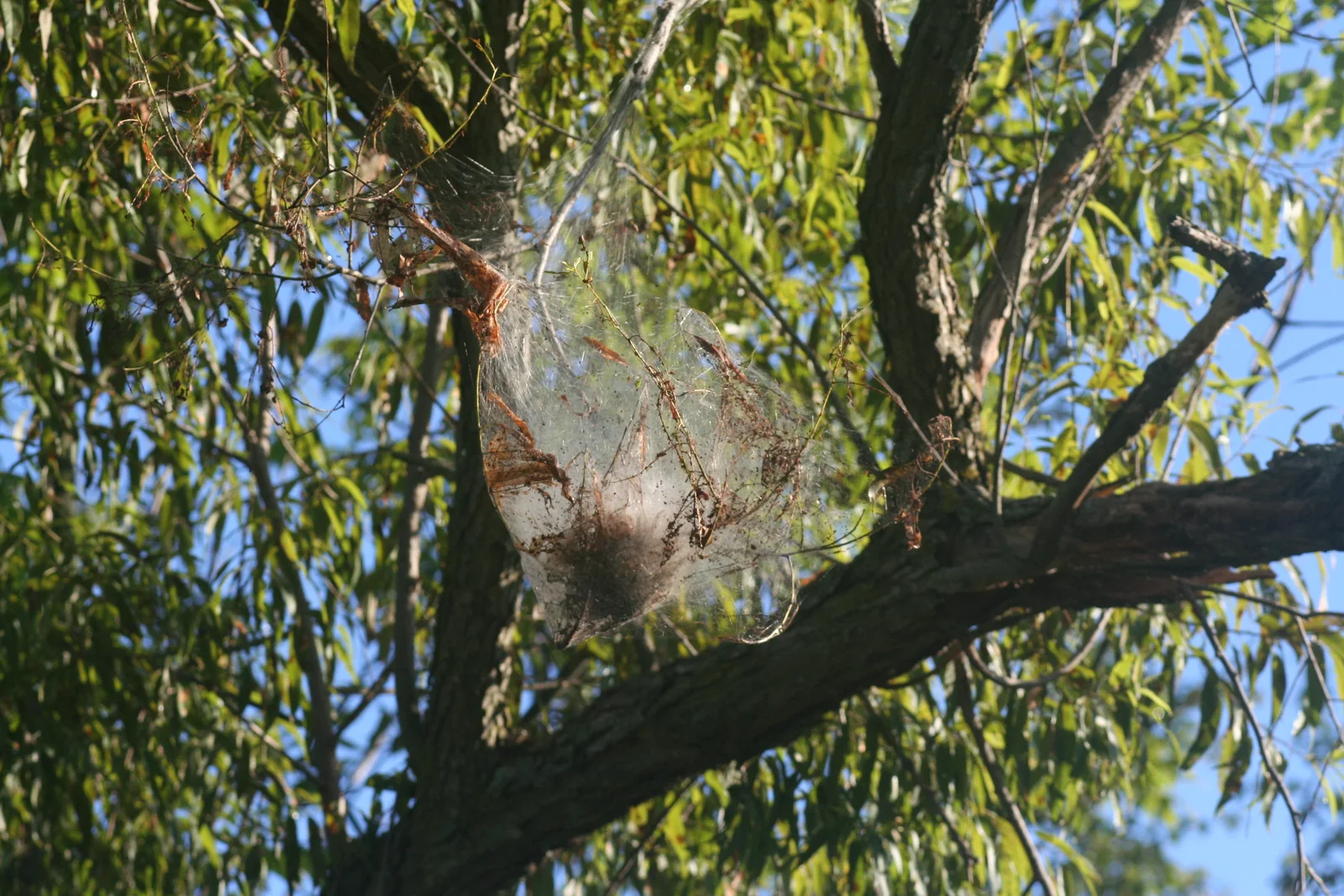
Position is more dependable than neatness. Rain, wind, age, and the shape of a branch can pull any silk shelter into an odd outline. Follow the twigs through the web instead of judging only its overall shape. Leaves captured inside the structure are a strong fall webworm mark.
That pattern also separates the colony from an ordinary spider web. A spider may stretch silk between twigs, sometimes across a surprising distance. A vertical orb web with a white zigzag is an open wheel across a gap. The fall webworm pattern is a feeding group expanding a shared shelter around foliage, with eaten leaves and caterpillars inside.
Let the season confirm the branch clue
Season supplies the second strong mark. Eastern tent caterpillars are active in spring as leaves open. Their branch-fork tents can become conspicuous in May and June. By late summer, those spring colonies are no longer building fresh tents.
These branch-end colonies become noticeable later. Timing varies by latitude and yearly weather, but extension records place the familiar webs from midsummer into fall. The insect’s common name works as a seasonal hint, though a web may appear well before the first autumn leaf color.
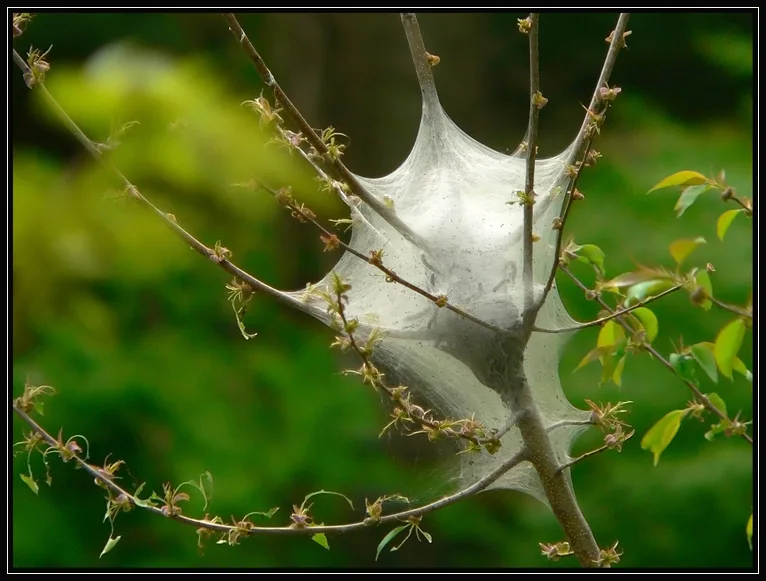
Place and time reinforce each other. An outer web in August carries two fall webworm clues. A fork tent in May carries two eastern tent caterpillar clues. When season and position disagree, widen the photograph and keep the identification open.
Read what the silk has enclosed
A fall webworm web is both shelter and feeding record. Newly hatched caterpillars begin around a small patch of foliage. As they grow and use those leaves, the group spins farther along the branch and brings another cluster of leaves inside.
Follow the web’s edge and the strange strategy becomes visible. Fall webworms carry their dining room outward by wrapping each new set of leaves into the web. The result may start as a small veil and become a gray-white chamber around much of a branch tip. Older sections can hold leaf fragments, dark droppings, shed material, and the outlines of veins left after feeding.
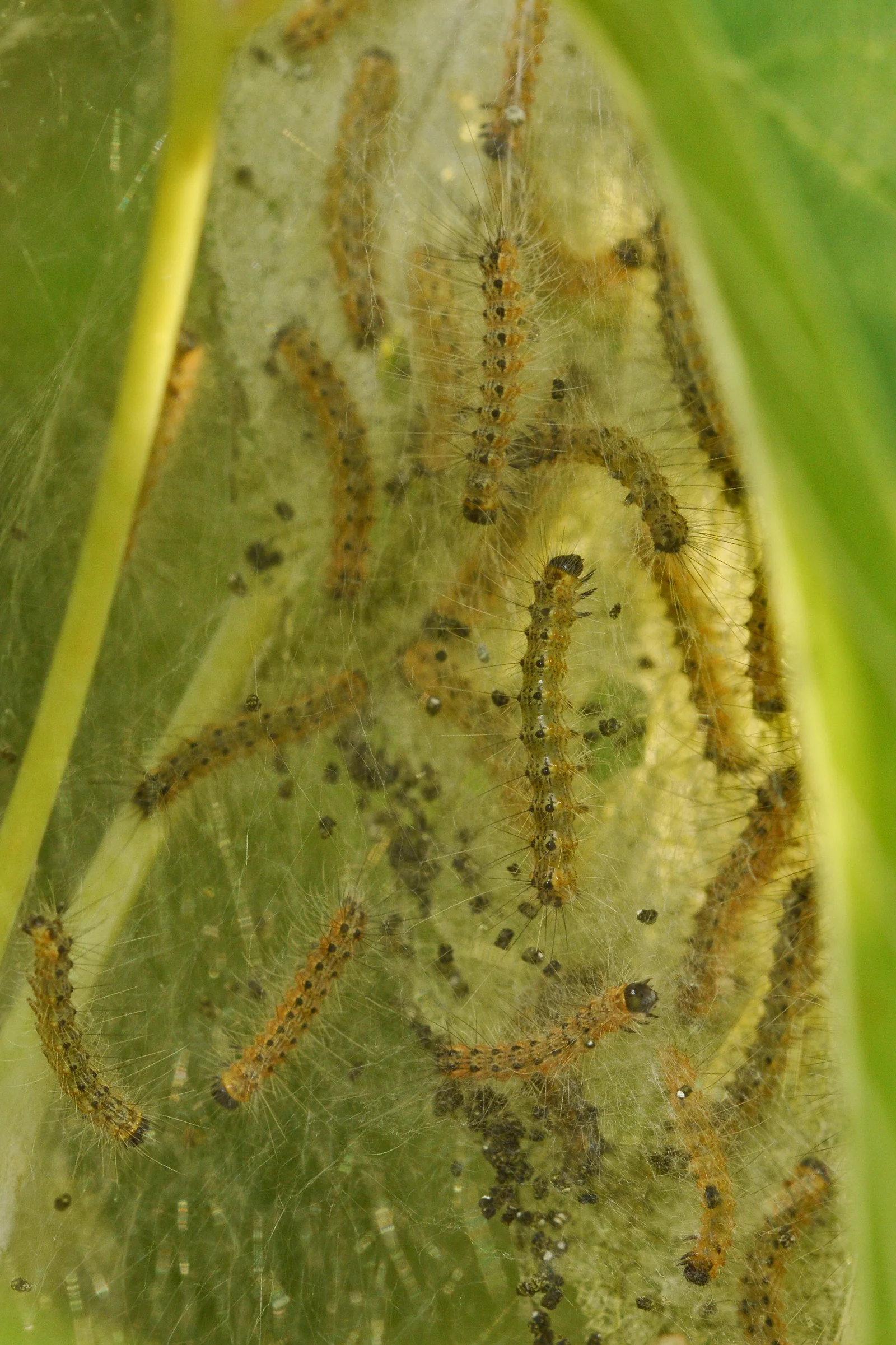
Look through the silk rather than treating it as a blank surface. Young larvae can leave a thin windowpane effect between major leaf veins. Larger larvae remove broader portions of the leaf. A sequence of dated photographs can show the boundary moving as new foliage joins the enclosed space.
Use caterpillar markings as supporting evidence
The larvae do not arrive in one tidy color. University extension descriptions range from pale green and yellow to gray or darker forms. Heads may appear red or black. Long pale hairs rise from small bumps, and two rows of dark spots often run along the back.
Eastern tent caterpillars have a different repeated mark: a pale solid stripe down the middle of the back, surrounded by blue, black, yellow, or orange patterning. That stripe can support an identification when the animal is clearly photographed.
Color alone remains a weak starting point. Light passing through silk changes yellow, tan, and green. Phone cameras shift contrast. Several hairy caterpillars occupy trees in the same season. A black-and-orange woolly bear belongs to the same tiger moth group as the fall webworm, yet it travels alone across paths in autumn and builds no shared web. Let the web’s address and the calendar lead, then use body markings as confirmation.
A clear photo series helps. Begin with the whole tree or canopy edge. Frame the web and its nearest branch junction. Add a closer image that shows whether leaves continue through the silk. If caterpillars are visible, record several individuals rather than one partly hidden body.
The same calm routine works for other tree mysteries. How to Observe Bugs Safely with Kids builds an identification from distance, patience, and photographs. Bumps on Leaves: Plant Galls uses placement and plant structure to read a very different kind of clue.
Name the tree without making it the only answer
Their host list crosses many deciduous trees and shrubs. Extension sources include ash, elm, oak, willow, walnut, birch, cherry, cottonwood, and others. A web on Green Ash, Cedar Elm, or Willow Oak fits that broad range.
Tree identity adds context, but it does not replace the web clues. The same colony structure can appear across many hosts, and no single tree name proves which caterpillar made a web. Photograph leaves, twig arrangement, bark, and the wider branching pattern when the host itself is uncertain.
The web also belongs to more than the caterpillars. University sources describe birds, spiders, predatory insects, and parasitoid wasps and flies among the animals connected to these colonies. What looks sealed from a distance is part of a busy set of relationships, with silk offering shelter while other hunters search its edges.
A photograph can identify the likely web maker, but it cannot describe the full condition of the tree. Tree size, age, vigor, weather, and the number of colonies all matter. A local extension office or qualified arborist can evaluate a specific tree when that larger question remains.
Make a two-clue field record
Write the evidence in plain terms: outer branch or inner fork, late summer or spring, leaves enclosed or web standing apart from the feeding area. Add the date and tree name when known. Those details will outlast a guess based on one flash of caterpillar color.
Return from the same viewpoint several days later. The web may have crossed another twig, enclosed greener leaves, or faded toward gray. A single silver chamber becomes a timeline, recording where a small group has moved through the canopy.
From below, the web first reads as an interruption in the tree. Look longer and it becomes a map. Silk marks the branch tip, leaf veins mark past meals, and the season narrows the maker. The mystery is large enough to catch the eye, yet its best answer begins with two small observations: place and time.
Sources
- Penn State Extension: Fall Webworm Accessed 2026-08-04
- Penn State Extension: Eastern Tent Caterpillar Accessed 2026-08-04
- University of Minnesota Extension: Caterpillars on Ornamental Plants Accessed 2026-08-04
- University of Connecticut Home and Garden Education Center: Fall Webworm Accessed 2026-08-04
- University of New Hampshire Extension: Fall Webworm and Eastern Tent Caterpillar Accessed 2026-08-04
- Iowa State University Extension: Fall Webworm Accessed 2026-08-04
Image credits
- Top image Courtney Celley / U.S. Fish and Wildlife Service · Public domain
- After the placement comparison Alison Hunter · CC BY-SA 2.5
- After the inside-the-web section Ryan Hodnett · CC BY-SA 4.0
- After the seasonal comparison Greg Hume · CC BY 2.5
More Field Notes
 Praying Mantis Egg Case: How to Identify an Ootheca on a Twig
  Why Pine Cones Open When Dry and Close When Wet
  Black and Orange Fuzzy Caterpillar: Woolly Bear ID Guide
Read it. Then go find it.
Open Leafari on your next walk and see what has been waiting in plain sight.