
Big Yellow-and-Black Spider in a Zigzag Web: ID Guide
Read a large garden spider's vertical orb web, white zigzag, body pattern, season, and location before comparing writing, Joro, and banded garden spiders.

At a glance
What is the big yellow-and-black spider in my garden web?
A large spider with a black-and-yellow abdomen, sitting head-down in a vertical wheel-shaped web with a white zigzag, is often an adult female yellow garden spider (Argiope aurantia), also called a writing or zipper spider. Color alone is not enough: compare the body, web, season, and location with banded garden, Joro, and golden-silk orb-weavers. Observe an unidentified spider and any egg sac from a distance.
Morning light finds the silk first. Fine spokes brighten between two tall stems. A sticky spiral rounds the center, almost too thin to see, while one thick white line folds back and forth like chalk marks on glass. Only then does the spider come into focus, resting head-down where the threads meet.
That combination is a strong yellow garden spider clue. An adult female Argiope aurantia has a bold black-and-yellow abdomen, a silvery front body, long legs, and a habit of waiting at the hub of a large vertical orb web. The white zigzag is called a stabilimentum. It inspired names such as writing spider and zipper spider.
A reliable name should come from several agreeing details. Color begins the search, but web shape, posture, body pattern, season, location, and photographs finish it.
Read the web as a diagram
An orb web is the familiar wheel-shaped kind. Dry radial threads run outward like bicycle spokes. A spiral of adhesive silk crosses them and catches flying insects. Near the middle sits the hub, where the spider can read vibrations passing through the structure.
Yellow garden spiders usually place the wheel upright between grasses, weeds, garden plants, or other supports in a sunny open place. Penn State Extension reports that webs 50 to 100 centimeters across are not unusual. The adult female often waits in the center with her head toward the ground.
Then there is the white zigzag. It is bright, thick, and visually louder than the nearly transparent capture spiral around it. Its exact job remains unsettled. Researchers have tested ideas involving prey, camouflage, and making the web more visible to animals that might fly through it, but no single explanation closes the question.
The boldest line in a writing spider’s web is still the part scientists cannot fully explain.
Architecture also rules out a very different silk mystery. Large webs in trees may be caterpillar shelters wrapped around leaves at branch tips. A yellow garden spider’s web is an open wheel stretched across a gap. Leaves may frame it, but they are not sealed inside a communal silk room.
Turn one photograph into four clues
Begin with the whole scene. A wide frame can preserve the vertical wheel, the central white band, the web’s height, and the plants that hold its outer lines. That context may be more useful than a close picture of yellow and black alone.
Next, look at the body through the camera. Adult females are the large, conspicuous form most people notice. Penn State gives a body length of 19 to 28 millimeters, roughly three-quarters of an inch to a little over an inch, before the legs are counted. Males are far smaller and lighter, so a tiny brownish spider near the same web may belong to the same species.
On the female, the front body looks silver-white. The abdomen is an elongated oval with a black-and-yellow pattern, not a simple set of even stripes. Leg color shifts from warmer yellow or reddish sections close to the body toward black farther out. A clear dorsal photograph, a view of the underside when it is naturally visible, and a wide web frame together preserve much more evidence than one silhouette.
Web structure supplies behavior too. A spider at the hub responds to vibrations rather than chasing across the garden. NC State Extension notes that females renew the sticky portion of the web, often consuming old silk before replacing it. What looks still at noon is a structure that is sensed, repaired, and rebuilt.
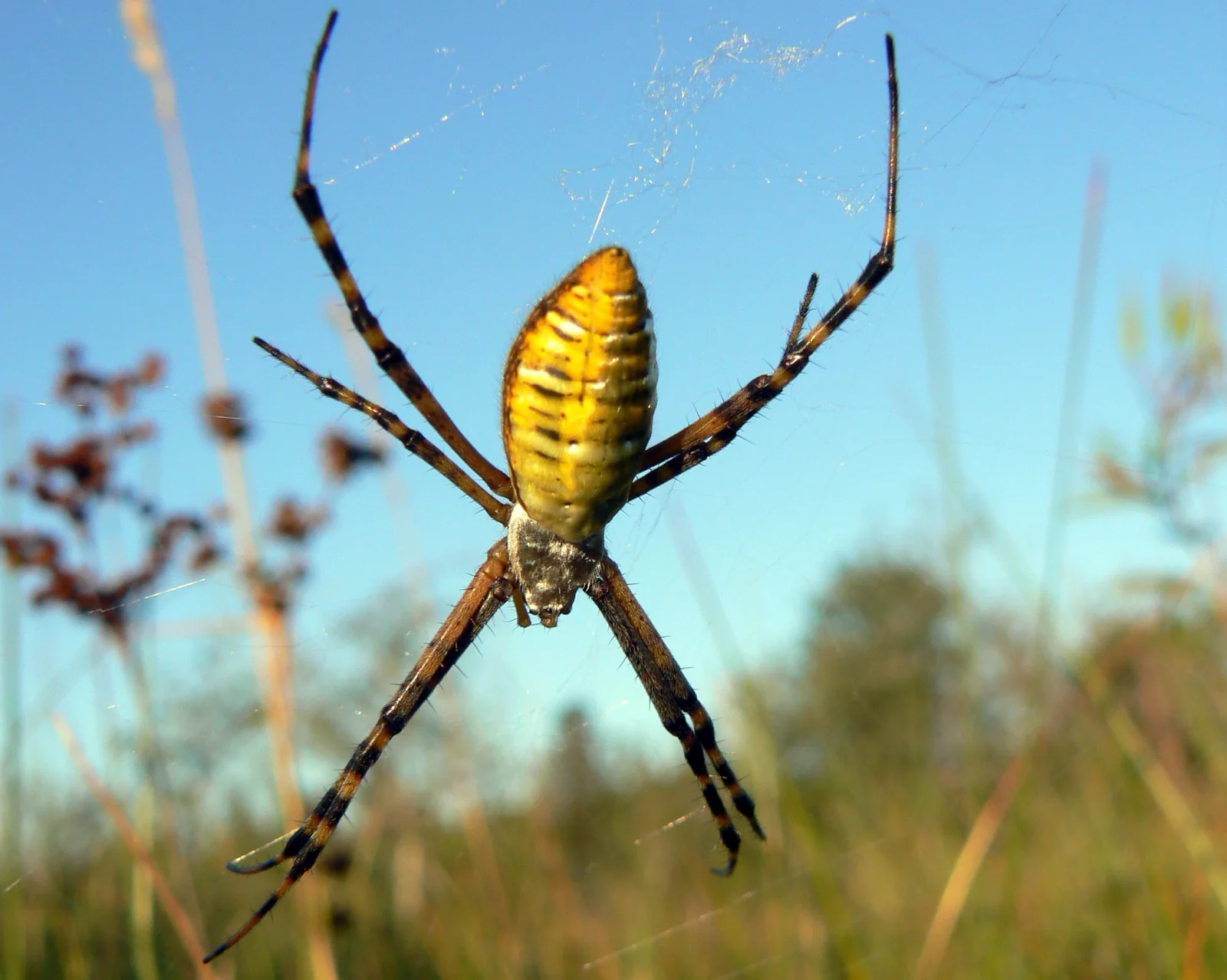
Banded garden spider: look for many narrow stripes
The banded garden spider, Argiope trifasciata, can occupy similar open places and build a similar orb. It may also add a stabilimentum, though Penn State notes that the white band can be absent or vary in shape. A zigzag therefore points toward Argiope, but it does not settle the species by itself.
Body pattern carries the cleaner comparison. A female banded garden spider usually has a long pale yellow or silver abdomen crossed by numerous narrow black bands. Yellow garden spiders show larger, blockier yellow areas against black. Both can have silvery hair over the front body, both can hang head-down, and both mature late in the season.
Joro spider: check body shape, legs, silk, and geography
An adult female Joro spider, Trichonephila clavata, also combines yellow, dark markings, long legs, and a large orb web. That resemblance explains many worried identification requests. The differences appear when the full animal and web are visible.
Joro females have a more cylindrical abdomen patterned in bright yellow and blue-gray bands, with a strong red mark on the underside. Their black legs carry clear yellow bands. The web can look golden and broad rather than like one flat garden wheel. Penn State’s current comparison also notes that adult Joro spiders do not make the conspicuous stabilimentum typical of many Argiope webs.
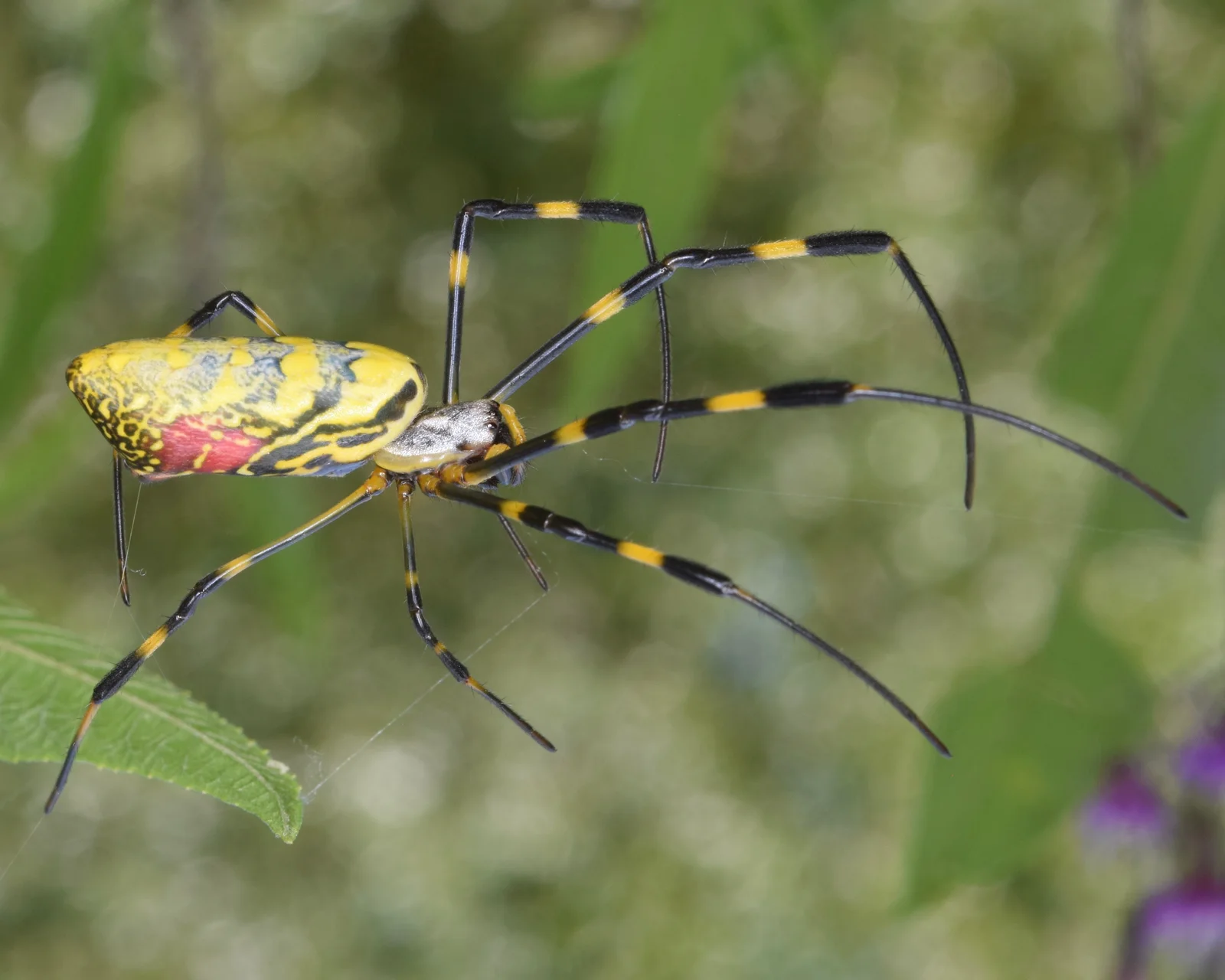
Geography is supporting evidence, not a substitute for field marks. Joro records are changing as the introduced population expands, so a current extension map is more dependable than an old social post or remembered state list. A yellow-and-black spider well outside a known Joro area should not receive that name from color alone. One inside the mapped area still needs the body and web comparison.
Golden-silk orb-weaver: find the warm colors and leg brushes
The golden-silk orb-weaver, Trichonephila clavipes, is another large relative in the southeastern United States and American tropics. Its web can shine gold. The adult female has a warmer orange to tan abdomen with pale yellow or white spots instead of the yellow garden spider’s hard black-and-yellow blocks.
Several leg pairs offer an especially useful close clue. Dark brush-like tufts appear like narrow cuffs around the joints. Yellow garden spiders and Joro spiders lack those conspicuous brushes.
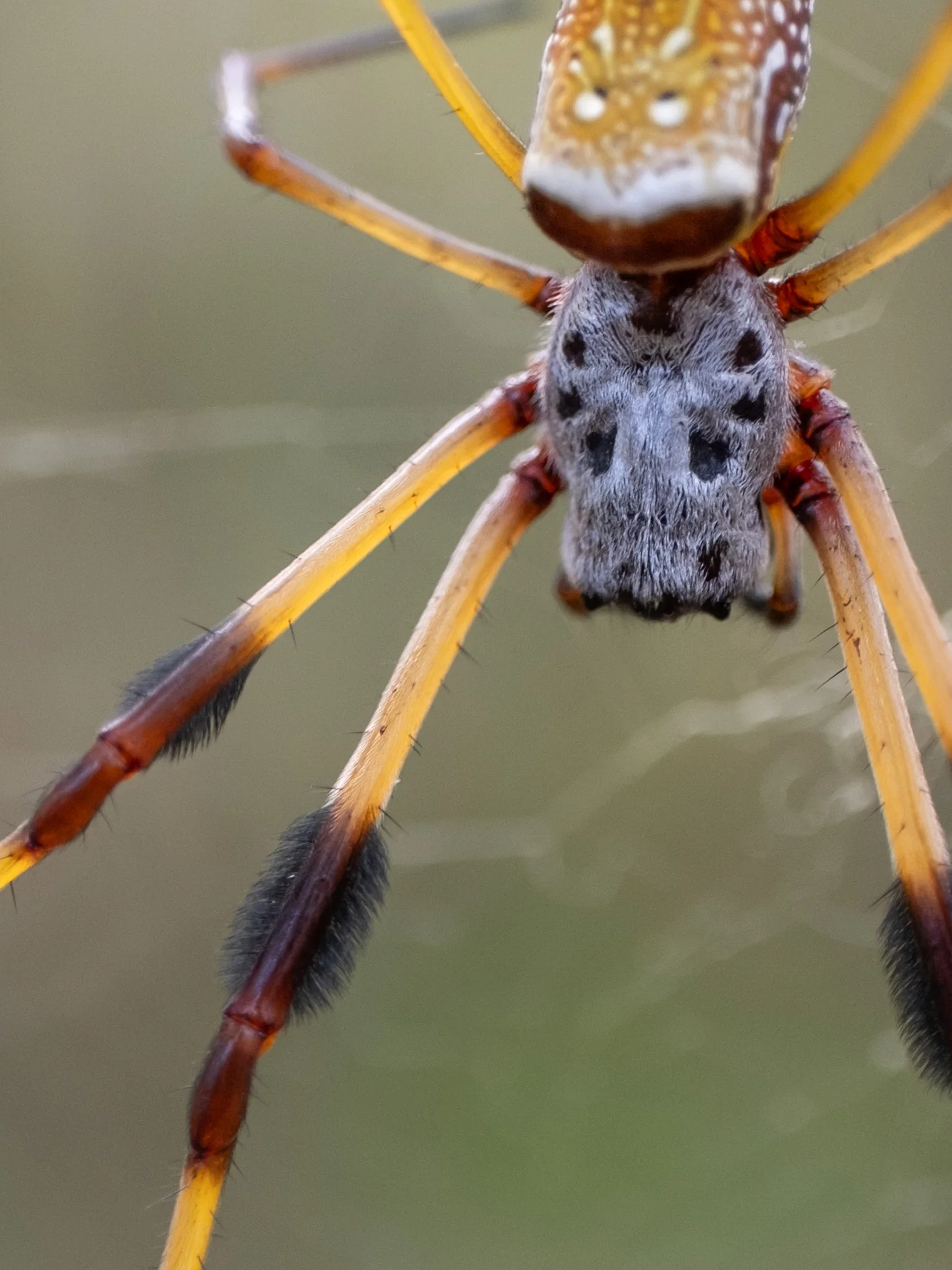
A photograph can overstate web color. Warm sun, shade, and camera processing shift clear silk toward gold. Record the animal’s abdomen and legs along with the web instead of asking silk color to carry the whole identification.
The web records the season
Yellow garden spiders become conspicuous as females mature in late summer. Illinois Department of Natural Resources places mature females from August through September in that state. Farther south, the visible season can stretch, but late summer and early fall remain the classic window across much of North America.
This timing explains why a large spider can seem newly present even when smaller stages passed unnoticed. Growth changes the scale of both animal and web. Stems that once held a small circle of silk now support a wheel broad enough to cross a path between plants.
After mating, a female may place a brown, papery, round or pear-shaped egg sac on vegetation near the web. Hundreds of eggs can be enclosed inside. The young hatch within the protected sac and remain there through winter in colder parts of the range, emerging the following spring. A photograph of the sac beside the web can connect two seasons without opening or moving anything.
Surrounding plants help place the scene, but they rarely identify the spider. Tall grass, weeds, and garden stems provide anchor points. Flying insects supply prey. The important relationship is architectural: open vegetation makes room for a vertical wheel and puts that wheel across insect flight paths.
What a confirmed name can and cannot say about risk
Penn State Extension describes Argiope aurantia as not known to be medically important. NC State Extension describes the species as not aggressive toward people. Those statements belong to a source-confirmed yellow garden spider. They are not a broad promise about every large spider with yellow marks, every photograph, or every person’s response.
That boundary keeps the identification honest. If the body pattern, web, season, and region do not agree, leave the name open. The useful outcome can be “large orb-weaver in a vertical web” while clearer evidence is gathered. This guide stays with visual identification and natural history, not contact, removal, control, or medical decisions.
Make a field record that preserves the web
A careful photo sequence begins several steps back. Frame the entire wheel and its anchor points. Move the camera, not the web, until the white zigzag catches the light. Record the spider’s back if visible, then the underside from another unobstructed angle. Add one wider image that shows whether the web is vertical, horizontal, flat, or layered.
Note the date, general region, time of day, and habitat. If an egg sac is visible, include its shape and position in the wide frame. If a second small spider is nearby, preserve the size difference rather than assuming it is a young version of the female.
Our family guide to observing bugs offers the same no-contact photo rhythm: pause, frame, describe, and leave the scene working. A web is both evidence and habitat. Keeping it intact preserves the details that make a later identification possible.
In the next slant of light, the capture spiral may disappear again. The white writing remains, bright and unresolved, with the spider waiting at its center and a season held between the stems.
Sources
- Penn State Extension: Yellow Garden Spider Accessed 2026-09-08
- NC State Extension: Black and Yellow Garden Spider Accessed 2026-09-08
- University of Arkansas Arthropod Museum: Yellow Garden Spider Accessed 2026-09-08
- Illinois Department of Natural Resources: Black-and-Yellow Garden Spider Accessed 2026-09-08
- Penn State Extension: Banded Garden Spider Accessed 2026-09-08
- Penn State Extension: Joro Spiders Accessed 2026-09-08
- NC State Extension: Similar but Different: These Are NOT Joro Spiders Accessed 2026-09-08
- U.S. Fish and Wildlife Service: Yellow Garden Spider Accessed 2026-09-08
Image credits
- Top image Deisy Mendoza / Hmendoza356 · CC BY 3.0
- In the banded garden spider comparison Benny Mazur · CC BY 2.0
- In the Joro spider comparison Christina Butler · CC BY 2.0
- In the golden-silk orb-weaver comparison Alex Abair · CC BY 4.0
More Field Notes
 Praying Mantis Egg Case: How to Identify an Ootheca on a Twig
  Why Pine Cones Open When Dry and Close When Wet
  Black and Orange Fuzzy Caterpillar: Woolly Bear ID Guide
Read it. Then go find it.
Open Leafari on your next walk and see what has been waiting in plain sight.