
Blue Wildflowers in Summer: A Family Field Guide
Blue and blue-purple summer wildflowers become easier to name when you compare stars, spikes, petals, leaves, setting, and bloom timing instead of trusting color alone.

At a glance
Which blue wildflowers bloom in summer?
Blue flag and Virginia spiderwort can carry blue-purple color from late spring into summer. American bellflower adds flat five-pointed flowers from midsummer into early fall, while blue vervain raises narrow flower spikes in mid to late summer. Check shape, leaves, setting, and local bloom time together.
A patch of blue beside a summer path can change color while you are still looking at it. Sun brings out violet. Shade cools the same petals toward blue. A phone camera makes its own decision. For a moment, the flower seems to be moving between color names.
Useful clues stay put. Count the main flower parts. Notice whether the leaves are broad, narrow, or sword-shaped. Read the setting as wet ground, an open woodland edge, or a shaded garden bed. Then compare one low bloom with a line of bells on a tall stalk.
Blue starts the question; flower form, leaves, setting, and season build the answer.
What to notice before naming the flower
First, look at the flower’s architecture. A blue flag iris has six showy parts arranged in two groups, with three spreading or drooping outer parts and three more upright ones. Virginia spiderwort has a much simpler face: three broad petals around six yellow stamens. A hosta flower is a bell or narrow trumpet carried on a stalk above the leaves. A hydrangea gathers many small flowers into a rounded or flat-topped head.
Second, read the leaves. Blue flag leaves are long, narrow, and sword-shaped. Spiderwort leaves are narrow too, but they fold along the middle and gather around softer stems. Hostas make broad, ribbed leaves near the ground. Bigleaf hydrangea is a woody shrub with broad leaves growing in pairs.
Third, step back. A flower growing beside standing water is telling a different story from one under a porch window. Setting does not settle an identification by itself, but it can quickly expose a poor guess.
Fourth, add time. Bloom calendars are local, not mechanical. The same species can open earlier in a warm region and later in a cool one. A date is a clue to compare with the flower and the place, never a substitute for them.
Four shapes make a useful summer shortlist. Blue flag has the layered structure of an iris. Virginia spiderwort shows three broad petals around yellow stamens. American bellflower opens into a flat five-pointed star. Blue vervain lifts many tiny flowers on narrow branching spikes. The color names overlap, but the architecture does not.
Blue flag: the wet-edge signal
Blue flag is a flower of marshes, wet meadows, shorelines, and pond edges. Its leaves rise in upright fans, and its large flowers carry purple veining and yellow-white marks on the outer parts. Those marks are often easier to trust than the blue-purple color itself.
NC State Extension places its main bloom in late spring to early summer. Farther north or in a cool season, a family may still meet late flowers after that window. By midsummer, the leaves and wet setting may remain even when the brightest display has passed.
That makes blue flag useful for learning how absence can become a clue. If a wet edge holds strong fans of sword-like leaves but few flowers, the season may be moving ahead of the bloom. If the flower is present, compare the drooping outer parts, the upright inner parts, and the pale signal patch together.
A closer Blue Flag Species Showcase explores the plant’s field marks and wetland setting.
Virginia spiderwort: three petals for one morning
Virginia spiderwort often grows in open woods, shaded slopes, and moist edges. Its flowers are blue to violet, with three rounded petals and a center of yellow stamens. Long, narrow leaves fold into a shallow groove, making the plant look grassy from a distance.
One flower carries summer’s best small surprise. NC State Extension notes that the blooms open in the morning and close in the afternoon. Missouri Botanical Garden describes each flower as lasting only one day, while a cluster continues by opening fresh buds in succession. The plant can seem full of blue faces one morning and quieter by late day.
That rhythm suggests a simple repeat visit. Photograph the same patch once in the morning and once later. The leaves, stems, and unopened buds may make the match clearer even as individual flowers change.
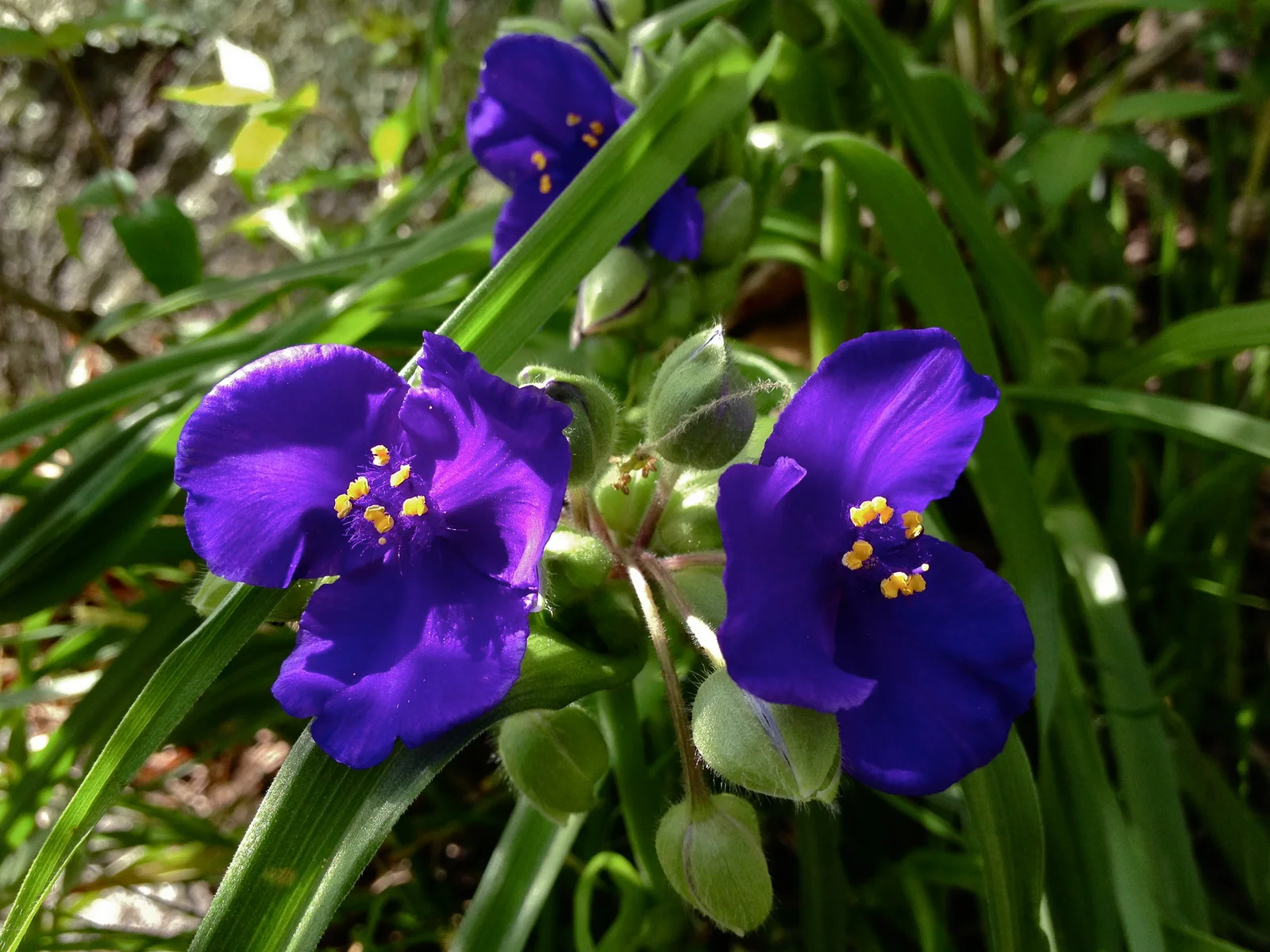
Visit the Virginia Spiderwort Species Showcase for its range, ecology, and one-day flowers.
American bellflower: a star, not a bell
American bellflower can rise two to six feet through moist open woods, streambanks, and shady ditch edges. Its name sets a small trap for the imagination. Instead of hanging like a bell, the violet-blue flower opens almost flat. Five pointed lobes spread around a pale center, and a long curved style reaches outward.
NC State Extension places those flowers from midsummer into early fall. Look along the upper stem as well as at one bloom. Flowers can appear alone or in small clusters where the leaves meet the stem, giving the plant a loose ladder of blue stars rather than one dense flower head.
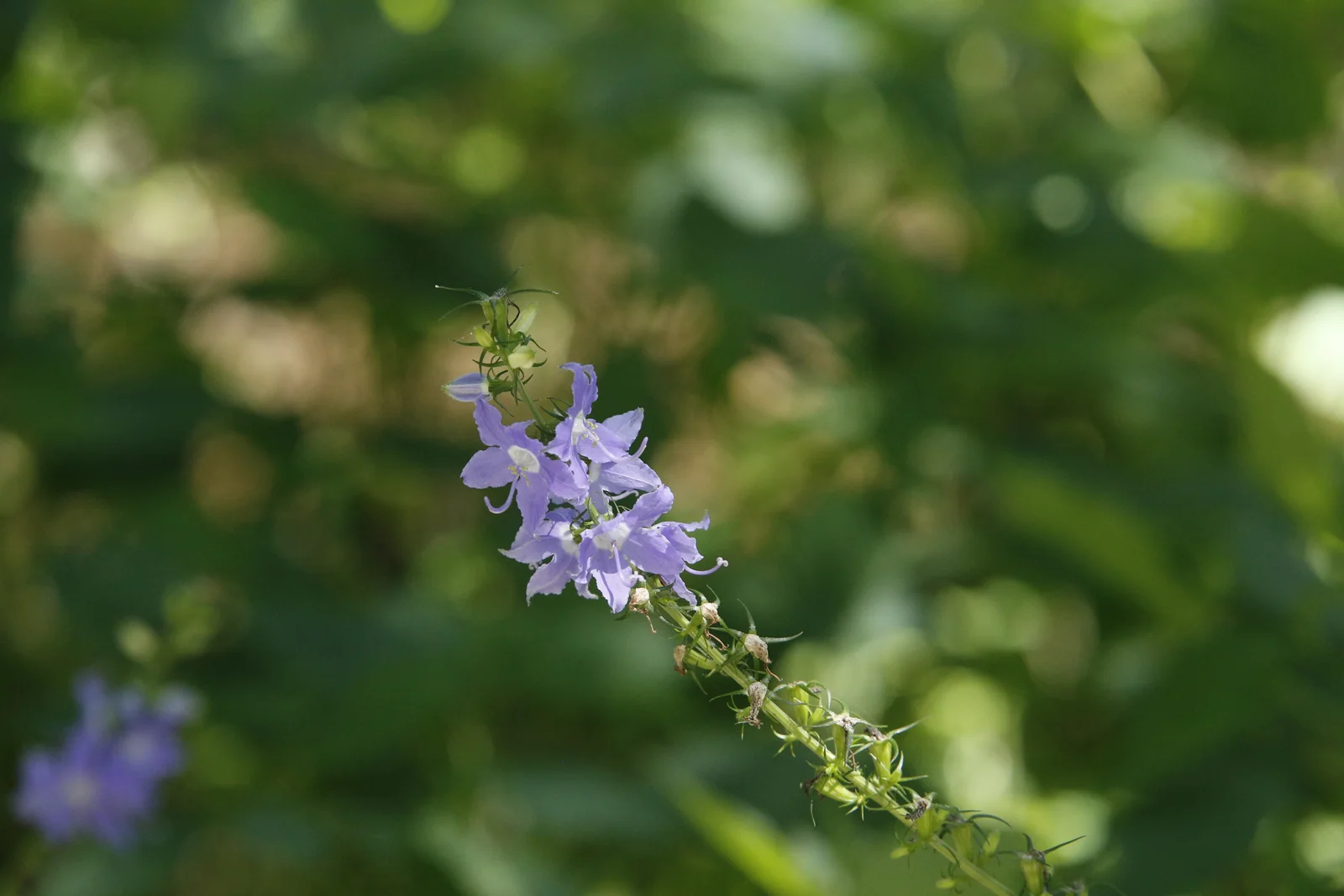
The star shape is the first clue, not the whole answer. Include the long stem, the leaves, and the moist shaded setting in a photograph. A flower portrait alone can make a tall woodland plant look like a low garden bloom.
Blue vervain: small flowers on tall spikes
Later in summer, blue vervain changes the scale again. From a distance, it may look like a thin purple candelabra standing in a moist meadow, marsh edge, riverside, or ditch. Up close, each pencil-like spike carries many tiny tubular flowers, with only a few open at once as the bloom moves upward.
The USDA Natural Resources Conservation Service and NC State Extension describe blue vervain as a native perennial of moist ground that blooms in mid to late summer. Paired, toothed, lance-shaped leaves climb its square stem. Those leaves matter because the blue-purple flowers are much smaller than the iris, spiderwort, or bellflower blooms elsewhere in this guide.
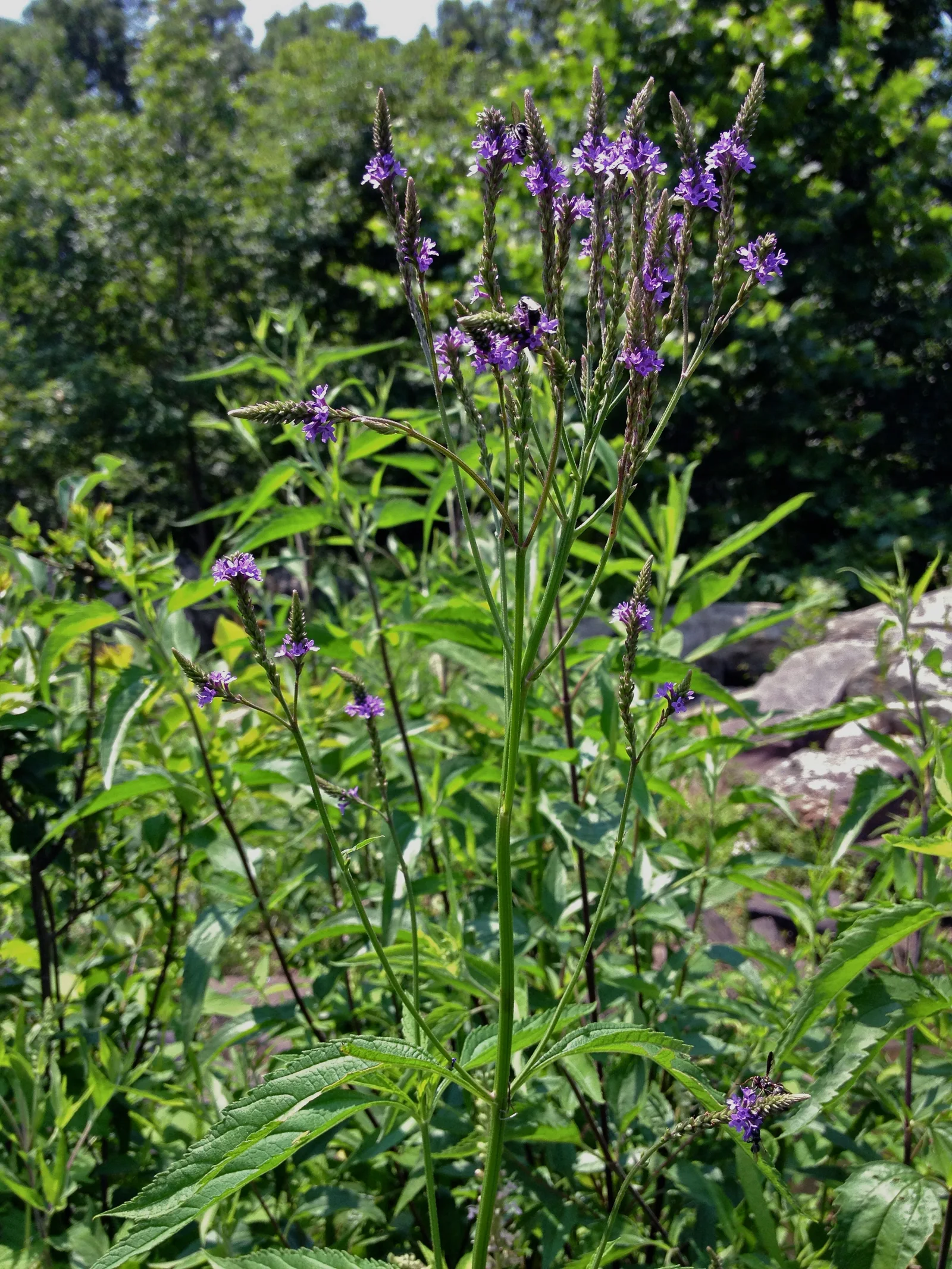
This is a good plant for practicing the whole-plant photograph. One close bloom barely shows the branching pattern. Step back far enough to include several spikes and the opposite leaf pairs, then make one closer image of the small flowers.
When the blue flower belongs to a garden
Paths do not respect editorial categories. A walk can pass a wetland plant, a planted border, and a shrub leaning through a fence in the same ten minutes. Before calling every blue bloom a wildflower, ask whether the plant’s shape suggests a garden neighbor.
In a shaded planting, blue plantain lily makes a broad mound of ribbed leaves. Its summer flower stalk rises above that mound and carries lavender bells. From far away, the bells may read as a loose blue haze. Up close, the broad basal leaves and straight stalk separate it from three-petaled spiderwort and iris-shaped blue flag.
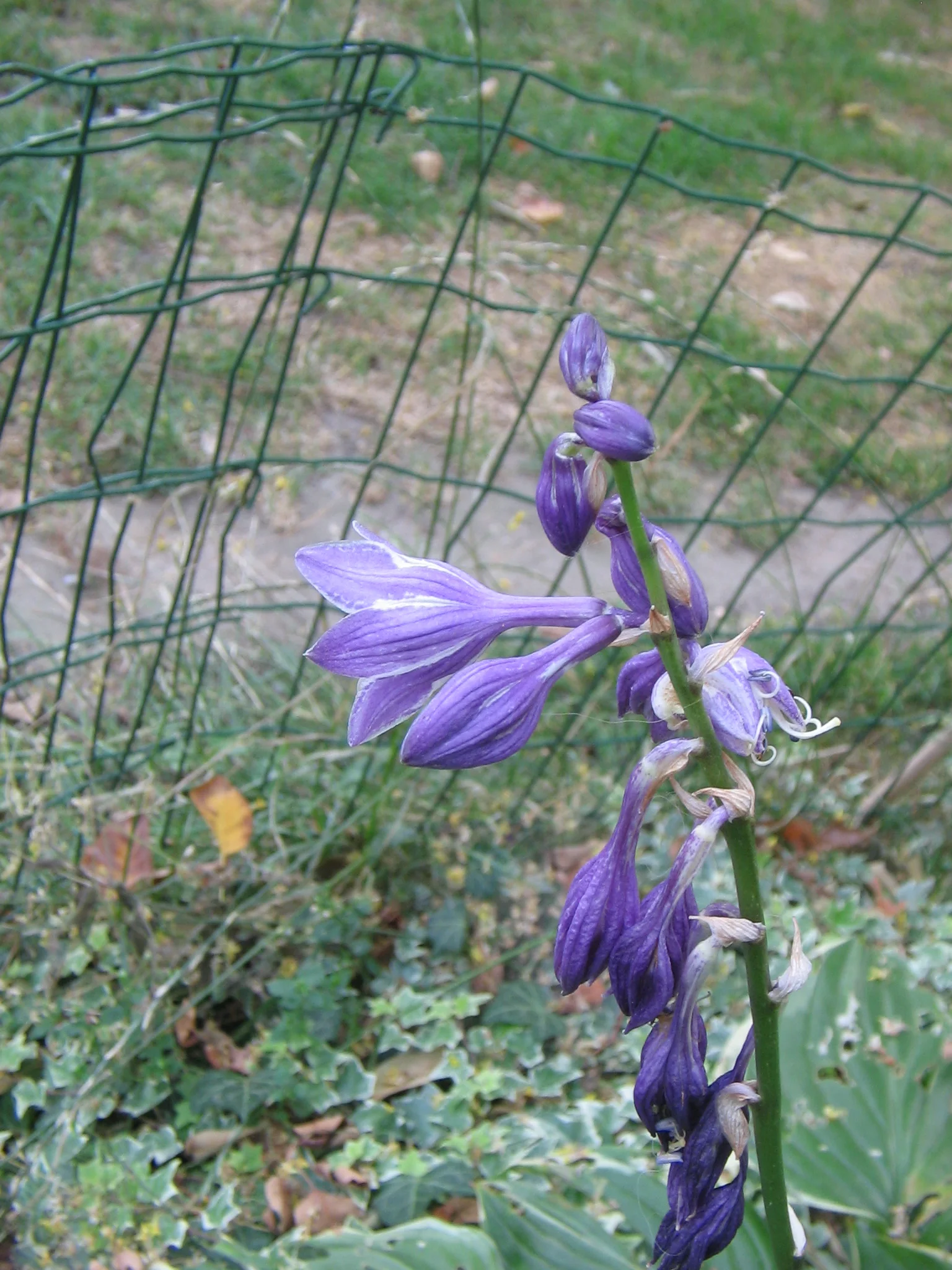
See the Blue Plantain Lily Species Showcase for the full plant form.
Bigleaf hydrangea is different again. It is a woody shrub, not a low herb. Its flowers gather into mophead balls or flatter lacecap clusters, and the broad leaves grow in pairs. Some forms shift among pink, purple, and blue as plant variety and root-zone chemistry interact. That wider color story belongs in the hydrangea color guide, while the Bigleaf Hydrangea Species Showcase shows the shrub as a whole.
Garden context does not make a flower less worth noticing. It changes the questions. Who planted it? Does the same species appear beyond the bed? Which insects visit the smaller flowers? A useful field note records the setting before assigning a story to the plant.
Make a picture set, not one perfect picture
One close flower portrait can hide every clue that matters. A stronger observation uses a short sequence.
Start with the whole plant in its setting. Include water, shade, path edge, fence, or garden border. Next, photograph the flower straight on so its parts can be counted. Then include the leaves and the way they meet the stem or ground. Finish with one side view that shows the flower stalk, branching, or shrub shape.
Write the color down twice. Try an ordinary word first, such as blue, violet, lavender, or purple. Then add a comparison: washed-sky blue, grape-skin violet, or blue with a yellow-white center. The second phrase is not a formal identification term. It is a memory aid that makes you look again.
If the answer remains uncertain, keep the temporary name. “Three-petal blue” or “wet-edge iris shape” preserves the observation without forcing a species name. A careful unknown can become useful later when another flower opens, fruit forms, or a regional field guide supplies the missing clue.
How the season changes the shortlist
Even the phrase “summer wildflower” sounds more precise than the season is. Summer moves across a continent in uneven steps. Elevation, latitude, rainfall, shade, and a particular year’s weather all influence what is open. Blue flag may be finishing as American bellflower opens. Spiderwort may hold a last cluster of buds while blue vervain begins moving bloom up its spikes and hydrangea heads keep expanding.
This is why a useful comparison guide should teach a method instead of promising one universal July list. Flower form narrows the possibilities. Leaves reveal the plant’s basic build. Setting adds habitat or garden context. Timing tests the match against the local season.
Return to the first blue patch with those four clues in mind. The color may still shift when a cloud crosses the sun. Now the rest of the plant stays legible: three petals, six iris parts, a five-pointed star, or a ladder of narrow spikes; wet edge, shaded woods, moist meadow, or garden bed. The blue has not become less beautiful. It has become more specific.
Sources
- NC State Extension: Iris versicolor Accessed 2026-07-21
- NC State Extension: Tradescantia virginiana Accessed 2026-07-21
- NC State Extension: Plantain Lily, Hosta Accessed 2026-07-21
- NC State Extension: Hydrangea macrophylla Accessed 2026-07-21
- Missouri Botanical Garden: Tradescantia virginiana Accessed 2026-07-21
- NC State Extension: American Tall Bellflower Accessed 2026-08-29
- NC State Extension: Blue Vervain Accessed 2026-08-29
- USDA NRCS: Blue Vervain Plant Fact Sheet Accessed 2026-08-29
Image credits
- Top image NasserHalaweh · CC BY-SA 4.0
- After the Virginia spiderwort section Fritzflohrreynolds · CC BY-SA 3.0
- After the garden-neighbor section Meneerke bloem · CC BY-SA 3.0
- After the American bellflower section Carol VanHook · CC BY-SA 2.0
- After the blue vervain section Fritzflohrreynolds · CC BY-SA 3.0
More Field Notes
 Praying Mantis Egg Case: How to Identify an Ootheca on a Twig
  Why Pine Cones Open When Dry and Close When Wet
  Black and Orange Fuzzy Caterpillar: Woolly Bear ID Guide
Read it. Then go find it.
Open Leafari on your next walk and see what has been waiting in plain sight.