
Why ants visit flowers
A peony bud with ants on it can look like a problem at first. Look closer and it becomes a small lesson in nectar, timing, and flower visitors.

At a glance
Why do ants visit flowers?
Ants visit many flowers because they find sugary nectar on buds, petals, or nearby plant parts. On peonies, the nectar is outside the flower bud, and the ants are visitors rather than bloom openers.
At first, the ant on a peony bud is easy to miss. The bud is still tight, green at the seams, with a faint shine where the outer scales meet. Then one dark speck moves. Another follows. Soon the bud has a tiny route system over it, as if the flower has become a hill with paths only the smallest travelers can read.
For many people, that scene starts with worry. A flower bud is supposed to become a flower. Ants arriving early can make it look as if something has gone wrong. The better question is quieter: what are they finding there?
On peonies, the answer is mostly sugar. The bud can produce nectar on the outside, before the flower opens. Those nectar spots are called extrafloral nectaries, which simply means nectar places outside the flower. The ants are not opening the peony. They are reading a reward the plant has placed where a small visitor can find it.
The difference matters. It turns the scene from a problem into a clue.
Why the peony myth lasts
Peonies have collected a persistent story: the buds need ants before they can open. It is a memorable idea, partly because it feels like a secret bargain. The plant waits. The ants arrive. The bloom follows.
Extension sources are plain about it. Peonies do not require ants to bloom. Iowa State Extension says the buds will open without ants, and University of Missouri IPM describes the ant-required story as a myth. The ants are drawn to sugary nectar on the bud. The flower’s opening is the plant’s own seasonal work.
The myth probably lasts because the timing is convincing. Ants often appear just when the bud is swelling and the garden is paying attention. A tight peony bud can look sealed, almost glued shut. Then, after days of ants moving across it, the petals unfurl. A human observer connects the two events. The link is real, but the job assigned to the ants is not.
A truer story is still interesting. The plant is not passive. It is offering nectar before the showy part of the flower has opened. That nectar can bring ants to the bud surface, where their presence may make the bud a less comfortable place for some other small flower visitors. University of Missouri describes the relationship as a kind of mutualism, a relationship in which both sides may benefit.
Nectar outside the flower
When we think of nectar, we often picture the center of an open blossom: petals spread, a bee or butterfly leaning in, pollen dusting the scene. But plants are more inventive than that. Some produce nectar away from the flower’s main reproductive parts. Those extrafloral nectaries can appear on stems, leaf stalks, buds, or other plant surfaces.
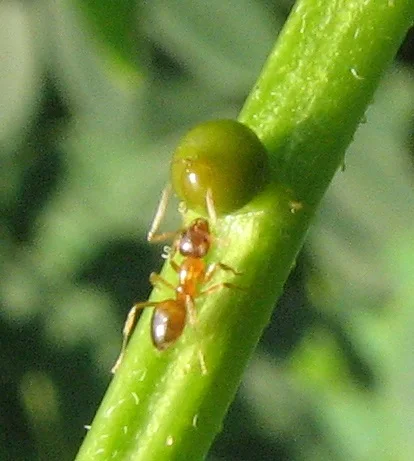
The term sounds technical, but the field idea is simple. A plant can place a sweet signal somewhere that is useful to the plant. Ants are good at finding small rewards. Once they find one, they may return again and again, mapping the plant with their feet.
Peony buds make the idea easy to see because the ants are out in the open. They are not tucked deep inside a trumpet-shaped flower. They are on the outside of a rounded bud, walking over the green surface and pausing where nectar collects. If you watch for a minute, the bud stops looking like a closed object. It becomes a little station, visited before the flower is ready for the rest of the garden to notice.
Every ant on every flower is not part of the same tidy arrangement. Some ants visit flowers for nectar and do little for the flower. The USDA Forest Service notes that ants are often seen on flowers, but they are usually not the main pollination story. They may carry pollen, but their bodies and habits do not make them the classic flower partners that bees, butterflies, moths, beetles, flies, and hummingbirds can be.
This correction helps in the field too. Flower visitors are not all doing the same work. A visitor can be looking for nectar. A visitor can move pollen. A visitor can shelter, rest, hunt, or pass through. One flower can be a dining room, a signal tower, a crossing, and a stage at different hours of the day.
What ants might be telling you
If ants are moving over flower buds, begin with the plant part they are visiting. Notice whether they are on unopened buds, open petals, stems, or leaves. Watch for pauses in one place or quick crossings through. Look for other flower visitors nearby. Check whether the buds look sticky or glossy, and whether the plant is in early bloom season, when tender new growth and nectar are especially noticeable.
On a peony, ants on the buds often point to extrafloral nectar. On another plant, the answer may be different. The best first move is not a conclusion. It is a careful look.
This is where a common garden scene becomes a field note. Instead of asking only whether ants are bad for the flowers, you can look for a fuller pattern: the part of the plant they visit, what changes after the flower opens, whether they return at the same time each day, and whether one plant draws traffic while another nearby does not.
Try this with a peony, a rose, a prairie rose, or another flowering shrub you can visit more than once. Watch from the side rather than hovering over the bud. Sketch the bud shape. Mark where the ants pause. Return after the petals open and see whether the traffic changes.
Slow comparison is more useful than a single answer. It helps you see the plant as a place rather than only a bloom. A flower is connected to weather, timing, sugar, structure, and the small lives moving across it.
A small relationship on a bud
There is something generous about this kind of observation because it does not ask the flower to be only beautiful. Beauty is still there. A peony opening after rain can stop a person in the path. But before the bloom, there is another story: a green bud producing nectar outside itself, ants finding that sweetness, and the garden briefly revealing a relationship that is usually too small to notice.
That same habit of looking can carry into other garden mysteries. Flowering quince opens early enough that its buds can become a useful place to watch spring visitors. Bigleaf hydrangea turns a different kind of garden question toward soil and chemistry. In each case, the visible part is only the beginning.
Ants on a flower bud are not a command to panic, and they are not proof of a magical partnership. They are a prompt. Something on that plant is worth a closer look. The next time you see a dark speck moving over a bud, pause for a few breaths. Follow the route with your eyes. Notice where the ant stops.
Tomorrow, the flower may open. The smaller story is already happening.
Sources
- University of Missouri IPM: Ants on Peony Flowers Accessed 2026-06-30
- Iowa State Extension Yard and Garden: Are ants necessary for peonies to flower? Accessed 2026-06-30
- Penn State Extension Master Gardener: Ants On Peonies Accessed 2026-06-30
- USDA Forest Service: Ant Pollination Accessed 2026-06-30
- Wikimedia Commons: Ants on a Peony Bud Accessed 2026-06-30
- Wikimedia Commons: Nylanderia flavipes extrafloral nectary Accessed 2026-06-30
Image credits
- Top image WalGreens2018 · CC BY 4.0
- After the nectar outside the flower section Beatriz Moisset · CC BY-SA 4.0
More Field Notes
 Praying Mantis Egg Case: How to Identify an Ootheca on a Twig
  Why Pine Cones Open When Dry and Close When Wet
  Black and Orange Fuzzy Caterpillar: Woolly Bear ID Guide
Read it. Then go find it.
Open Leafari on your next walk and see what has been waiting in plain sight.