
Zigzag Goldenrod
Solidago flexicaulis
A shade-tolerant woodland goldenrod with broad leaves, a bent stem, and late-season yellow flowers that feed a busy web of insects.
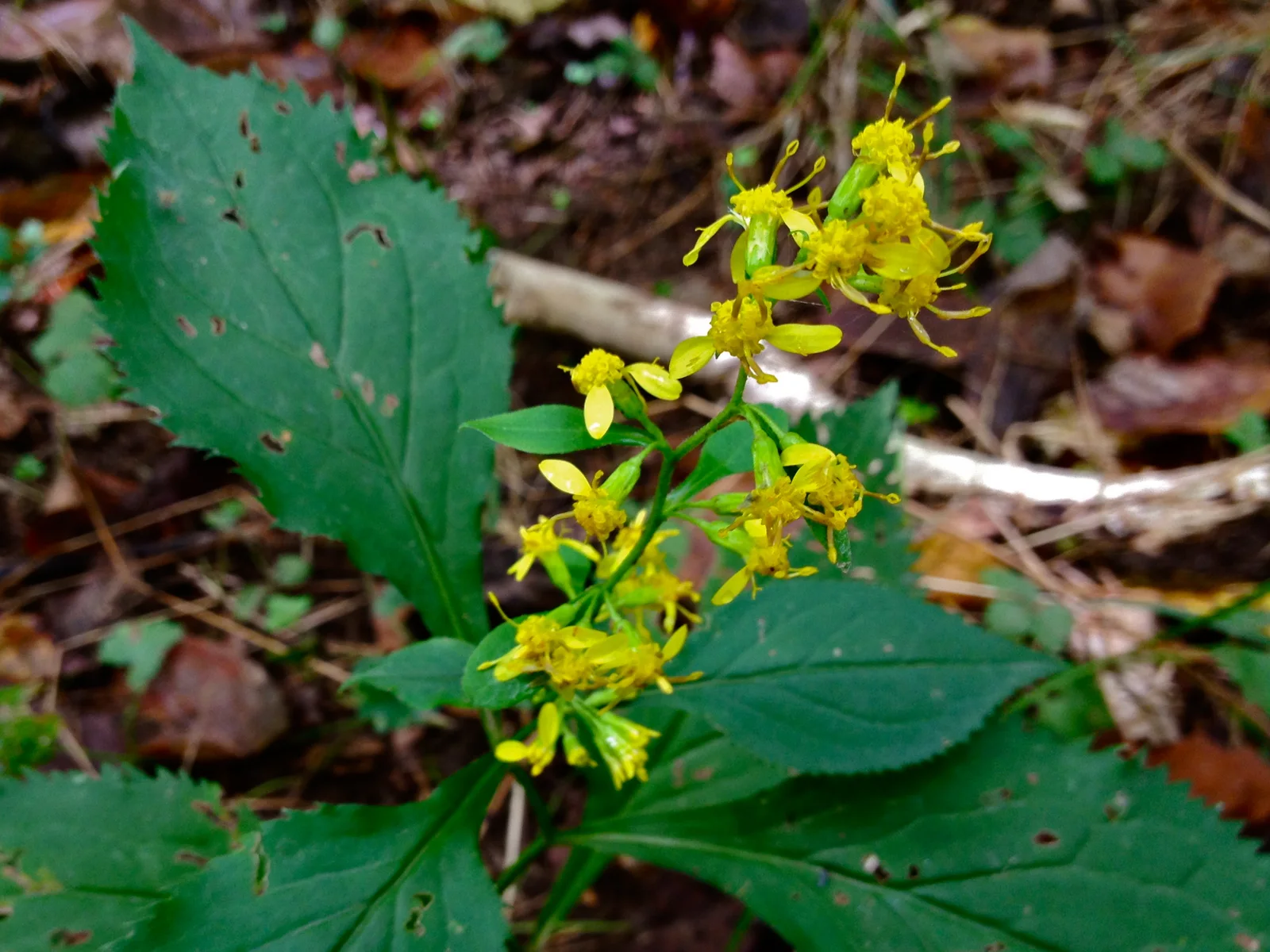
At a glance
- TypeHerbaceous perennial
- NativeEastern Canada to U.S.A.
- HeightAbout 1 to 3 feet
- BloomsYellow heads in late summer to fall
- LeavesBroad, toothed, alternate
- VisitorsBees, flies, wasps, butterflies
Where it grows in the wild
This is an eastern North American plant: Kew places its native range from eastern Canada to the United States, and Flora of North America records it from New Brunswick, Nova Scotia, Ontario, Prince Edward Island, Quebec, and many eastern and central U.S. states. The map uses Flora of North America's province/state distribution for the native overlay, plus reported GBIF observations and the privacy-safe community find.123
How to recognize it
Start with the habitat and leaves, then look for the bent stem and the upper flower clusters.
Broad toothed leaves
Lower and middle leaves are wider than many goldenrod leaves, with coarse teeth and a tapering base that can look slightly winged.
A stem with angles
The stem often changes direction from one leaf node to the next, especially in the upper half of the plant.
Small yellow heads
Flower heads gather at the top and in shorter clusters from upper leaf axils, rather than forming one large open plume.
Woodland setting
Look in shaded woods, thickets, woodland edges, and part-shade garden plantings with leaf litter and loamy soil.
Lookalikes & how to tell them apart
Goldenrods can blur together from a distance. Zigzag goldenrod becomes clearer when the broad leaves, shaded habitat, and axillary flower clusters all line up.
Blue-stemmed goldenrod
Bluish or purplish stem. This woodland species can grow in similar places, but its narrower leaves and bluish stem cast help separate it from the broader-leaved zigzag goldenrod.
Canada goldenrod
Tall sunny plumes. Often taller and more open-field in habit, with many narrow leaves and a larger arching plume of flowers.
Elm-leaved goldenrod
More open branched array. Another shade-tolerant species, but its flower array is usually more openly branched and the plant lacks the same strong bent-node look.
The goldenrod that bends through shade
In a shaded woods, yellow can feel almost secret. Sunflower-bright plants usually belong to fields and roadsides, places with open sky. Zigzag goldenrod keeps its gold lower and quieter. Its stem rises through green shade, bends at a leaf node, rises again, then bends once more, as if the plant is changing direction while it climbs toward the light.
The bent stem is the first clue, but not the only one. Look for broad leaves with coarse teeth, set one after another along the stem. Near the top, small yellow flower heads gather in short clusters, some at the tip and some tucked into the upper leaf axils. Seen close, the plant is less like a golden cloud and more like a set of small lanterns hung along a woodland path.2
The first recorded community find behind this page came from New Brunswick, Canada, on June 5, 2026. That fits the larger map. Kew places zigzag goldenrod’s native range from eastern Canada to the United States, and Flora of North America lists it across New Brunswick, Nova Scotia, Ontario, Prince Edward Island, Quebec, and many eastern and central states.12
Many goldenrods are plants of sun. Zigzag goldenrod takes a different bargain. Flora of North America gives its habitat as shaded woods and thickets, and regional field guides describe it in part shade, woods, and fertile woodland soil.245 It does not need the full blaze of an open field. It makes use of broken light, leaf litter, and the cooler ground beneath trees.
The flowers matter because of timing. By late summer and early fall, many spring woodland flowers are already memories stored underground. Zigzag goldenrod opens when the understory has fewer fresh invitations. University of Illinois Extension lists bees, butterflies, wasps, and flies among its visitors, and records the plant as a host for many caterpillar species.6 A late flower can be a bridge between seasons.
Below the flowers, the plant has a slower way of holding ground. Flora of North America describes short rhizomes, and Illinois Wildflowers notes that vegetative colonies can form from spreading rhizomes.25 In a woodland, one visible stem may be part of a wider hidden body. The aboveground plant changes with the season, while the underground network waits in the soil.
A good field prompt is simple: kneel beside the plant and trace one stem with your eyes. Where does it bend? How broad are the lower leaves compared with the upper ones? Are the yellow heads only at the top, or do smaller clusters appear from the upper leaf axils too? Then step back and look at the light. If the plant is flowering in woodland shade while the season leans toward fall, you are seeing one of the understory’s late lamps.
Its place in the ecological web
Zigzag goldenrod blooms when many spring woodland flowers are long finished, turning shade into a late-season feeding station.
Small flowers, many visitors
University of Illinois Extension lists bees, butterflies, wasps, and flies among its pollinator visitors. The value is partly timing: yellow heads arrive late in the growing season, when insects still need pollen and nectar.6
A host plant in the understory
The Illinois Pollinators profile lists 112 caterpillar species associated with this plant, a reminder that leaves can be nursery space as well as green scenery.6
A plant of richer woodland soil
Regional field guides place it in fertile woods, shaded thickets, and leaf-littered ground. Its short rhizomes let it persist as small colonies while fallen stems and leaves return organic matter to the woodland floor.25
When to look
Leaves rise through spring and summer in shaded woods. Flowering is mainly late summer into fall, with Flora of North America giving August to October and regional field guides placing bloom in the same late-season window.245
- Peak bloom
- Fading & dried heads
- Leaves out
Found one? Keep a field journal
Save this species to your journal, earn its badge, and see community discoveries on an approximate, privacy-safe map.
- 1Start with a shaded woodland or forest-edge plant.
- 2Photograph the whole stem so the bent nodes are visible.
- 3Add a close photo of one broad toothed leaf and one yellow flower cluster.
- 4Use a whole-plant photo and a close detail photo to support the ID.

Zigzag Goldenrod Badge
Earned when you identify this species in Leafari.
In the Leafari community
Curated videos
Grouped by purpose, with each video chosen for identification, care, or broader context.

Zigzag Goldenrod
VCE-Fairfax County
Butterfly Garden Goldenrods - Definitive Guide!
Backyard Ecology
Sources
Key facts and claims trace back to a named reference. Superscript numbers in the text link here.
- Plants of the World Online: Solidago flexicaulis Taxonomy and native range
- Flora of North America: Solidago flexicaulis Morphology, habitat, phenology, range
- GBIF species record: Solidago flexicaulis Distribution observations
- Minnesota Wildflowers: Zigzag Goldenrod Field marks and habitat
- Illinois Wildflowers: Zigzag Goldenrod Field marks, habitat, seasonality
- University of Illinois Extension: Zigzag Goldenrod Pollinators and host relationships
- University of Waterloo Astereae Lab: Solidago flexicaulis Goldenrod taxonomy and post-glacial research notes
- USACE National Wetland Plant List: Solidago flexicaulis Plant details and wetland rating
- Wikimedia Commons image: Solidago flexicaulis - Zigzag Goldenrod by Fritzflohrreynolds, CC BY-SA 3.0 Hero image
- Wikimedia Commons image: Solidago flexicaulis SCA-5339 by R. A. Nonenmacher, CC BY-SA 4.0 Supporting image
- Leafari app records: badge, first finder, fun facts, and public discovery counts. Community data