
Flowering Quince
Chaenomeles speciosa
A thorny spring shrub from China with bare-stem flowers, dense sheltering branches, and a long life in gardens beyond its native range.
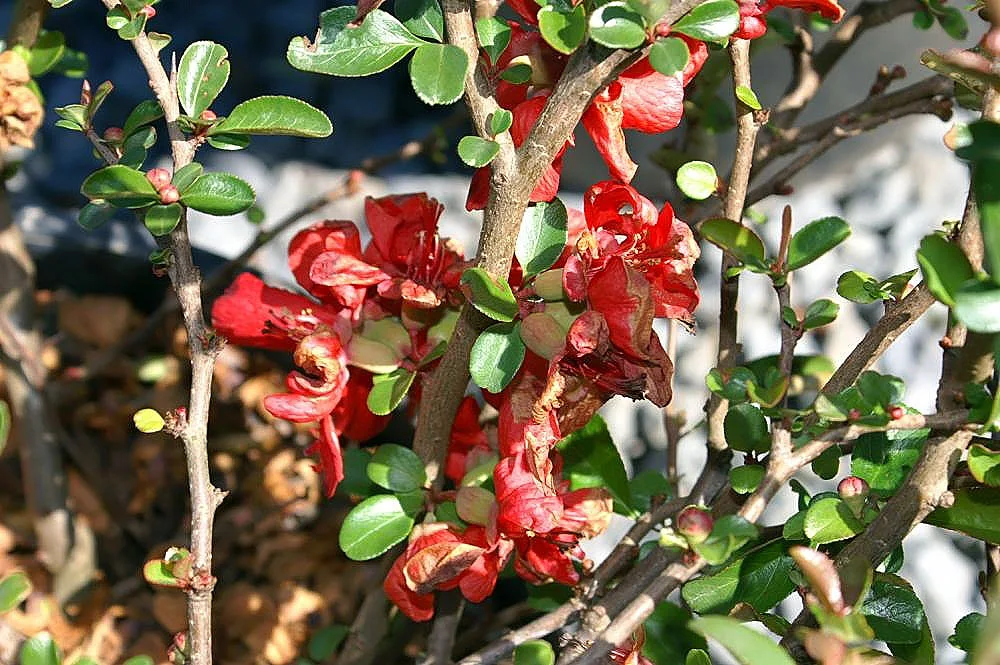
At a glance
- TypeThorny deciduous shrub
- NativeChina
- HeightOften 6 to 10 feet
- FlowersRed, pink, orange, or white
- SeasonLate winter to spring
- CautionThorny branches
Where it grows in the wild
POWO places Chaenomeles speciosa as native to China North-Central, China South-Central, China Southeast, Tibet, and Xinjiang, and records introduced TDWG regions beyond that range, including named U.S. states and Mexico Southeast. The public overlay now preserves those exact source regions instead of painting whole-country United States or Mexico polygons.14
How to recognize it
Flower color varies, so start with timing, branch structure, thorns, leaves, and where the flowers sit.
Flowers before full leaf
Blooms often open on bare or just-leafing stems, making the shrub stand out early in the season.
Thorny woody stems
Flora of China and NC State both describe spiny or thorny branchlets, a strong clue when paired with early flowers.
Serrated oval leaves
Leaves are oval to oblong with toothed edges, becoming more visible after the flower show begins.
Dense shrub habit
Older plants can form a twiggy, sheltering thicket rather than a single open-stemmed flower display.
Lookalikes & how to tell them apart
Several spring shrubs bloom before the landscape has fully leafed out. Flowering quince becomes clearer when thorny stems, flower placement, leaf shape, and fruit type agree.
True quince
Larger tree or shrub fruit. Cydonia oblonga is the true quince, usually grown for larger fuzzy fruit. Flowering quince is Chaenomeles, with smaller hard fruits and a different ornamental shrub habit.
Japanese quince
Related Chaenomeles species. Chaenomeles japonica is a close relative and common garden plant. Exact species ID may require flower, fruit, leaf, and cultivar context.
Forsythia
Yellow flowers, no quince-like fruit. Forsythia also blooms early on bare-looking stems, but its flowers are yellow and the branch and fruit characters are different.
Spring flowers on thorny wood
Flowering quince can make a cold garden edge look awake before the rest of the shrubs have decided what season it is. The flowers sit close along woody stems, red, orange, pink, or pale, often before the leaves have fully opened. Because the branches are thorny, the beauty has a little structure to it. This is not a soft spray of petals floating by itself. It is spring fastened to wood.
The first community record behind this page came from South Carolina on June 6, 2026. In many North American settings, flowering quince is encountered as a planted or escaped garden shrub, so that record is a local discovery rather than a native-range clue. Plants of the World Online places Chaenomeles speciosa as native to named China TDWG regions and records introduced TDWG regions beyond that origin.1
Recognition starts with timing. Few shrubs put on such an early show along bare or nearly bare stems. Then look for the branch details: thorny twigs, flowers held along the wood, and oval leaves with toothed edges as the season advances. Flora of China describes the species as a shrub with spiny branchlets, serrate leaves, flowers in clusters, and small pome fruits.2
That fruit is one reason the name can confuse people. Flowering quince is not the same as true quince, Cydonia oblonga, the plant known for larger fuzzy fruit. This one belongs to Chaenomeles. The fruits are smaller and harder, and on this page they matter as field marks, not as kitchen advice.
The range map carries the same caution as the name. TDWG geometry can show the native Chinese regions and introduced regions POWO names, but the map still cannot tell you which roadside thicket, old garden, or building edge is wild, planted, or merely persistent. GBIF points add observations. They do not turn the map into a complete distribution.
As a plant in the rose family, flowering quince shares some familiar shrub signals: toothed leaves, woody stems, and showy spring flowers. Its ecological role in many places is shaped by people planting it, birds using cover, insects visiting early flowers, and leaves returning to the soil beneath the branch layer. NC State describes well-drained soil tolerance and thorny branches, a useful pairing for understanding where the shrub settles in garden edges and informal thickets.3
Those thorns are more than an inconvenience. Dense twiggy growth can make a small refuge for birds and other animals that benefit from cover. The shrub’s annual leaf fall, petals, and small fruits add seasonal litter under the plant, where soil organisms break the year back down into usable matter. It is a common edge story: a human-chosen shrub still becomes part of the ground it shades.
A good field observation is to step close enough to see structure, then stop. Are the flowers attached directly along older wood? Are there thorns? Have the leaves opened yet, and are their edges toothed? Is the shrub standing alone in a garden bed, or has it become part of a hedge, old foundation planting, or brushy edge?
Flowering quince is easy to remember because it arrives early and loudly. It is better understood when the loudness settles into details: thorn, petal, leaf, fruit, soil, shelter. A branch in bloom can look like a simple announcement of spring. Look a little longer, and it becomes a record of origin, movement, and the small lives that gather around a shrub.
Its place in the ecological web
In gardens and edges, flowering quince is a human-planted shrub that still enters a local web through flowers, branches, litter, and cover.
Early flowers in a sparse season
Flowers open in late winter to spring, when early insects may be searching for floral resources. The bloom timing gives the shrub ecological interest beyond display.34
A thorny refuge
Dense thorny branches can provide protective cover for small birds and other small animals at garden edges, especially where shrubs are allowed to grow as thickets.3
Well-drained shrub-edge soil
NC State describes flowering quince in well-drained soils and broad moisture tolerance. As a deciduous shrub, it returns leaves, petals, and small fruits to the surface, adding seasonal litter beneath a dense branch layer.3
When to look
The branch structure is visible through winter, flowers arrive from late winter into spring, leaves expand afterward, and fruit develops later in the growing season.234
- Peak bloom
- Fading & dried heads
- Leaves out
Found one? Keep a field journal
Save this species to your journal, earn its badge, and see community discoveries on an approximate, privacy-safe map.
- 1Photograph a whole branch so flower placement and thorns are visible.
- 2Add a close image of one flower cluster and one leaf if leaves have emerged.
- 3Record whether the shrub is wild-looking, garden-planted, or at a building edge.
- 4Compare with true quince, Japanese quince, and other early spring shrubs.

Flowering Quince Badge
Earned when you identify this species in Leafari.
In the Leafari community
Curated videos
Grouped by purpose, with each video chosen for identification, care, or broader context.

Chaenomeles speciosa - Flowering Quince
Cornell SIPS
Sources
Key facts and claims trace back to a named reference. Superscript numbers in the text link here.
- Plants of the World Online: Chaenomeles speciosa Taxonomy, native range, introduced range context
- Flora of China via eFloras: Chaenomeles speciosa Morphology, fruit, habitat, distribution
- NC State Extension Plant Toolbox: Chaenomeles speciosa Description, bloom, soil, thorns, wildlife shelter
- Oregon State Landscape Plants: Chaenomeles speciosa Identification, bloom, garden context
- GBIF species record: Chaenomeles speciosa Distribution observations
- Wikimedia Commons image: Chaenomeles speciosa Texas Scarlet Hero image
- Wikimedia Commons image: Chaenomeles speciosa Toyo-Nishiki Supporting image
- YouTube: Chaenomeles speciosa - Flowering Quince Curated video
- Leafari app records Product snapshot, first found, fun facts, badge, community discovery