
Bigleaf Hydrangea
Hydrangea macrophylla
A rainy-season shrub from Japan that turns soil chemistry into color and has become one of the world's most familiar garden plants.
At a glance
- TypeFlowering shrub, bare in winter
- NativeJapan and Kazan-retto
- Height3 to 6 feet
- BloomsMophead & lacecap heads
- ColorPink, purple, blue, white
- SafetyToxic to pets if eaten
Where it grows in the wild
POWO lists Hydrangea macrophylla as native to Japan and Kazan-retto, and records many introduced TDWG regions beyond that range. The map preserves those exact POWO regions, including Arkansas as a U.S. region rather than a country code, with subtle gold and green points marking approximate, privacy-safe community observations.12
How to recognize it
Four cues, from the most reliable to the most situational. Start with the leaves and flower heads, then let habitat confirm it.
Broad opposite leaves
Large green leaves grow in pairs with toothed edges and a soft, water-rich look.
Mophead or lacecap heads
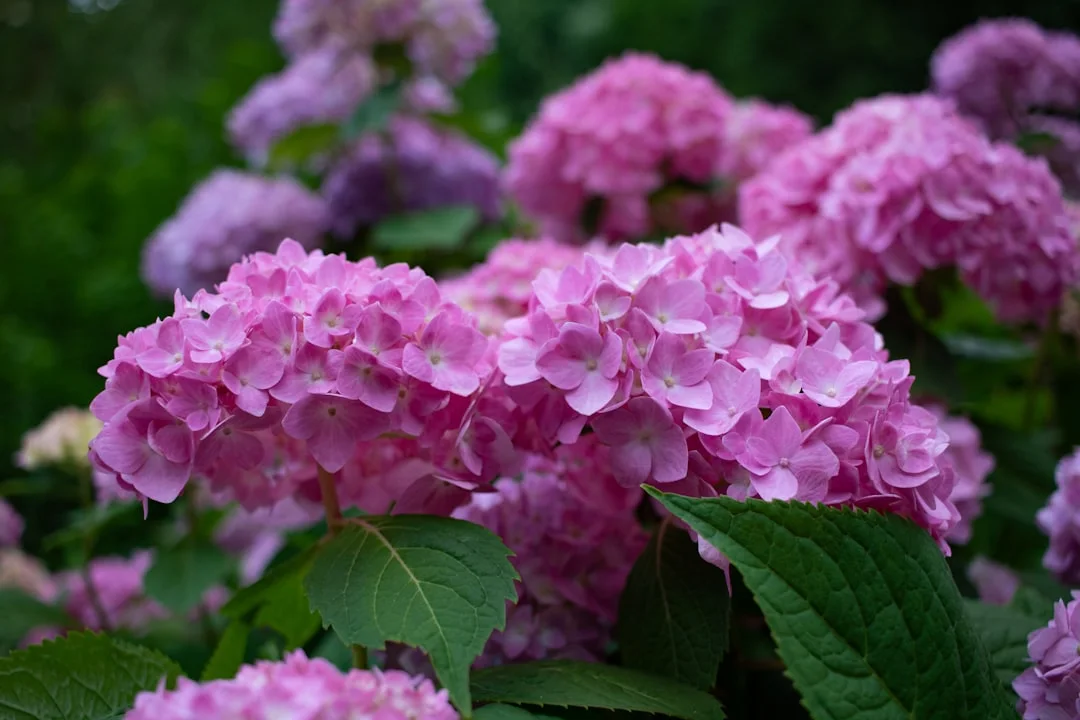
Rounded mophead clusters (big ball-shaped heads) are common in gardens; lacecaps are flatter, with a ring of showy flowers around a lacy center.
Color as a clue
Bloom color reflects both the variety and the soil chemistry.
Found near homes & gardens
Look near porches, paths, old foundations, cemeteries, and shaded garden borders.
Lookalikes & how to tell them apart
It's probably bigleaf hydrangea if you see broad, glossy leaves in pairs and ball- or plate-shaped heads in pink, blue, purple, or white that shift with the soil. Here's what rules out the usual confusions.
Panicle hydrangea
Cone-shaped heads. Flowers form a pointed cone, not a ball or flat plate. Blooms later (mid-to-late summer) and grows well in full sun.
Smooth hydrangea
Giant white globes. Huge, soft white snowball heads (like 'Annabelle') on thinner, matte leaves. Native to the eastern United States.
Oakleaf hydrangea
Oak-shaped leaves. Leaves lobed like an oak's, flowers in cones, and foliage that turns deep red and burgundy in fall.
The shrub that reads the soil
By the end of June, a bigleaf hydrangea can seem less like a shrub than a pocket of weather that decided to stay put. The leaves are broad enough to cup rain, and the flower heads hold color the way fog holds light.
That dampness is not incidental. Bigleaf hydrangea was shaped in Japan, where summer rain is a season of its own and the wild plant lives close to the sea.1 Seen from that origin, it stops resembling a parlor ornament. It becomes what it has always been: a coastal survivor with large leaves built for humid air, dappled light, and soil that stays cool under leaf litter.
The wild flower head is closer to a lacecap (a flat head with a lacy, open center) than the full mop of the florist trade. At the center sit tiny fertile flowers with pollen, nectar, and the machinery of the next generation. Around the edge hover larger showy sepals, the petal-like parts that do the advertising.4 The signboard is beautiful, but the meal is in the middle.
Blue in acidic soil, pink in alkaline. The reason is stranger than a nursery tag makes it sound. In acidic ground, aluminum becomes soluble enough for roots to absorb. Inside the colored sepals, that aluminum joins anthocyanin pigments, the same ones that redden autumn leaves, and shifts the hue toward blue. When aluminum is unavailable, the same pigments read pink to red. White varieties usually lack the pigments needed for the shift.7
Bigleaf hydrangea is easy to take for granted because it is so familiar. Behind the porch shrub stands a coastal Japanese species that learned to survive rain, salt, insects, gardeners, and the chemistry of its own root zone. We looked at the bright edge and carried it across oceans. Meanwhile, as always, the real life of the plant went on in the center.
Its place in the ecological web
Not a keystone wildlife plant everywhere it grows, but its flowers, leaves, shade, and root zone still create a small web of relationships.
The useful flowers are the small ones
Lacecap heads expose a center of fertile flowers, while the larger showy sepals act as visual flags and landing pads. Many mophead varieties are bred for show, with sterile flowers that offer pollinators far less pollen and nectar.4
A moth turns leaves into a nursery
The hydrangea leaftier moth lays eggs near branch tips. Its caterpillar ties young leaves together with silk, feeding inside the shelter before pupating. The damage is usually minor, but it is a real lifecycle relationship.56
Soft growth attracts opportunists
Deer and rabbits may browse the tender leaves and buds, especially where they're common. The dense stems and broad leaves also cast a cool, moist pocket of shade at the garden edge, with cover for ground beetles, spiders, and other small creatures.3
It reads soil more than it rewrites it
Color is a visible response to pH and aluminum availability. The plant takes up and stores aluminum under acidic conditions, but the bloom is mostly a readout, not proof that the shrub acidifies the soil.78
When to look
Leaves open in spring and stay until late autumn. Fresh blooms peak in midsummer, then fade to papery dried heads that can linger into fall.3
- Peak bloom
- Fading & dried heads
- Leaves out
Found one? Keep a field journal
Save this species to your journal, earn its badge, and see community discoveries on an approximate, privacy-safe map.
- 1Note the paired leaves and the flower-head shape.
- 2Check the color-and-soil clue.
- 3Photograph the whole shrub, one flower head, and a leaf.
- 4Log it in Leafari to confirm the ID and earn the badge.

Bigleaf Hydrangea Badge
Earned when you identify this species in Leafari.
In the Leafari community
Curated videos
Grouped by purpose, with each video chosen for identification, care, or broader context.

Hydrangea macrophylla Care Guide and Troubleshooting
HortTube with Jim Putnam

Complete Growing Guide to Bigleaf Hydrangea macrophylla
Plant Vibrations with Devin Wallien

How to choose the right hydrangea
The Impatient Gardener
Sources
Key facts and claims trace back to a named reference. Superscript numbers in the text link here.
- Plants of the World Online: Hydrangea macrophylla Taxonomy & native range
- GBIF species record: Hydrangea macrophylla Global distribution
- NC State Extension Gardener Plant Toolbox Size, zones, browsing
- Pollination-related functions of decorative sterile flowers of nine Japanese Hydrangea species Flower structure & pollination
- University of Vermont Extension: The Hydrangea Leaftier Insect lifecycle
- UMass Extension: Olethreutes ferriferana Insect lifecycle
- Agronomy: Flower-color changes induced by aluminum Color & soil chemistry
- ISHS: Endo-mycorrhiza effects in Hydrangea macrophylla subsp. serrata Soil & fungi
- ASPCA hydrangea toxicity profile Safety
- Leafari app records: badge, first finder, fun facts, and public discovery counts. Community data