
Cheddar Pink
Dianthus gratianopolitanus
A fragrant rock-garden pink with blue-gray leaves, fringed rose flowers, and a native story rooted in limestone ledges from Cheddar Gorge into central Europe.
At a glance
- TypeMat-forming perennial
- NativeGreat Britain to Ukraine
- HeightAbout 6 in to 1 ft
- FlowersFringed pink, fragrant
- LeavesNarrow, blue-gray, waxy
- SafetyLow-severity caution
Where it grows in the wild
POWO places the native range from Great Britain to Ukraine, and BSBI describes a fragmented European species with core areas in the French, Swiss, and German Jura plus a northern British outlier around Cheddar Gorge and the Mendip Hills. The map uses source-backed TDWG botanical country units for native context, with GBIF observations shown separately.125
How to recognize it
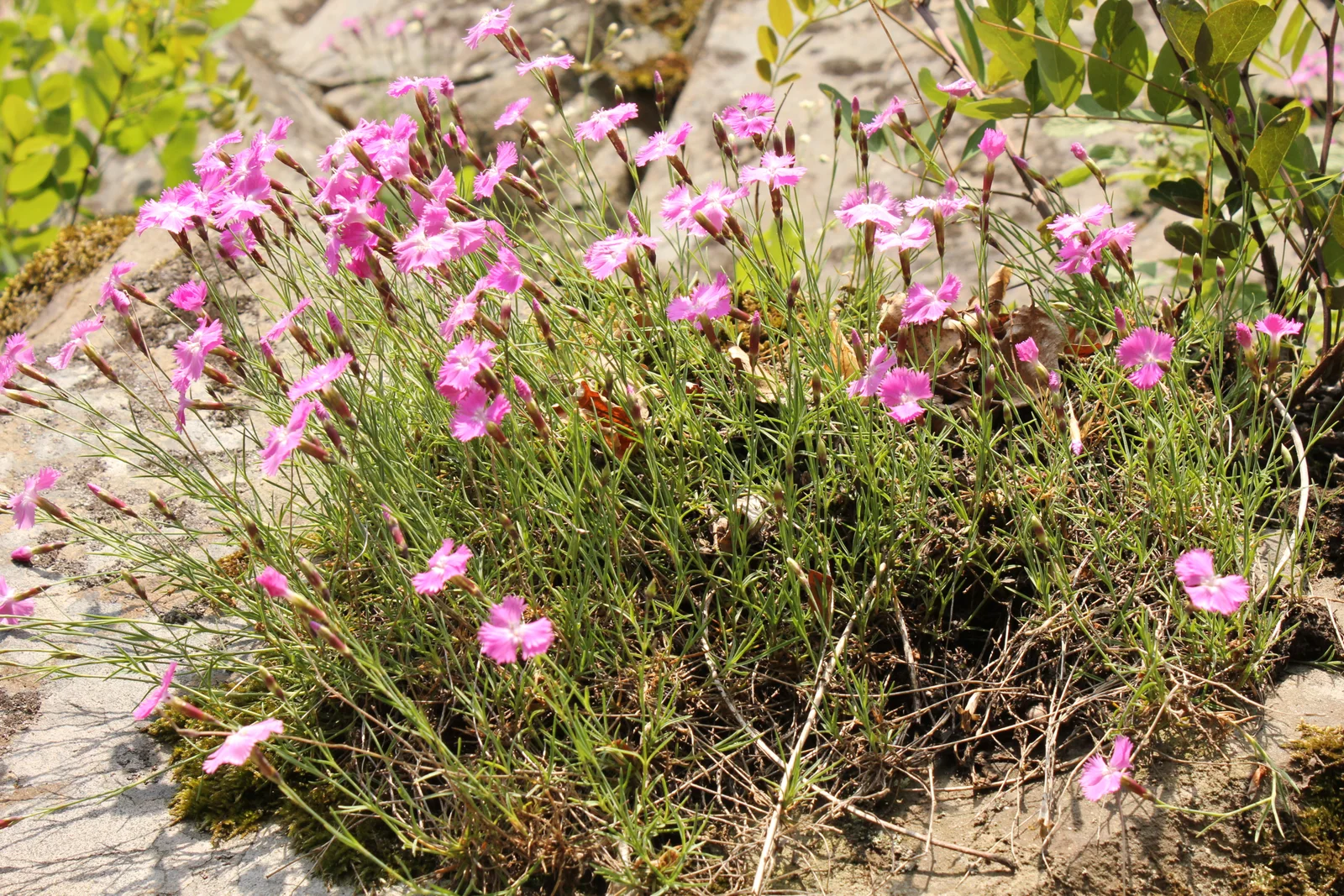
From a distance it may read as a small garden pink. Up close, the leaf color, petal edge, scent, and low cushion shape narrow the ID.
Blue-gray narrow leaves
Leaves are linear, glaucous, and close-set, forming a low cushion or mat rather than a tall leafy stem.
Fringed rose flowers
Flowers are sweetly scented, pale to deep pink, and shallowly toothed or fringed at the petal tips.
Cushion-forming habit
BSBI describes a densely tufted perennial; RHS and NC State both place it in the small, mat-forming perennial range.
Garden pink confusion
Cultivars and hybrids can blur the field picture, so look for several traits together rather than relying on flower color alone.
Lookalikes & how to tell them apart
Many Dianthus flowers have pink petals and a spicy scent. Cheddar pink becomes clearer when the shallow petal teeth, short calyx, glaucous foliage, and low cushion all agree.
Cottage pink
More deeply cut petals. BSBI separates Dianthus plumarius by petals cut more deeply, at least one-third of the way to the base, and a larger calyx.
Carnation or clove pink
Larger calyx, unbearded petals. Dianthus caryophyllus can smell similar, but BSBI notes a larger calyx and petals that are not bearded.
Garden pink hybrids
Bolder markings or cultivar traits. Retail garden pinks may include Cheddar pink ancestry, but many show obvious markings or mixed traits from several Dianthus species.
A pink rooted in stone
At first glance, Cheddar pink looks almost too polished for a cliff plant. A small cushion of blue-gray leaves sits low to the ground, and from it rises a flower the color of a summer sweet, rose-pink, fringed at the tips, and carrying a faint clove scent when the air is warm. It is the kind of plant a person might meet beside a path or in a rock garden and assume it was made for borders. The deeper story begins in stone.
The first community record behind this page came from Michigan on June 6, 2026. That is a long way from the plant’s native limestone strongholds, but it fits the double life of many Dianthus species. Cheddar pink is both a cultivated flower familiar to gardeners and a wild plant with a much narrower, more exacting biography. In the wild, it is not seeking rich garden beds. BSBI describes it rooting in thin soils, cliff crevices, and ledges of dry open limestone grassland, places where the ground is shallow and light is abundant.
Its name points to one of those places. Cheddar pink is tied in public imagination to Cheddar Gorge in Somerset, where native British plants survive as a northern outlier of a wider European range. POWO places the species from Great Britain to Ukraine, while BSBI describes fragmented populations through parts of western and central Europe, including the French, Swiss, and German Jura. That map is not a smooth blanket. It is more like a scatter of rocky chapters, with open ledges and short turf holding the plant where shrubs and shade have not closed in.
Recognition starts with scale. Cheddar pink is small, often only a few inches tall, spreading as a cushion or mat rather than standing upright like a meadow flower. The leaves are narrow and glaucous, a blue-gray word that means they carry a waxy, pale cast. The flowers are solitary, fragrant, and pink, with petal tips that look cut or fringed. That fringe matters: BSBI separates Cheddar pink from similar garden and wild Dianthus by details such as shallow petal teeth, bearded petals, calyx size, and short glaucous bracts.
The plant’s soil story is plain in its body. A deep-rooted, lush plant would be out of place on a ledge where rain runs off quickly and organic matter gathers in scraps. Cheddar pink stays close to the surface, making dense mats from many small rosettes. In that position, it can occupy little pockets where mineral soil, weathered stone, moss, and last season’s plant litter meet. Its fallen leaves and stems are small contributions, but on thin ground small contributions matter.
The flowers are not only decorations. BSBI reports visits from butterflies and moths, including day-flying hawk-moths that can move pollen over longer distances. A fragrant pink flower on a sunny ledge is a signal in a demanding place, and the signal has to work before the season moves on. NC State gives the main bloom as May to June, which matches the plant’s feel: spring’s momentum gathered into one low, scented flush.
There are cautions around both plant and place. NC State flags low-severity poison characteristics, so this is a plant to observe rather than sample. Wild British populations also carry conservation weight; BSBI notes that picking is prohibited under Schedule 8 of the Wildlife and Countryside Act. The best field habit is simple: notice the mat, the leaves, the petal edge, the scent if it is already in the air, and the kind of ground beneath it.
Look again at a single flower and the name begins to feel less odd. Cheddar is a place, not a cheese joke. Pink is not only a color, but an old flower word that lives on in the cut-looking edge of the petals. A small plant can carry both histories at once, a soft bloom held by hard stone.
Its place in the ecological web
In the wild, Cheddar pink is less a bedding plant than a small cliff-edge specialist, holding close to open stone, short grass, and thin soil.
Scent for wings
BSBI reports visits by butterflies, day-flying and night-flying moths, including hummingbird hawk-moth. Scent and accessible pink flowers make the small plant part of a moving pollinator route.2
Thin limestone soil specialist
Wild plants grow in shallow, humus-poor limestone soils, cliff crevices, and ledges. Their dense mats trap small bits of litter and slow wind at the surface, participating in the ground-layer system without needing deep soil.2
Open ground matters
BSBI links the species to dry, open, tightly grazed limestone grassland. Too much scrub can shade out the open ledges and short turf this light-loving plant uses.2
When to look
The blue-gray mat can be visible beyond the flowering season, but the main show is late spring into early summer. NC State gives May to June bloom, and BSBI's field account places flowers in the same early-season window.237
- Peak bloom
- Fading & dried heads
- Leaves out
Found one? Keep a field journal
Save this species to your journal, earn its badge, and see community discoveries on an approximate, privacy-safe map.
- 1Photograph the whole low mat so the blue-gray leaves and plant shape are visible.
- 2Add a close flower photo showing the fringed petal tips.
- 3Record scent, setting, and whether the plant is in a garden, wall, rockery, or wild rocky habitat.
- 4Use multiple traits because cultivated garden pinks can look similar.

Cheddar Pink Badge
Earned when you identify this species in Leafari.
In the Leafari community
Curated videos
Grouped by purpose, with each video chosen for identification, care, or broader context.

Cheddar Pink - Champion Species for the Mendip Hills National Landscape
Mendip Hills National Landscape
Sources
Key facts and claims trace back to a named reference. Superscript numbers in the text link here.
- Plants of the World Online: Dianthus gratianopolitanus Taxonomy and native range
- BSBI species account: Dianthus gratianopolitanus Field marks, habitat, ecology, range caveats
- NC State Extension Plant Toolbox: Dianthus gratianopolitanus Description, soil, bloom, safety
- Royal Horticultural Society: Dianthus gratianopolitanus Description, size, flower traits, growing conditions
- GBIF species record: Dianthus gratianopolitanus Distribution observations
- Flora of North America: Dianthus North American genus context and escape record
- USA-NPN Nature's Notebook: Dianthus gratianopolitanus Fruit and phenology context
- YouTube: Cheddar Pink - Champion Species for the Mendip Hills National Landscape Curated video
- Leafari app records Product snapshot, first found, fun facts, badge, community discovery