
Tree Dahlia
Dahlia imperialis
A towering mountain dahlia with hollow cane-like stems, late lavender flowers, and a native range from Mexico into Colombia.
At a glance
- TypeTall herbaceous perennial
- NativeMexico to Colombia
- HeightOften 3 m; taller in mild sites
- FlowersLarge mauve to lavender-pink heads
- StructureHollow cane-like stems
- SeasonLate-season flowering
Where it grows in the wild
Plants of the World Online lists Tree Dahlia as native from Mexico to Colombia, including named Mexican TDWG regions, Central American countries, and Colombia, with introduced records in several additional regions. The map uses TDWG geometry for those source-backed units and Queensland admin1 geometry for the Australian introduced record, with GBIF observations and the privacy-safe South Australia community find.145
How to recognize it
Look for a dahlia that has stretched upward into cane height, then confirm the flower form and leaf structure.
Tree-like height
The plant can rise above many garden flowers in a single season, especially in mild climates where frost does not cut the stems early.
Hollow cane stems
The stems are tall, green, and bamboo-like, a useful clue when the flowers are high above the leaves.
Open late flowers
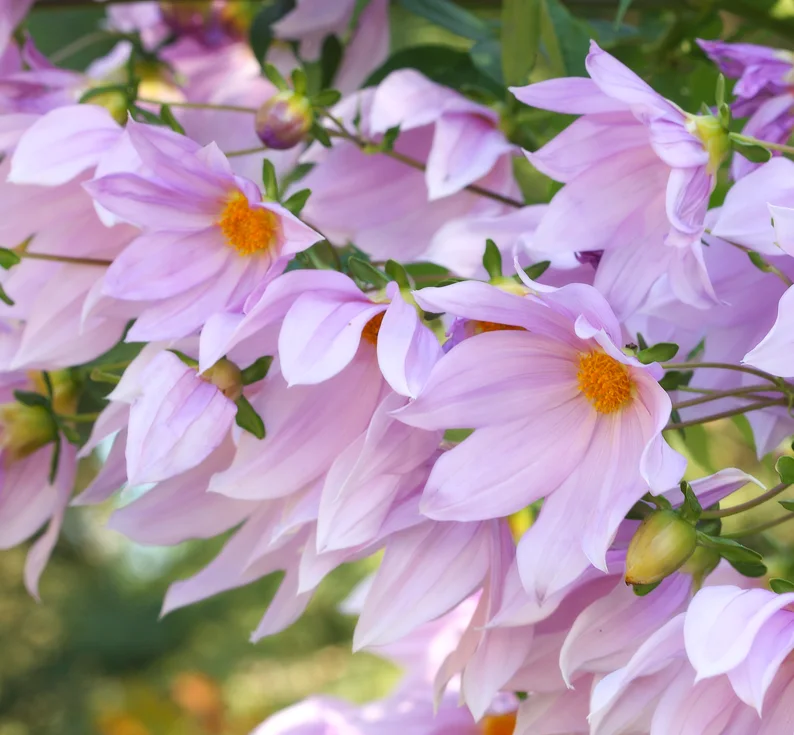
Flower heads are usually mauve, lavender, or pinkish with a yellow center, often appearing late in the season.
Large divided leaves
The foliage is large and green, giving the plant a coarse, lush look beneath the tall flowering stems.
Lookalikes & how to tell them apart
Tree dahlia is most likely to be confused with other dahlias or other tall cane-like ornamentals. Height, flower form, and leaf texture help narrow the ID.
Garden dahlias
Shorter, denser flower displays. Many garden dahlias have showier, more doubled blooms and lower stems. Tree dahlia is usually recognized by its towering habit and open flower heads.
Dahlia tenuicaulis
Another tree dahlia relative. This species can also be called tree-like, so a confident ID should compare flower size, leaf form, location, and expert records.
Bamboo-like garden canes
No dahlia flower heads. Some tall ornamentals have cane-like stems, but they lack the paired clues of dahlia foliage and lavender-pink composite flower heads.
A dahlia that grows like a tower
A tree dahlia can make a familiar word feel slightly wrong. The flower still has the open, sunny center of a dahlia, but the plant lifts it on tall green canes, high enough that a person may look up instead of down. In bloom, Dahlia imperialis seems to ask a simple question: what if a garden flower remembered the mountains?
The first recorded community discovery for this page came from Silent-Dreamer in South Australia on June 7, 2026. That location is part of the plant’s introduced story, not its beginning. Plants of the World Online places the native range from Mexico to Colombia, and its source descriptions point to subtropical and Andean mountain settings. The page map keeps those layers separate: source-backed country context for origin and introduction, plus GBIF observation dots and a privacy-safe community point.
Up close, the clues are sturdy and visible. Tree dahlia grows from belowground reserves into hollow, bamboo-like stems. The leaves are large and green, and the flower heads are usually lavender, mauve, or pinkish with yellow centers. It is not a tree in the woody, year-after-year trunk sense. It is a herbaceous perennial that can still create a tree-like impression in a single season.
That quick upward growth changes the way the plant meets the ground. A tall stem begins with stored energy below the soil surface, then spends the season lifting leaves into light. In mountain habitats, moist organic soils and leaf litter help hold the coolness and water that many large herbaceous plants need. When the stems soften, break, or die back, their tissues return to the litter layer, feeding the slow work of decomposition.
The hollow stems have also carried human meaning. Kew notes that the dahlia’s Nahuatl name, acocoxochitl, means water-pipe flower, tied to the use of Dahlia imperialis stems for carrying water. That is not a care tip or a modern instruction. It is a reminder that field marks are not only for identification. Sometimes the same structure that helps a plant grow also shapes how people name and remember it.
Tree dahlia often flowers late, which gives it a little drama in colder places. Smithsonian horticulturists described a plant in Washington, DC, beginning to bloom in late fall after reaching impressive height, with cold weather waiting close behind. In mild climates, the season may be kinder. In frost-prone places, bloom can feel like a race between shortening days and the first hard cold.
If you meet one, step back first. Notice whether the plant really has that dahlia flower lifted above a cane-like frame. Then move closer for the leaf, stem, and flower details. A good observation holds both scales at once: the tower you saw from the path, and the hollow green architecture that made the tower possible.
Its place in the ecological web
Tree dahlia's drama is partly belowground. A tall season begins with stored energy and ends by returning soft stems and leaves to the soil surface.
Mountain humus and seasonal return
Source descriptions place this species in subtropical and Andean mountain settings. In those systems, fast herbaceous growth rises from belowground reserves, then spent leaves and stems can add soft organic matter back to the litter layer.1
A late-season signal
Smithsonian horticulturists observed flowering in late fall in Washington, DC, which helps explain why cold snaps can interrupt bloom before the plant reaches its full display.3
Hollow stems with a story
Kew connects the dahlia's Nahuatl water-pipe name to hollow Tree Dahlia stems, a reminder that plant structure often becomes part of human attention.2
When to look
Tree dahlia grows upward through the warm season and often waits until shortening days to flower. In frost-prone places, that timing can make bloom a race against cold weather.3
- Peak bloom
- Fading & dried heads
- Leaves out
Found one? Keep a field journal
Save this species to your journal, earn its badge, and see community discoveries on an approximate, privacy-safe map.
- 1Photograph the whole plant so the unusual height is clear.
- 2Add a flower close-up that shows the open lavender-pink head.
- 3Include a stem or leaf detail to show the cane-like structure.
- 4Record the setting without sharing exact private location details.

Tree Dahlia Badge
Earned when you identify this species in Leafari.
In the Leafari community
Curated videos
Grouped by purpose, with each video chosen for identification, care, or broader context.

Dahlia imperialis
Big Plant Nursery
Sources
Key facts and claims trace back to a named reference. Superscript numbers in the text link here.
- Plants of the World Online: Dahlia imperialis Taxonomy, native range, introduced range, morphology, habitat
- Kew: Dahlia Cultural history and hollow stem context
- American Dahlia Society: Dahlia imperialis blooming at the Smithsonian Height and late-season flowering observation
- GBIF species record: Dahlia imperialis Distribution observations
- Leafari app records First-found, community, badge, and product snapshot fields