
Hardy Fuchsia
Fuchsia magellanica
A South American fuchsia with arching stems, dangling red-and-purple flowers, hummingbird ties, and a wide introduced footprint in mild climates.
At a glance
- TypeDeciduous shrub or perennial
- NativeCentral and southern Chile to southern Argentina
- SizeOften 5 to 10 feet in mild climates
- FlowersRed to magenta tubes with purple petals
- BloomsSummer until frost
- SoilMoist, humus-rich, well-drained
Where it grows in the wild
Plants of the World Online places the native range in Argentina South, Chile Central, and Chile South. POWO and Flora of North America record introduced plants beyond that range, including California, Oregon, Great Britain, Ireland, New Zealand, South Australia, Tasmania, Victoria, and other named TDWG regions. This map preserves those exact source regions rather than replacing Mexico, Australia, or island records with whole-country polygons.1256
How to recognize it
The best clues are the dangling flower shape, the leaf arrangement, and the arching shrub habit.
Pendant tubes
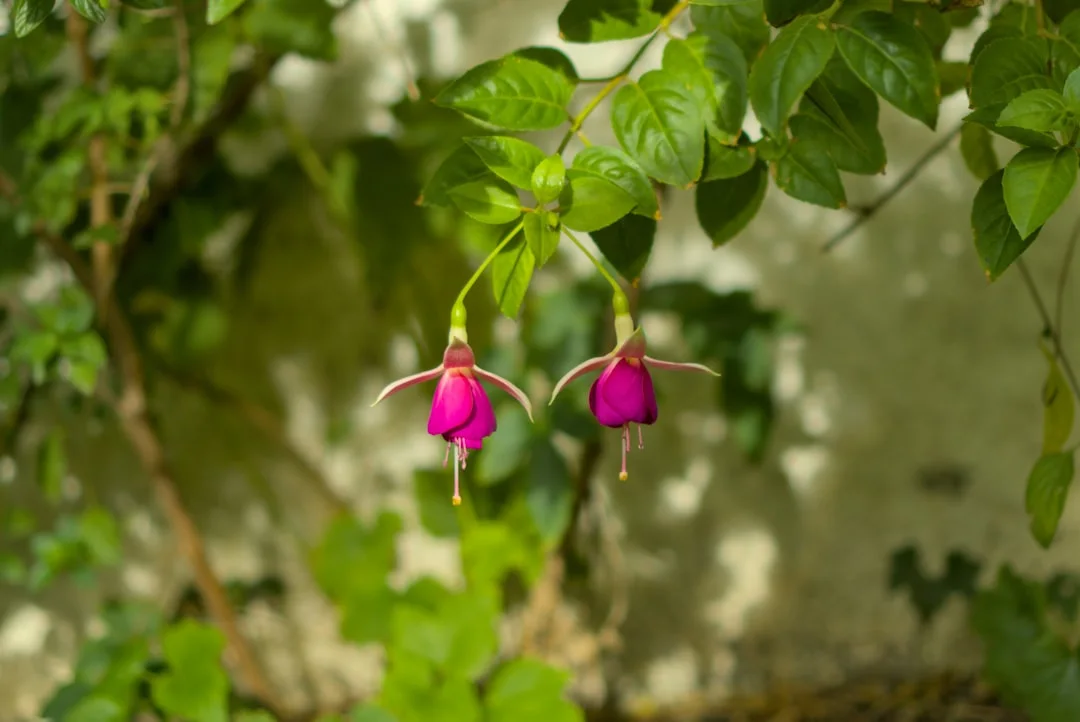
Flowers hang downward, often with red or magenta sepals around purple petals and long exposed stamens.
Opposite or whorled leaves
Leaves are simple, green, and often opposite or in whorls of three or four along thin stems.
Arching fountain habit
Stems can form a loose fountain shape, especially where winter is mild enough for a woody framework to persist.
Long bloom window
NC State describes bloom from summer until frost, with small magenta to red tubular flowers.
Lookalikes & how to tell them apart
Many garden fuchsias share parentage and flower shape, so use the whole plant, not one bloom alone.
Hybrid fuchsias
Often larger or more elaborate flowers. Garden hybrids may have bigger, fuller, or differently colored blooms. Check habit, leaf arrangement, and local records before assuming the wild species.
Fuchsia regia
Another hardy parent species. This related species can appear in hardy fuchsia breeding lines, so a confident ID may need flower proportions and expert confirmation.
Other pendant ornamentals
No fuchsia floral structure. Some shrubs have hanging flowers, but they lack the fuchsia combination of tubular sepals, purple petals, and strongly exposed stamens.
The fuchsia that follows mild coasts
Hardy fuchsia is easiest to notice when the flowers hang like small lanterns under the leaves. Each bloom has a red or magenta tube, swept sepals, purple petals, and stamens that reach out into the air. It looks delicate, almost theatrical, but the plant behind it can be a tough arching shrub in mild places.
The first recorded community discovery for this page came from Silent-Organizer in Co. Dublin, Ireland, on June 7, 2026. Ireland is part of the plant’s introduced story. Plants of the World Online places Fuchsia magellanica in central and southern Chile to southern Argentina as its native range, while both POWO and Flora of North America record it beyond that home range in cool, moist, maritime climates.
That movement helps explain the common name. Hardy fuchsia is still a fuchsia, with pendant flowers and fine stems, but it can persist outdoors where many tender fuchsias would disappear. NC State describes it as a shade-loving deciduous shrub or perennial, often with tops that die back in hard freezes and roots that return when conditions improve.
For identification, start with the flower shape. The blooms hang downward rather than facing up, and the sepals and petals often make a red-and-purple contrast. Then look at the leaves. They are simple, green, and often opposite or whorled along slender stems. Later in the season, the plant can carry dark berries, but the Species Showcase keeps those as visual field marks only, not as a reader activity.
The flowers are not only ornaments. Flora of North America describes floral traits associated with hummingbird pollination, and NC State lists hummingbirds and bees among visitors. In western North America, Anna’s Hummingbird is specifically noted as a visitor in the flora area. A flower built like a narrow hanging tube is also a small piece of architecture, shaping who can reach the nectar and how the plant meets its pollinators. Even from a sidewalk, that relationship can be seen in the flower’s shape.
The soil story is quieter but just as important. NC State says hardy fuchsia prefers fertile, well-drained soil rich in humus, while tolerating heavy clay. That points to a ground layer that holds moisture without staying airless. Fallen leaves, spent stems, and seasonal dieback all return soft material around the plant base, where fungi, insects, and microbes do the slow work of making last season available to the next one.
If you find hardy fuchsia along a garden edge, lane, or mild coastal planting, take two kinds of photographs. First, capture the whole arching habit, because many fuchsias share similar flowers. Then move close enough for the hanging bloom and leaf arrangement. The best observation shows both the little lantern and the shrub that carried it there.
Its place in the ecological web
Hardy fuchsia is often encountered in gardens, but its flower shape and range story point back to larger ecological relationships.
Tubular flowers for nectar visitors
Flora of North America links the floral pattern of this species to hummingbird pollination, and NC State lists hummingbirds and bees among visitors.23
Cool, moist, humus-rich ground
NC State describes a preference for fertile, well-drained soil rich in humus, with tolerance for heavy clay. In the ground layer, dropped leaves and pruned or winter-killed stems can add soft organic matter around the shrub base.3
A mild-climate traveler
POWO and Flora of North America record the species beyond its native Chilean and Argentine range, especially in mild coastal or maritime regions where gardens and naturalized plants can overlap.12
When to look
Hardy fuchsia leaves out through the growing season and can flower for a long stretch. NC State describes bloom from summer until frost, and University of Washington Botanic Gardens notes that flowers can cover plants for about five months in its collection.34
- Peak bloom
- Fading & dried heads
- Leaves out
Found one? Keep a field journal
Save this species to your journal, earn its badge, and see community discoveries on an approximate, privacy-safe map.
- 1Photograph the dangling flowers from the side so the tube, sepals, petals, and stamens are visible.
- 2Add a leaf-and-stem photo showing opposite or whorled leaves.
- 3Capture the whole shrub shape if it is safe and practical from a public path or garden edge.
- 4Avoid exact private location details when recording a discovery.
Hardy Fuchsia Badge
Earned when you identify this species in Leafari.
In the Leafari community
Curated videos
Grouped by purpose, with each video chosen for identification, care, or broader context.

Hardy Fuchsia (Fuchsia magellanica)
How Does Your Garden Grow
Sources
Key facts and claims trace back to a named reference. Superscript numbers in the text link here.
- Plants of the World Online: Fuchsia magellanica Taxonomy, native range, introduced range
- Flora of North America: Fuchsia magellanica Introduced range, morphology, pollination context
- North Carolina Extension Gardener Plant Toolbox: Fuchsia magellanica Field marks, soil, bloom, wildlife, plant traits
- University of Washington Botanic Gardens: Hummingbird Fuchsia Bloom season and hummingbird value
- GBIF species record: Fuchsia magellanica Distribution observations
- Leafari app records First-found, community, badge, and product snapshot fields