
Seeds That Stick to Clothes: Identify Burrs and Sticktights
Identify burrs and sticktights caught on clothes by their hooks, prongs, shape, parent plant, and the habitat where you picked them up.

At a glance
What are the seeds that stick to clothes?
They are hitchhiking fruits and seeds built to catch a ride on fur, feathers, or fabric. Long dark needles often point to a Bidens such as Spanish Needles; tiny prickly clusters can be stickseed; soft bristly ovals can be enchanter's nightshade. Shape is the first clue, but the parent plant and habitat make the identification stronger.
A black boot comes home carrying a miniature plant collection. Green burs dot the fabric. A few stems lie crosswise over the laces. None of the passengers is wider than a shirt button, yet every one has held through the whole walk.
People often call all of these hitchhikers seeds. Many are actually dry fruits with seeds inside. Their outlines differ because plants have built several solutions to the same problem: how to leave the parent plant without legs or wings.
If the mystery object fell from a tree rather than arriving on fabric, the tree seed pod identification guide sorts samaras, pods, nuts, capsules, and cones by their visible structure.
Shape is the best first clue. A flat dark fruit with two short prongs suggests a beggartick. A long narrow fruit with several needlelike tips suggests Spanish Needles. A green cluster of tiny prickly beads may be Virginia Stickseed. A soft oval covered in clear hooked hairs fits enchanter’s nightshade. One fruit is rarely enough for certainty, so pair that close view with the parent plant, habitat, and season.
Start with the outline on the fabric
Set the names aside for a moment and look at the silhouette. Is the hitchhiker long or round? Does it end in two prongs or four? Are the hooks gathered at one end, spread over the whole surface, or too small to see without magnification?
Size helps too. Missouri Department of Conservation notes that sticky fruits range from plantain seeds about the size of a pinhead to cockleburs nearly as wide as a nickel. A phone photograph beside a familiar object can preserve that scale. Include the path edge or parent plant in a second frame, because the growing place often breaks a tie between similar shapes.
Botanists use different names for these structures, but their engineering is visible. A prong can carry backward-facing barbs. A rounded fruit can bristle with hooked hairs. A large bur can act like a thicket of tiny grappling hooks. Each design waits at the height of a passing animal.
Two short prongs point toward Devil’s Beggartick
Devil’s Beggartick makes flat brown fruits with two barbed spines at one end. Under magnification, the shape resembles a tiny pitchfork. The body is much broader and shorter than the dark needles in the next comparison.
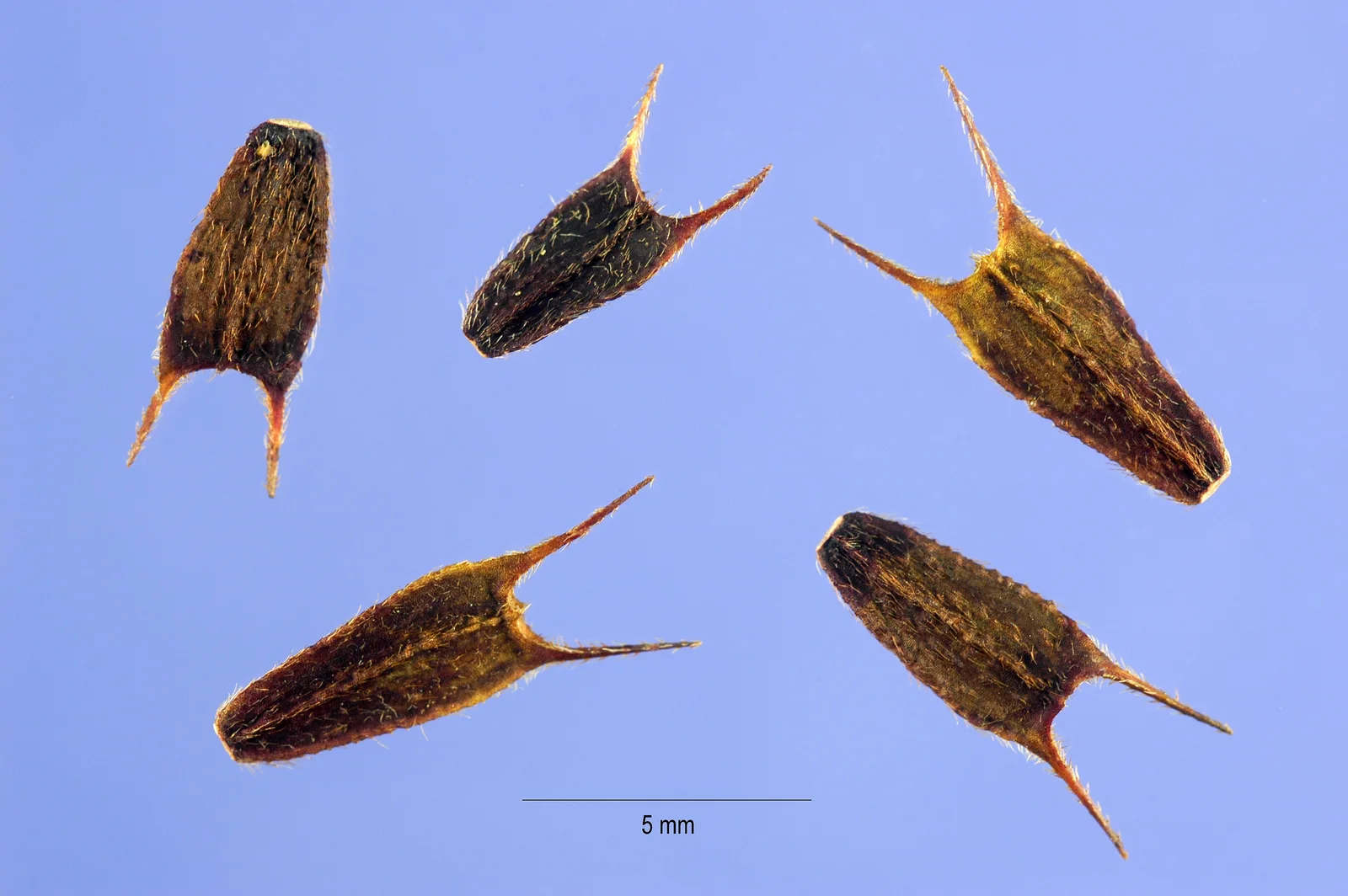
Three parent-plant marks strengthen the match. Devil’s Beggartick usually has opposite leaves divided into three to five toothed leaflets, yellow-orange disk flowers with few or no rays, and long green bracts around each flower head. North Carolina’s wetland guide places it in wet meadows, marshes, floodplain forests, ditches, and other damp disturbed ground.
That setting matters. A two-pronged fruit found after crossing a wet edge fits this species better than the same shape with no record of the plant or place. Keep the identification at the genus level when the leafy evidence is missing, because other Bidens species also make barbed fruits.
Longer needles suggest Spanish Needles
Spanish Needles belongs to the same genus, but its fruits stretch into long, dark rods. Illinois Extension describes two to four prongs at the tip, each with backward-facing barbs. The narrow body and long tips explain the common name before the whole plant enters the picture.
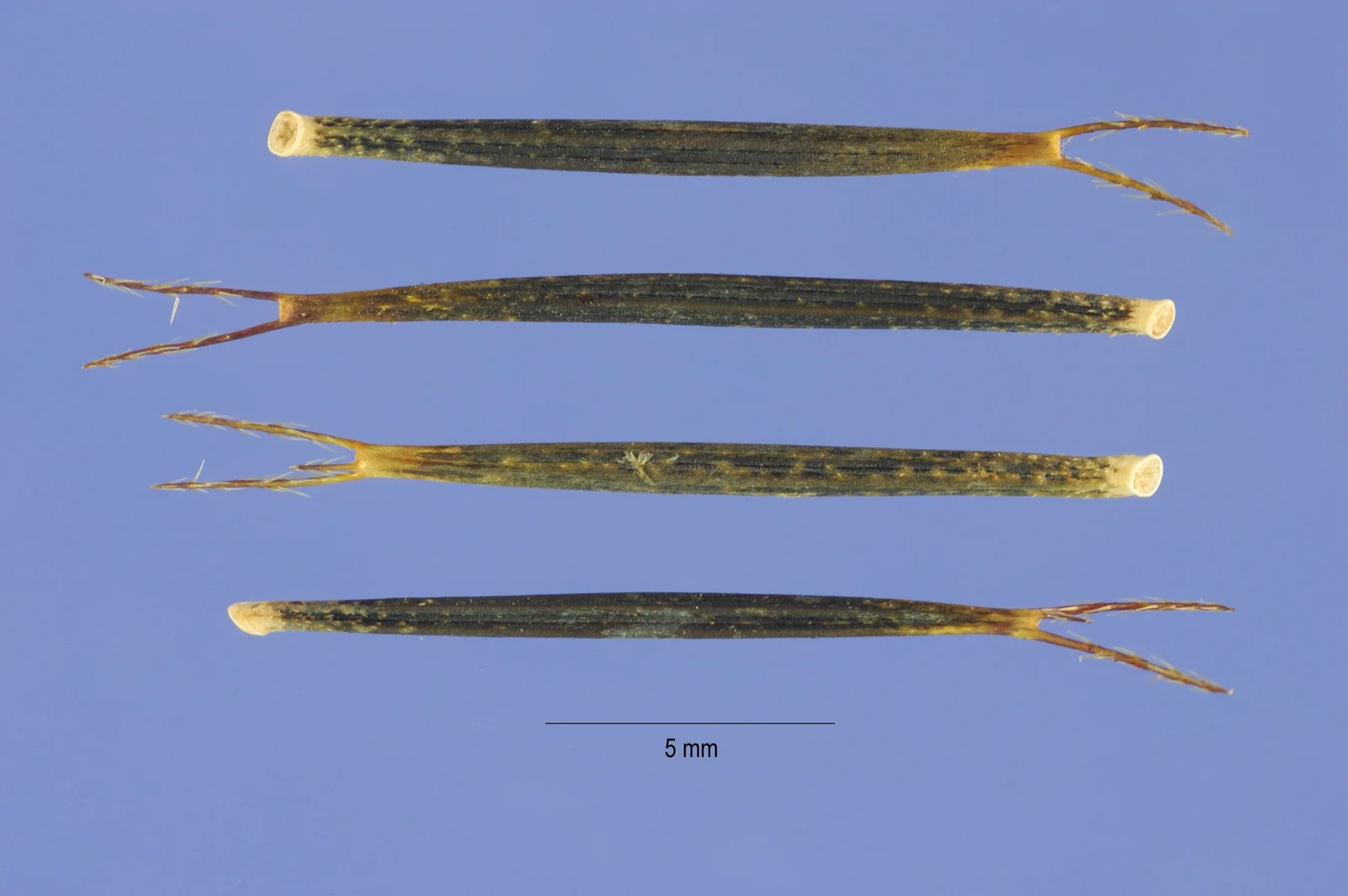
Seen on the growing plant, the two dark shapes belong to different living scenes. Spanish Needles carries finely divided leaves and small yellow flower heads, often in open or disturbed ground. Devil’s Beggartick favors wetter edges and makes a flatter, broader fruit. These differences work together; no single prong count has to carry the whole identification.
At normal viewing distance, both fruits can look like short black lines. A close photograph reveals whether that line is a broad wedge or a narrow rod. The barbs themselves may show as tiny teeth pointing back toward the fruit body.
Small burs can lead back into the shade
Virginia Stickseed offers a different outline. Its fruits gather as tiny green or brown prickly beads along one side of a stem. Illinois Extension describes each bur as less than one-quarter inch across, with many small prickles rather than a few long prongs. The hero photograph shows why a single brush past the plant can leave both fruits and brittle stems across a boot.
Enchanter’s nightshade also grows in shaded ground, but its fruit is a soft-looking oval. The hooks are not concentrated into a pitchfork. They cover the surface as clear curved hairs.
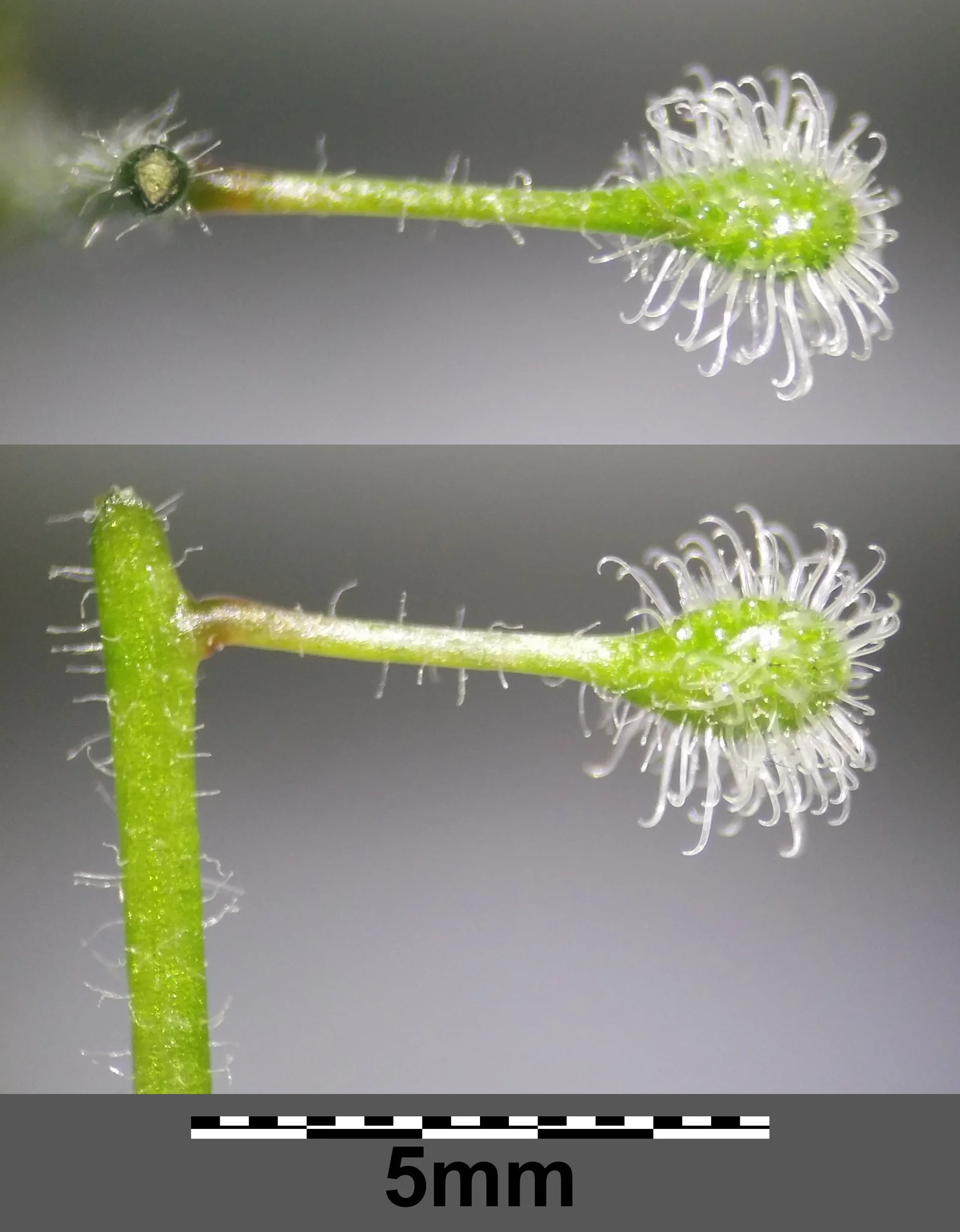
Enchanter’s Nightshade supplies the parent-plant clues: opposite toothed leaves, tiny white flowers with two deeply notched petals, and a loose stem of fruits in moist woodland shade. The mature fruit remains small enough for its hooked surface to look fuzzy rather than spiny.
This is where a macro photograph earns its place. A green speck on cloth may be unreadable. Enlarged beside a scale, it becomes an oval capsule ringed with hooks, each one curved like a shepherd’s crook.
Jumpseed uses a spring and a hook
One woodland hitchhiker uses two movements. Jumpseed holds tiny white flowers along a thin wandlike stem. Later, each fruit sits on a bent stalk under tension. A passing animal can trigger the stalk and send the ripe fruit several feet from the plant.
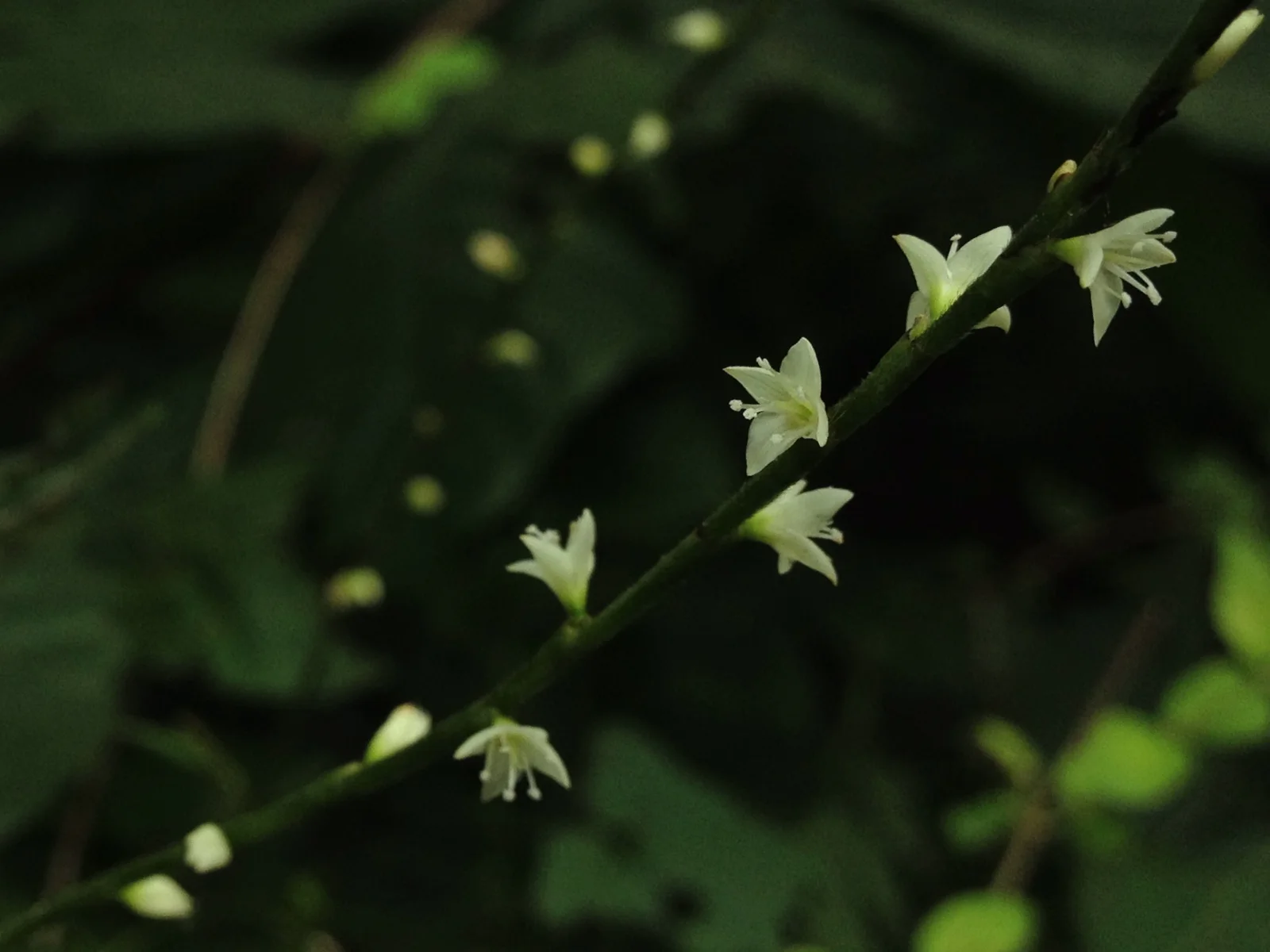
After that first leap, the fruit may keep moving. Missouri Department of Conservation describes a hook-shaped beak that can catch in fur. Native Plant Trust reports both the spring-loaded launch and further transport by an animal coat. Jumpseed combines a small launch system with the possibility of a ride.
Look for the parent plant in rich, moist woodland soil or along a shaded edge. Alternate oval leaves, papery sheaths at the stem joints, and the long flower spike provide a different set of clues from the opposite divided leaves of beggarticks.
Why fabric works like fur
Plants that travel on the outside of animals use a process called epizoochory. The long word means that a seed or fruit rides on the body’s surface rather than passing through it. Hooks, barbs, bristles, and sticky coatings increase the chance of attachment.
Clothing can accidentally fill the same role as fur. In one field experiment in an Australian national park, researchers collected more than 24,000 seeds from 207 pieces of hikers’ clothing. The seeds represented 70 plant taxa. Socks, boots, laces, and trouser legs did not all gather the same passengers, which shows that height, surface, and fabric change which fruits meet a moving person.
A seed on your sock may be completing a trip that began when the plant built its own tiny grappling hook.
Across those scales, a woodland plant invests in a fruit only a few millimeters long. The fruit meets the threads in a sock. A person follows a path far longer than any stem could grow. Plant architecture and animal movement become parts of the same dispersal system.
What to notice outside in three photographs
A useful field record has three distances. The first frame shows the hitchhiker on fabric with something familiar nearby for scale. The second shows the whole parent plant. The third closes in on leaves, flowers, or the remaining fruit cluster.
Add the setting in a few words: sunny path, wet ditch, dry woodland, shaded stream edge. Note whether the fruit body is flat, needlelike, round, or oval, then count visible prongs. Those details are more reliable than a name guessed from color alone.
Late summer and fall bring many of these structures into view. Flowers that drew attention weeks earlier have narrowed into travel devices. A return along the same path can reveal that shift from bloom to fruit without needing to turn the walk into a collection exercise.
The small passengers on a boot are easy to dismiss as trail clutter. Seen closely, they form a map of the walk: wet-edge beggarticks, open-ground Spanish Needles, woodland stickseed, a shaded enchanter’s nightshade, a Jumpseed wand waiting beside the path. Fabric has held the record together, one hook at a time.
Sources
- Illinois Extension: Sticky Plants Are Annoying Accessed 2026-08-11
- Missouri Department of Conservation: Hitching a Ride Accessed 2026-08-11
- UMass Extension Weed Herbarium: Bidens frondosa Accessed 2026-08-11
- North Carolina Wetlands Plant Guide: Bidens frondosa Accessed 2026-08-11
- NC State Extension Plant Toolbox: Jumpseed Accessed 2026-08-11
- Missouri Department of Conservation: Virginia Knotweed (Jumpseed) Accessed 2026-08-11
- Native Plant Trust Go Botany: Persicaria virginiana Accessed 2026-08-11
- Kew Plants of the World Online: Circaea lutetiana Accessed 2026-08-11
- Woodland Trust: Enchanter's Nightshade Accessed 2026-08-11
- Journal of Environmental Management: Clothing as a Seed Vector Accessed 2026-08-11
Image credits
- Top image SB_Johnny · CC BY-SA 3.0
- After the short-prong comparison Steve Hurst, USDA ARS · Public domain
- After the long-needle comparison Steve Hurst, USDA ARS · Public domain
- Before the Jumpseed dispersal section Fritzflohrreynolds · CC BY-SA 3.0
- After the woodland comparison Stefan.lefnaer · CC BY-SA 4.0
More Field Notes
 Praying Mantis Egg Case: How to Identify an Ootheca on a Twig
  Why Pine Cones Open When Dry and Close When Wet
  Black and Orange Fuzzy Caterpillar: Woolly Bear ID Guide
Read it. Then go find it.
Open Leafari on your next walk and see what has been waiting in plain sight.