
Cicada Shells on Trees: What the Empty Skin Means
Identify a cicada shell on a tree by its split back, hollow body, digging forelegs, and bark-clinging pose, then see how the adult emerged.

At a glance
What is the brown cicada shell attached to a tree?
A hollow brown cicada shape clinging to bark is usually an exuvia, the outer skin a wingless nymph left during its final molt. Look for a lengthwise split over the back, an empty interior, stout digging forelegs, and no adult wings. The winged cicada has already moved into the canopy.
On a tree trunk, six small feet keep a brown insect shape in place. The legs look ready to climb, but nothing moves. Its back is open from the head toward the abdomen. Sun reaches into a body that is no longer there.
This is the signature of a cicada exuvia, the shed outer skin of a wingless nymph. The word sounds technical, but the object is wonderfully direct: an old body covering that kept its shape after the adult pulled free. The brown shell on the tree is a doorway the cicada left behind.
Four visible clues make the identification useful: a long split over the back, a hollow interior, thick front legs built for digging, and the absence of the broad clear wings carried by an adult cicada.
Read the opening before the color
Color is the least dependable clue. Cicada shells may be pale tan, amber, dusty brown, or nearly the same gray as the bark beneath them. Light, weather, soil, and age all change the surface.
Look next at the opening over the back. During the final molt, the old outer covering separates along a line behind the head. The adult eases through that seam, leaving two stiff edges spread apart like small doors. A clear view from behind may reveal pale internal threads and a completely empty space where muscle and organs once filled the casing.
Next, look at the front legs. A cicada nymph spends most of its development below ground. Its forelegs are short, thick, and curved for digging. Those shovel-like limbs remain on the shell, often dusted with the soil the nymph crossed before reaching a trunk, stem, wall, fence post, or other upright surface.
From the side, two more details appear. Large clear eye covers bulge from the head, but no eyes sit behind them. Short pads lie along the upper sides of the body where the nymph’s developing wings were held. They are not the long, transparent adult wings that extend beyond a living cicada’s abdomen.
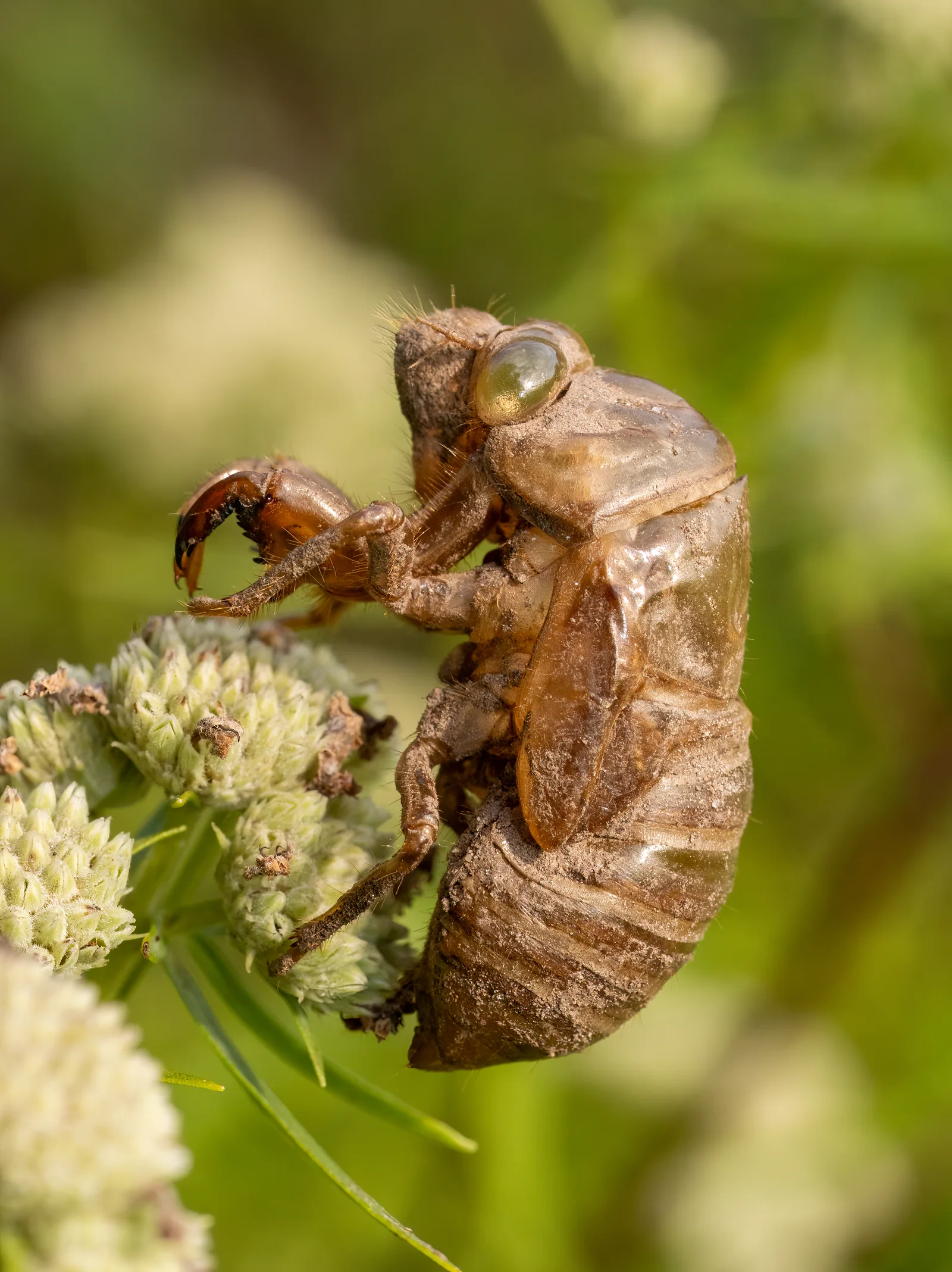
These marks can support a confident cicada-family identification. They usually cannot support an exact species name from one casual photograph. Cicadas are diverse, and researchers often use adult structure, place, timing, and especially sound to separate species.
One quiet shell records a busy night
Stillness hides the energetic part of the story. A mature cicada nymph climbed out of the soil, often after sunset, and searched for a firm surface. The grip had to hold through a complete change of form.
Once anchored, the outer covering opened along the back. The pale adult pressed outward, arched free, and hung from the old skin while its soft body changed position. Body fluid moved into folded wings, spreading them into broad transparent sheets. The new outer skeleton then began to darken and harden.
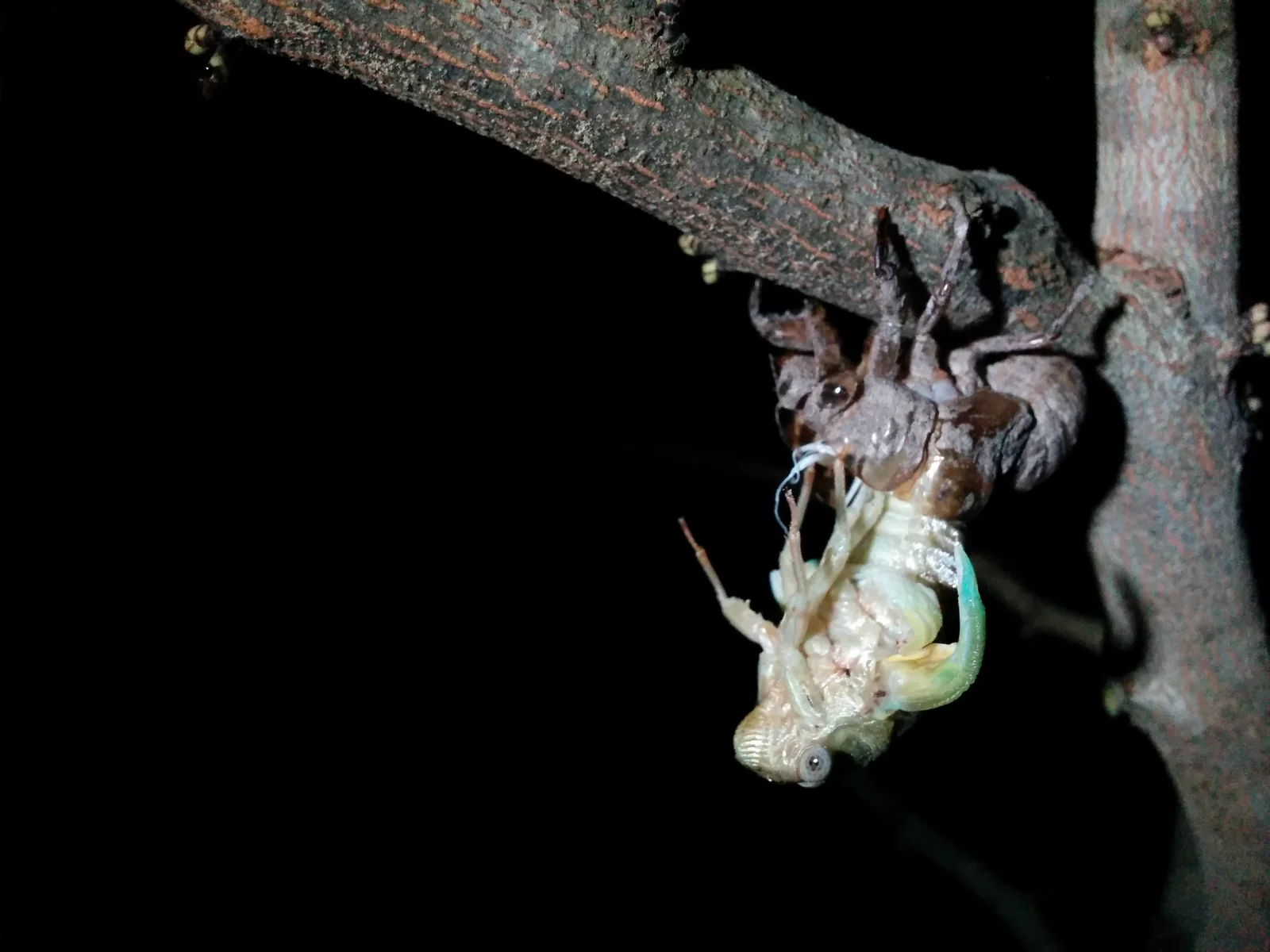
Colorado State University Extension describes the newly emerged adult hanging for several hours as its wings extend and its new covering hardens. National Park Service observers note the same pause near the empty shell. By the time daylight reveals the casing, the winged adult may already be high in the tree.
What remains is not a frozen adult. It is a cast of the last underground stage, preserved at the boundary between soil and air.
Why the shell stays attached
Those feet did not close after the cicada left. They were already gripping while the nymph was alive. The shed covering keeps that posture because its outer material has become dry and rigid.
Bark is especially good at holding it. Claws settle into narrow cracks. Rough ridges support the body from several directions. A grass stem, leaf, porch post, or wall can work too, so the surface is context rather than a requirement.
Sometimes several shells gather on one trunk. That can mean multiple nymphs found the same convenient route upward. A crowd of casings is evidence of many completed molts, but it does not automatically identify a periodical brood.
A cicada shell is not a pupa
Butterflies and many other insects pass through a pupal stage between larva and adult. Cicadas follow a different pattern. Their young are nymphs, body forms that gradually grow more adult-like through repeated molts without becoming pupae.
The shell on the tree came from the final nymphal stage. Its thick digging legs suit an animal that has been moving through soil. The adult that leaves has a different job above ground, with working wings and a body built for a short reproductive season.
This difference helps explain why the shell looks so complete. It is not a cocoon that enclosed a motionless transformation. It is the fitted outer covering of an active nymph that climbed into position under its own power.
Shell or adult cicada?
Start with structure. An exuvia has an open seam along the back and an empty interior. It has no full-size adult wings. Its limbs remain fixed in one gripping pose, and light may pass through parts of the head and body.
An adult cicada carries two pairs of clear, veined wings that fold over or beyond the abdomen. A newly emerged adult can be pale and soft, but it is still visibly present beside the old casing. A mature adult may rest quietly on bark, so lack of movement alone is not enough to classify what a photograph shows.
This is why the open seam matters. It records an exit. If the view is uncertain, take photographs from behind and from the side. A close image can preserve the hollow body, the wing pads, and the difference between a shell and a winged animal without changing the scene.
The family bug-observation guide offers a simple routine for that kind of patient field note: pause, photograph, describe, and leave the small structure where it is working as evidence.
Not every shell belongs to a 13-year or 17-year event
Synchronized periodical cicadas have made long counts part of the public story. Their nymphs develop for 13 or 17 years, then emerge together in particular regions and brood years.
Other North American cicadas follow different schedules. The large greenish dog-day cicadas in genus Neotibicen appear every summer in many places. That does not mean one individual completed its development in a single year. Multiple generations overlap, so some adults emerge each season even though individual nymphs spend several years below ground.
A late-summer shell can therefore be ordinary in timing and extraordinary in what it records. Most of that cicada’s development happened out of sight among roots. The final passage from soil to wing took only part of one night.
What to notice from shell to sound
An empty casing is silent, but it points toward sound. Adult male cicadas call from trees by vibrating specialized structures on the abdomen. Different species produce different patterns, one reason sound can be more informative than a shell alone.
Cicadas also belong to the same broad insect branch as froghoppers. A spittlebug nymph inside white plant foam looks very different, yet both insects use piercing mouthparts to feed from plants and pass through nymphal stages without a pupa. One leaves a bubble room on a stem. The other leaves a dry cast on bark.
For a useful shell photograph, begin wide enough to show the trunk or stem. Then move the camera, not the casing, for a rear view of the split and a side view of the forelegs and wing pads. Save the date, time, recent weather, and any cicada calls you hear nearby. Those details cannot guarantee a species, but they turn one brown shape into a richer record.
At first glance, the object seems to be an insect that forgot to move. Look through the open back and it becomes something else: a small architecture of departure, still gripping the tree after the living cicada has entered the air.
Sources
- Mississippi State University Extension: Cicada Exuviae Accessed 2026-08-22
- Colorado State University Extension: Cicadas Accessed 2026-08-22
- University of Connecticut Biodiversity Research Collections: General Periodical Cicada Information Accessed 2026-08-22
- U.S. National Park Service: Cicada Accessed 2026-08-22
Image credits
- Top image Ryan Hodnett · CC BY-SA 4.0
- After the field-mark section Rhododendrites · CC BY-SA 4.0
- After the nighttime-molt section Alex Gleason · CC BY-SA 4.0
More Field Notes
 Praying Mantis Egg Case: How to Identify an Ootheca on a Twig
  Why Pine Cones Open When Dry and Close When Wet
  Black and Orange Fuzzy Caterpillar: Woolly Bear ID Guide
Read it. Then go find it.
Open Leafari on your next walk and see what has been waiting in plain sight.