
Tiny Nests in Mulch: Meet Bird's Nest Fungi
Identify tiny cup fungi in mulch by their egg-like spore packets, wood-chip setting, changing form, and rain-powered splash launch.

At a glance
What are the tiny nests with eggs in my mulch?
Tiny cups holding several pale, gray, or dark discs in damp mulch are likely bird's nest fungi. Confirm their very small size, cup shape, decaying-wood setting, and multiple egg-like spore packets. A close photograph is usually safest at the family or genus level because several bird's nest fungi look similar.
After rain, a dark wood chip can hold something that looks built rather than grown. Several cups sit shoulder to shoulder, each smaller than a shirt button. Pale discs fill their centers like smooth eggs in miniature nests. A few inches away, the mulch looks ordinary.
These are strong clues for bird’s nest fungi, a family of small fungi whose fruiting bodies really do resemble tiny nests. The cups are the visible, spore-making part. Most of the organism remains threaded through damp wood and other decaying plant material below.
That resemblance is so good that the first question is often not “What fungus is this?” but “Who made those little nests?” Four details turn the surprise into a useful identification: scale, substrate, cup shape, and the number of egg-like packets inside.
Start with four clues at mulch level
First, check the size. Many bird’s nest fungi stand only a few millimeters tall. University of Florida researchers describe typical fruiting bodies as 3 to 10 millimeters tall, though the wider family varies. Penn State gives a practical comparison: the little nests are often no more than one-quarter inch across.
Second, look at what they grow from. Wood chips, bark mulch, fallen twigs, leaf litter, old boards, and other decaying plant matter are characteristic settings. A cup that rises from living leaf tissue points toward a different story. Here, the softened edge of a wood chip is evidence.
Third, find the cup. A mature fruiting body may be smooth inside or lined with vertical grooves. Its outer surface can be pale, yellowish, brown, gray, or shaggy. The family has several genera, so color alone is a weak clue.
Fourth, count what appears to be inside. Bird’s nest fungi hold several firm discs or rounded packets. These are not eggs. They are peridioles, compact cases packed with spores. Several “eggs” in one true cup are more informative than any one shade of brown.
This set of clues supports a family-level identification from a photograph. Exact species can require details that a casual close-up does not preserve, so the most honest field label may simply be bird’s nest fungus.
The cups begin closed
A nest shape appears only at maturity. Young fruiting bodies can look like tiny puffballs or blunt knobs. A thin covering seals the top while the peridioles develop inside. As the cup matures, that lid splits or wears away and exposes the packets to rain.
That change explains why one patch of mulch may seem to contain several unrelated objects. Covered forms sit beside fresh nests. Older cups may be empty. A single photograph of an unopened bump can be ambiguous, but returning after wet weather may reveal the structure that was forming inside.
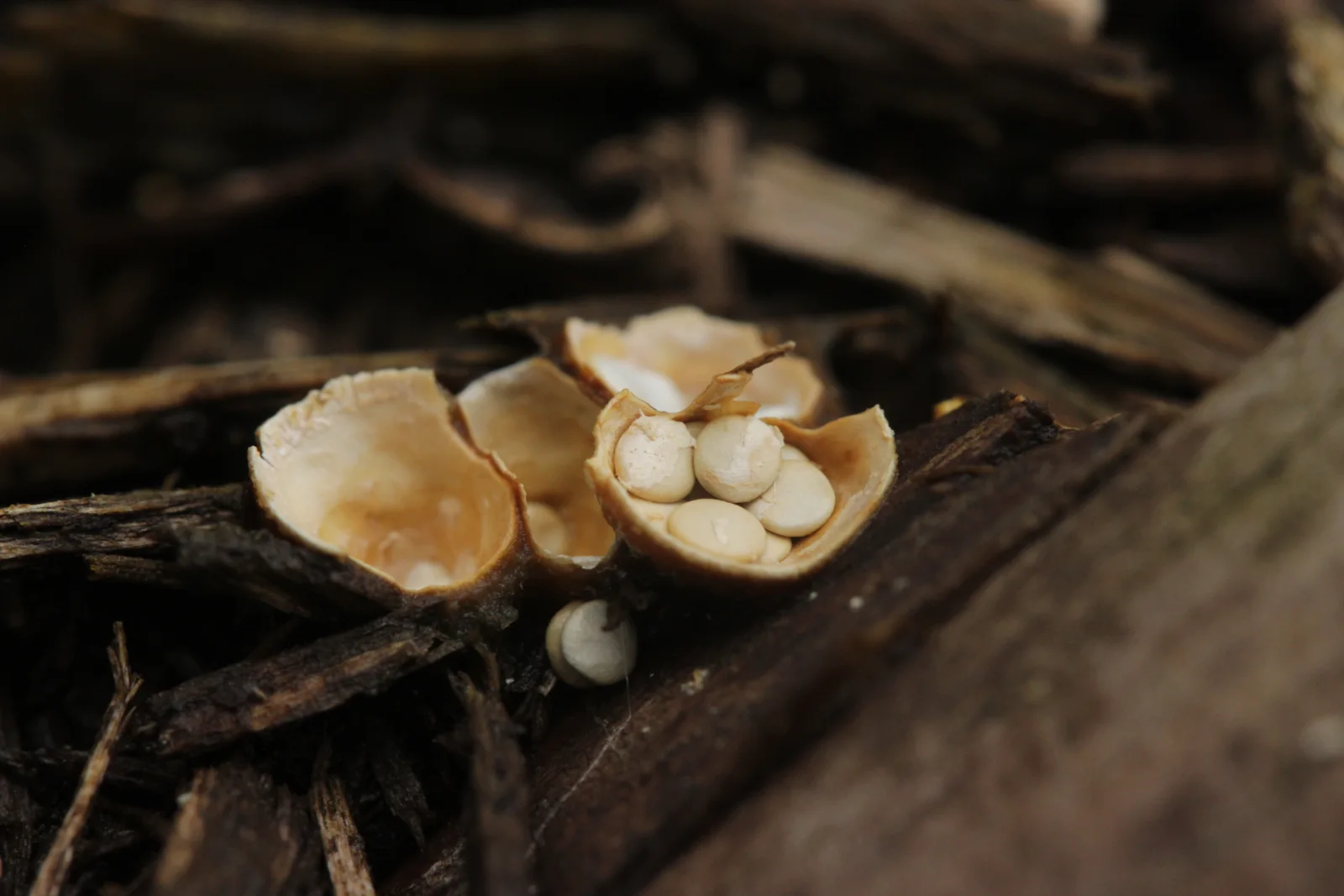
Caps and stems are only one fungal solution to the work of releasing spores. A splash cup is another. Its shape waits for weather.
A raindrop becomes a launch
When a falling drop strikes the inside of a mature cup, water races up the wall and can carry one or more peridioles over the rim. University of Minnesota Extension reports that some travel more than a yard. The cup does not shoot by muscle or spring. Its geometry redirects the energy already present in rain.
In Cyathus and Crucibulum, each peridiole is linked to the cup by a coiled cord with a sticky end. The impact can free that cord. If the sticky end catches a twig or stem, the cord may wrap around it and leave the spore packet hanging in a new place.
A mushroom smaller than a button can use one raindrop as a launch pad.
Numbers hidden inside the packet are even harder to picture. UF/IFAS cites as many as 30 million spores in one peridiole. With several packets in one fruiting body, a cup may contain more than a billion spores. The nest metaphor works at first glance, but the structure is closer to a rain-powered dispersal station.
Researchers still have questions about what happens after the launch and how the spores establish the next fungal individual. The visible mechanism is dramatic. The steps that follow remain partly out of sight.
Smooth cups and fluted cups
These photographs show two exact species, not a complete key. Crucibulum laeve forms relatively smooth, pale cups with light peridioles. Cyathus striatus, the fluted bird’s nest fungus, has pronounced vertical ribs inside the cup.
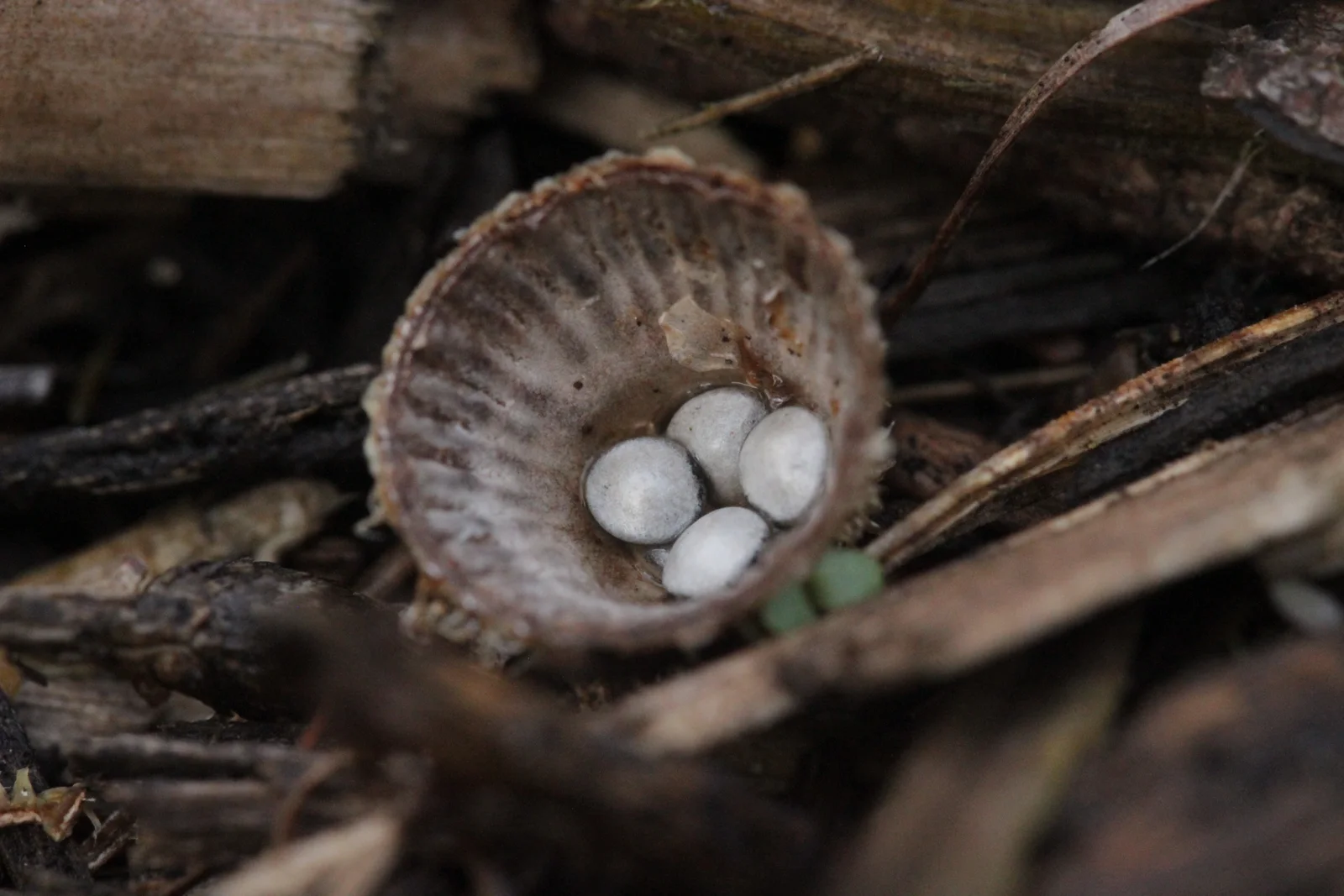
Those differences are useful once a clear macro photograph exists. They should not be stretched into a species name from a distant phone image. Age, light, moisture, debris, and empty cups can hide the traits that matter.
Other members of the family do not match either image perfectly. A good field note can therefore record “bird’s nest fungus, probably Cyathus or Crucibulum” and leave room for a closer expert look.
Tiny nests, false eggs, and other mulch shapes
Several small objects share the same wet garden bed. Insect eggs usually lack a fungal cup around several loose-looking packets. Seeds may repeat across the surface but do not sit within rows of millimeter-scale nests that change from covered knobs to open cups.
Artillery fungus creates another tiny cup on decaying wood. Penn State describes it as roughly one-tenth inch wide with a single dark spore mass. Bird’s nest fungi usually show several packets inside a recognizable nest. The distinction is visible when the camera is close enough.
More familiar mushrooms rise on stems or open broad caps. A flocculose inkcap can share the decomposer setting while keeping that cap-and-stem outline. A scarlet cup offers a larger, red cup on damp fallen wood. The brown funnel polypore is larger still, with concentric brown zones and pores underneath, often standing from sandy ground rather than opening as a tiny egg-filled cup in mulch.
These comparisons work best from structure and substrate. “Small and brown” includes too much of the forest floor.
Why bird’s nest fungus appears in mulch
Bird’s nest fungi appear in mulch because wood chips supply the dead plant material they use as decomposers. Fine fungal threads called mycelium spread through a damp chip and absorb nutrients as the wood breaks down. The little cups are temporary fruiting bodies made by that much larger hidden network, not nests built by an insect.
Mulch makes the network unusually easy to approach. A chip begins as a firm piece of bark or wood. Water enters its cracks. Fungi and other organisms work through its carbon-rich tissues. The chip darkens, softens, and joins the soil as smaller fragments and recycled nutrients. By the time a cup opens at the surface, fungal threads may already extend through material that still looks like an ordinary brown chip.
Seen in that context, the nests are signs of decomposition, not decorations placed on top. A wet spell can make the fruiting stage visible without creating the whole fungus overnight. Moisture supports the hidden growth, clears dust from cup rims, and later supplies the raindrops that launch the spore packets. UF/IFAS notes a strong late-summer and early-fall fruiting period in Florida, while northern extension guidance points observers toward damp garden corners in fall. Local weather matters more than one national calendar.
What to notice in a useful photograph
Begin with the whole patch. Include the wood chips, leaf litter, or twig that holds the cluster. That frame records the substrate and shows whether the cups repeat across a damp area.
Then take a view from above. The photograph should show the number of peridioles and whether the cup wall is smooth or fluted. A side view can preserve the outer texture and any covered young forms nearby. For scale, keep a familiar wood chip or a ruler at the edge of the frame rather than relying on zoom alone.
Save the date and recent weather. If the patch remains visible, a return photograph after another rain may show newly opened cups or empty nests. Those changes are part of the identification, not damage to a still object.
At eye level, mulch can look like a uniform brown layer. At nest level, it becomes a wet landscape of ridges, cups, packets, threads, and routes for falling water. The next rain is already part of the picture.
Sources
- UF/IFAS Extension: Bird's Nest Fungi Accessed 2026-08-20
- University of Minnesota Extension: Common Fungi in Yards and Gardens Accessed 2026-08-20
- Penn State Extension: What Is Growing in My Landscape Mulch? Accessed 2026-08-20
Image credits
- Top image Bernard Spragg. NZ · Public domain
- After the life-stage section Björn Sothmann · CC BY-SA 2.0
- Beside the genus comparison Björn Sothmann · CC BY-SA 2.0
More Field Notes
 Praying Mantis Egg Case: How to Identify an Ootheca on a Twig
  Why Pine Cones Open When Dry and Close When Wet
  Black and Orange Fuzzy Caterpillar: Woolly Bear ID Guide
Read it. Then go find it.
Open Leafari on your next walk and see what has been waiting in plain sight.