
Tiny Red Bugs on Concrete? Clover Mites vs. Sidewalk Mites
Compare red mites by scale, front-leg length, body texture, movement, season, and nearby vegetation before naming a tiny speck on pavement.

At a glance
What are the tiny red bugs on concrete?
Red pinpoints on pavement may be clover mites or mites often called sidewalk or concrete mites, but color and surface alone cannot identify them. Use a macro photo to compare size, texture, movement, front-leg length, nearby plants, and season. Extension descriptions place clover mites below 1 millimeter and adult Balaustium concrete mites around 1 to 2 millimeters, so preserved scale matters.
The first one looks like punctuation. A red dot crosses a pale patio slab, disappears into the shadow of a grain of sand, then appears again a few inches away. From standing height, color seems to be the whole animal. Through a close photograph, an oval body and eight legs begin to separate from the stone.
Several mite groups can make this scene. Clover mites are one possibility. So are mites often called concrete, sidewalk, brick, or patio mites. A visibly fuzzy velvet mite belongs in the comparison too. These names overlap in casual use, while the animals differ in size, shape, ecology, and what a photograph can prove.
A better question is not “Which red bug lives on concrete?” but “Which details survive when this red speck comes into focus?”
Photograph scale before color
Begin with two frames from the same position. One should show the broader setting: wall, window edge, paving joint, nearby lawn, low plants, shade, and sun. The other should preserve as much body detail as the camera can resolve. A short burst can record whether the animal travels steadily, darts, or pauses.
Keep an immovable reference in the wide frame when one is already beside the animal. The width of a paving joint, the corner of a brick, or a visible grain in the surface can hold scale after the mite has moved out of view. Digital zoom alone makes a dot larger without telling you how large it was.
Eight visible legs place an adult or nymphal mite among the arachnids, alongside spiders and ticks. At this size, legs may merge with glare or shadow. A blurred photograph that seems to show six is not enough to name a life stage. Record what is clear and leave the rest uncertain.
For a calm, repeatable routine, the family guide to observing unknown bugs keeps the work centered on distance, photographs, notes, and an undisturbed scene.
Clover mites: look for the long front pair
Clover mites are minute plant-feeding mites. University of Minnesota Extension describes them as smaller than a pinhead. University of Maryland Extension puts them below 1 millimeter. Their bodies may look reddish-brown, dark purple-brown, or dull red, while their legs can appear warmer orange-red.
The clearest structural clue is the front pair of legs. On a clover mite, those two legs are unusually long and project ahead of the body. At first glance they can look like antennae, but mites do not have antennae. The hero photograph shows several clover mites identified on iNaturalist as Bryobia praetiosa, making the long front pair easier to compare with the shorter legs behind it.
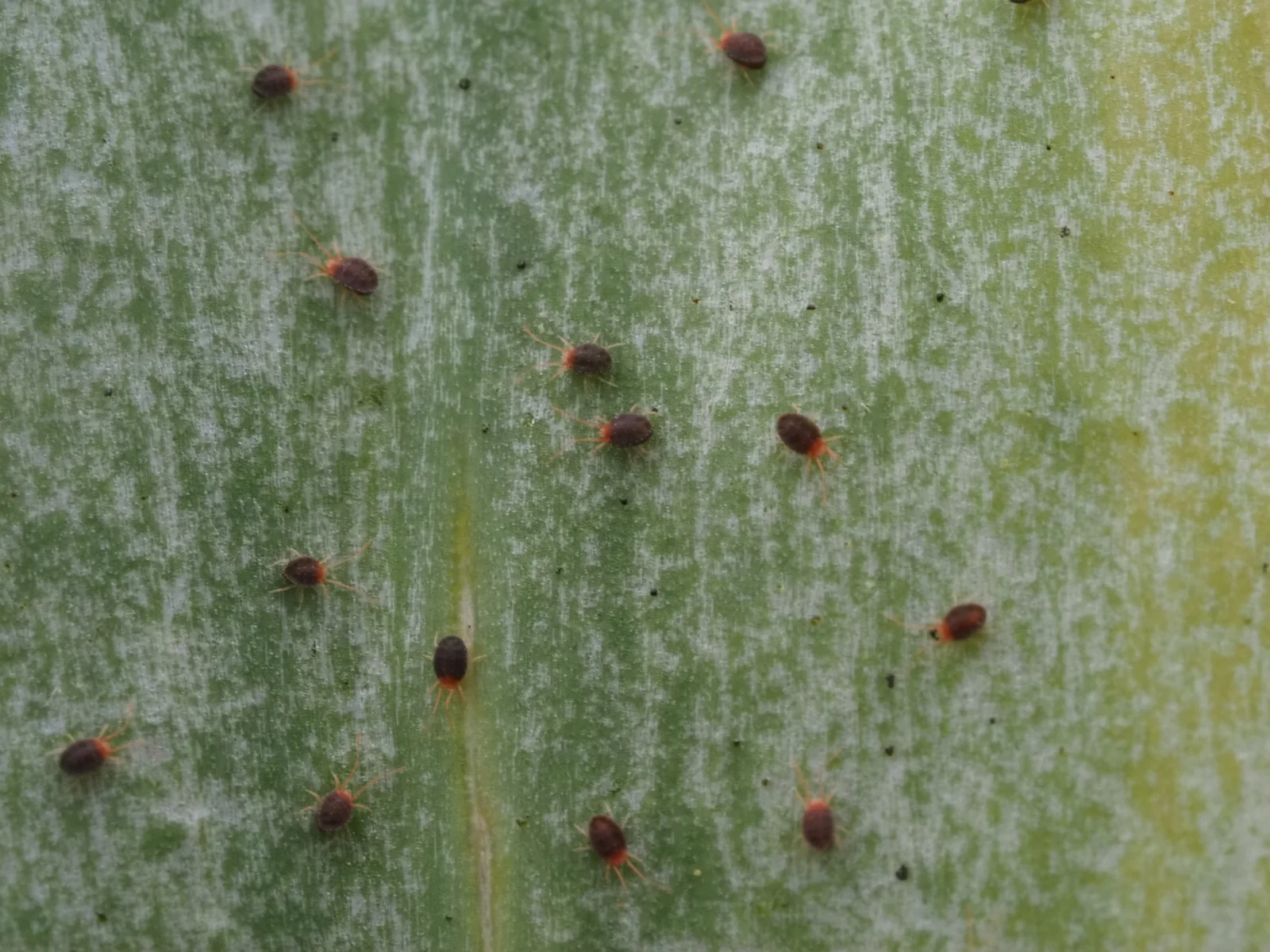
Habitat and season can strengthen the comparison. Clover mites feed on grasses and other plants. Extension sources describe activity around turf and movement onto sunny walls, foundations, and windows, especially during cool parts of spring and fall. Nearby Kentucky bluegrass, fescues, or suckling clover provide plant context, but no lawn plant proves the identity of a red speck.
University of Minnesota, Colorado State, and University of Maryland extension sources report that identified clover mites do not bite people or animals. The Maryland and Colorado State sources also report that identified clover mites do not carry or transmit disease. Those statements belong to a verified clover mite. They do not settle the risk profile of an unidentified red mite.
Sidewalk and concrete mites: preserve the uncertainty
“Concrete mite” and “sidewalk mite” are visual field labels more than tidy species names. Alabama Cooperative Extension discusses red predatory mites in the Balaustium complex that cross sunny hard surfaces. Adults are about 1 to 2 millimeters long, with a more elongated body than a typical clover mite, and can move rapidly. They feed on other tiny arthropods and their eggs rather than on turf leaves.
Our second photograph shows Balaustium identified only to genus. The bright animal stands out, but the lichen-covered rock is doing important work too. It shows the mite as a small traveler within a much larger mineral surface.
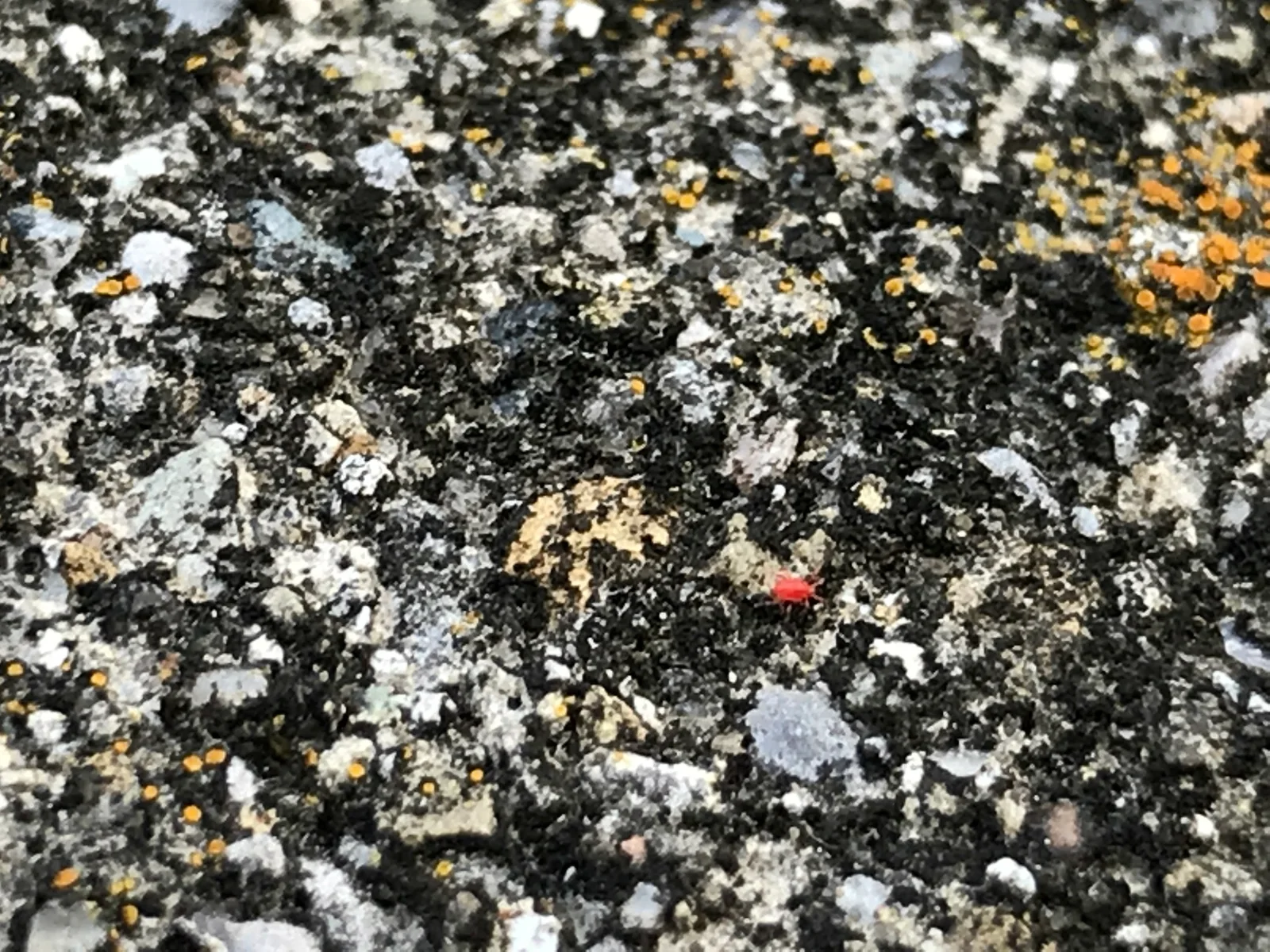
Long front legs are useful for clover mites, but they are not an exclusive switch. The National Institute of Environmental Health Sciences presents a real masonry-mite puzzle in which suspected concrete mites also appear to carry a conspicuous front pair. Shape, true size, movement, season, and vegetation need to agree.
The safety boundary is narrower here. Alabama Cooperative Extension says it is unclear whether concrete mites bite people or pets. That uncertainty should stay attached to the name. Extension guidance about clover mites cannot be transferred to Balaustium or to an unresolved red dot.
Velvet mites: texture changes the picture
Velvet mites are usually easier to recognize once a detailed macro image records the body surface. Many have a dense coat of fine hairs that gives the red animal a plush or suede-like texture. NC State Extension describes these trombidiid mites in soil and leaf litter, with adults and older young acting as predators of small arthropods.
That is a different visual form from the small, smooth oval of a clover mite. It can also be a very different scale. The image below is an exact Dinothrombium gigas, a giant true velvet mite, shown as a texture contrast rather than a size analogue for a patio speck.
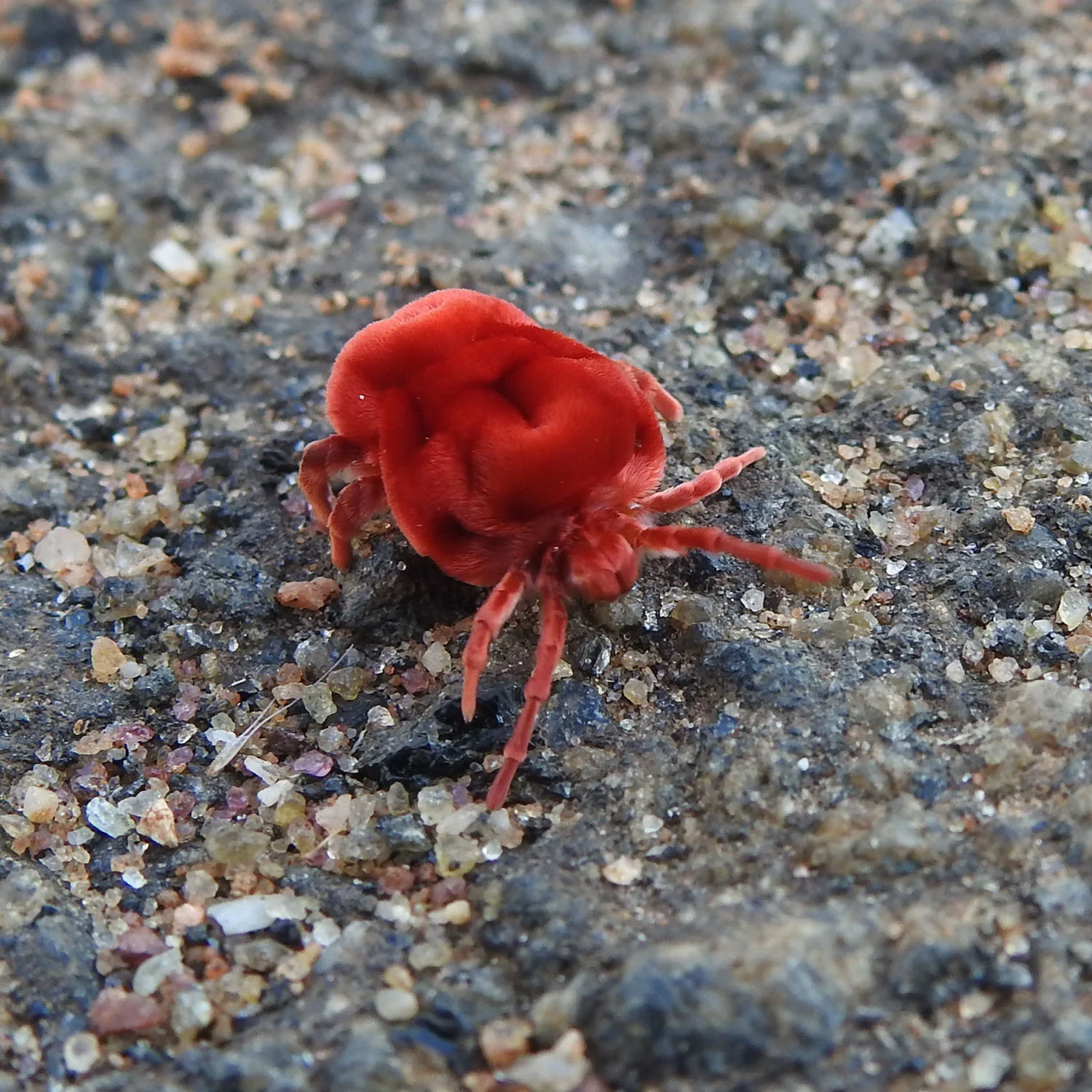
A distant red pinpoint may hide that texture completely. If the photograph cannot resolve a smooth or hairy surface, “red mite on stone” is a stronger field note than an unsupported velvet-mite label.
Why red on pavement does not mean chigger
“Chigger” refers to the larval stage of certain trombiculid mites, not every tiny red mite. Alabama Cooperative Extension describes those larvae as six-legged, under 0.4 millimeter, and associated with humid vegetation. Those clues do not make a diagnosis from a patio photograph. They show why life stage, scale, and habitat matter.
Color is especially weak here. A red animal on concrete may be a plant feeder, a predator, a velvet mite, or another arachnid that the photograph does not resolve. Counting legs can help only when the image is sharp enough for the count to be honest. The place where the mite was seen is evidence, not a verdict.
Read the lawn-to-pavement edge
A patio looks blank at human scale. At mite scale, it has warm and cool zones, joints, shade lines, windblown pollen, lichens, grains of soil, and routes leading back to plants. Clover mites may arrive from turf. Predatory mites may be crossing in search of animals too small for us to notice. Velvet mites may emerge from soil or litter and become conspicuous against a pale hard surface.
Nearby plants deepen the record. Grass blades can point toward a plant-feeding context, while leaf litter suggests another tiny community. But the animal remains the primary evidence. A patch of clover explains a possible route; it does not name the traveler.
Make the final record small and precise: date, time, sun or shade, exact surface, approximate scale, movement, nearby vegetation, and the clearest uncropped photograph. Add a second line for what remains unresolved. “Front legs look longer; body under 1 millimeter; beside turf; clover mite likely” preserves both the clues and their limit.
On a patio, one millimeter can separate a good clue from a confident mistake. The red speck becomes more interesting when the uncertainty stays visible: a tiny animal crossing the border between lawn and stone, carrying its own ecology into view for only a moment.
Sources
- University of Minnesota Extension: Clover Mites Accessed 2026-09-10
- Colorado State University Extension: Clover and Other Mites of Turfgrass Accessed 2026-09-10
- University of Maryland Extension: Insects and Mites in Home Lawns Accessed 2026-09-10
- Utah State University Extension: Clover Mite Accessed 2026-09-10
- National Institute of Environmental Health Sciences: They Seem to Be Everywhere, What Mite They Be? Accessed 2026-09-10
- NC State Extension: Velvet Mites, Brick Mites or Patio Mites Accessed 2026-09-10
- Alabama Cooperative Extension: Chigger and Concrete Mites Accessed 2026-09-10
Image credits
- Top image Jessica Williams / iNaturalist · CC BY 4.0
- In the sidewalk and concrete mite section kemper / iNaturalist · CC0
- In the velvet mite comparison Paulmathi Vinod · CC BY 4.0
More Field Notes
 Praying Mantis Egg Case: How to Identify an Ootheca on a Twig
  Why Pine Cones Open When Dry and Close When Wet
  Black and Orange Fuzzy Caterpillar: Woolly Bear ID Guide
Read it. Then go find it.
Open Leafari on your next walk and see what has been waiting in plain sight.