
Small White Butterfly in the Garden: Cabbage White Clues
Use dark wingtips, black spot count, the folded-wing underside, location, and nearby plants to recognize a cabbage white and separate pale lookalikes.

At a glance
What is the small white butterfly in my garden?
A cabbage white is a likely match when the upper forewings have dark tips and one or two black spots, while the folded underside looks pale yellow-green. Check several clues together, including size, location, season, and nearby mustard-family plants, because checkered whites, sulphurs, and other pale butterflies can look similar in motion.
A pale triangle skips over the flowers at knee height. It tilts white in the sun, disappears against a bright path, then settles for less than a breath. In that pause, a charcoal mark appears at the wingtip. The wings close, the butterfly lifts, and the garden turns into motion again.
Cabbage white is a strong possibility when a small white butterfly shows dark forewing tips, one or two central black spots, and a pale yellow-green underside. Several clues should agree. Pattern, resting posture, location, season, and nearby mustard-family plants carry more weight together than white color alone.
Rarely is the first view the useful one. Cabbage whites fly through sunny gardens, roadsides, lawns, and fields, often low enough to seem within reach and fast enough to deny a long inspection. A short sequence of photographs can gather the marks one landing at a time.
What to notice when the wings open
Start at the leading corner of each forewing. Cabbage whites usually have dusky or charcoal tips there, followed by a mostly plain white surface. In a clear upperwing view, females commonly show two central black spots on each forewing. Males commonly show one.
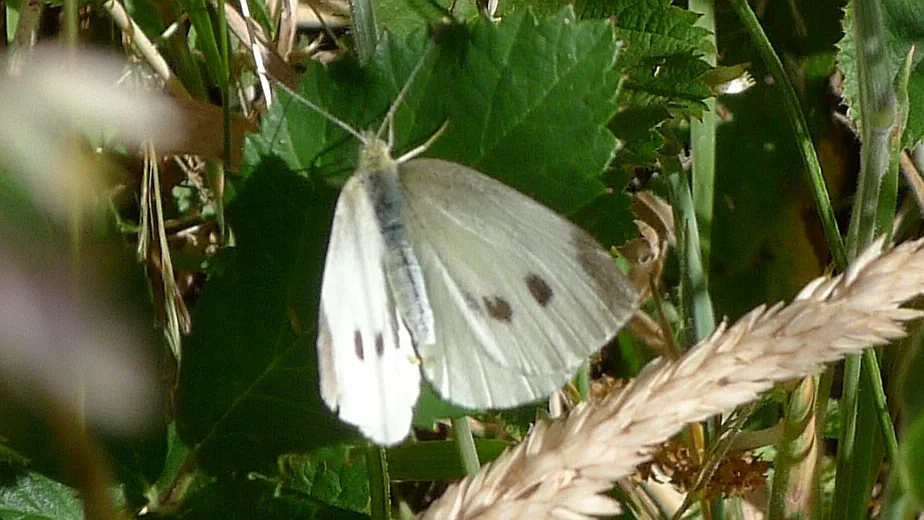
Spot count is a clue rather than a verdict. A moving wing may hide one mark behind the body. Sun glare can erase a faint spot, and worn scales can soften the whole pattern. Spring and late-fall individuals can also carry reduced dark markings. Use the tip, spots, overall plainness, and underside as a set.
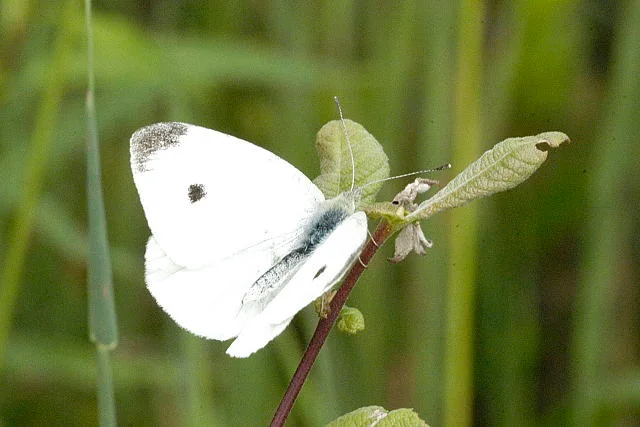
Size can support the impression, but it is difficult to judge in open air. Expert regional guides place the wingspan around one and a quarter to a little under two inches. A flower head, leaf, or stem in the same photograph preserves scale better than memory does.
How the folded wing changes the picture
Most white and sulphur butterflies spend long resting moments with their wings together above the body. That posture hides the bold upperwing marks and reveals a quieter underside.
On a cabbage white, the folded hindwing and forewing tip are often creamy, yellow-green, or gray-green. Fine dark speckling may dust the surface. One forewing spot can remain visible, but the dark tip that looked obvious in flight may nearly disappear from this angle.
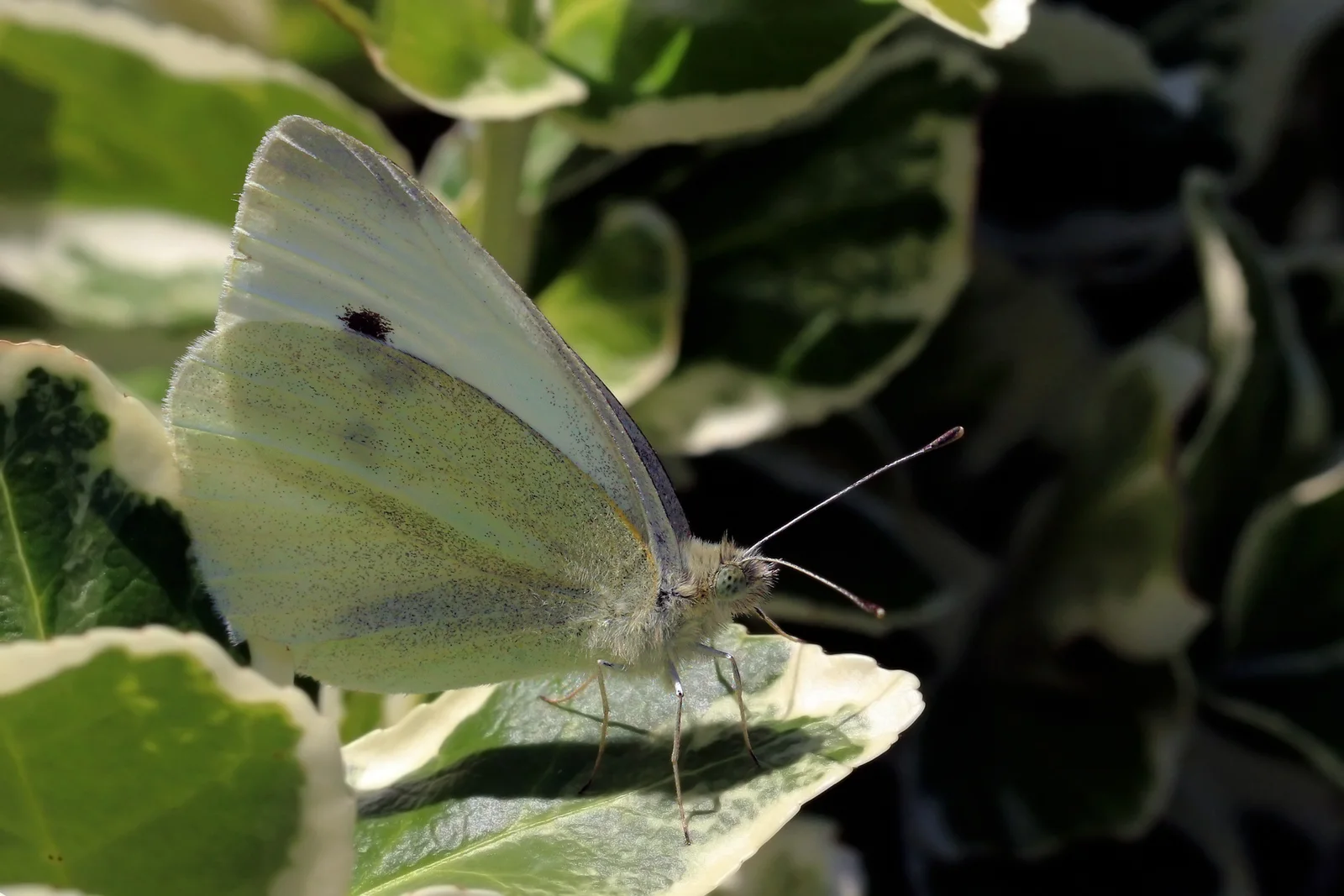
That color change is one reason a single flight impression can mislead. The butterfly has not changed wings. It has shown two surfaces built from different patterns. Photographing both postures, even on separate landings, turns a flicker into a usable record.
Why mustard-family plants matter
Adult cabbage whites visit many kinds of flowers for nectar. A loose summer flower such as Beeblossom can be one place to pause and watch pale visitors, while the butterfly’s next generation depends on a different plant relationship.
Females place single upright eggs on plants in the mustard family. That group includes wild mustards and cultivated forms such as Cabbage. The green caterpillar stage feeds on those leaves before becoming a chrysalis and, later, a winged adult. A White Mustard nearby does not prove the butterfly’s name, but it adds a meaningful habitat clue.
Plant context can redirect another striped garden find. A black-and-yellow caterpillar on dill or parsley belongs to a different host relationship and becomes a black swallowtail rather than a cabbage white.
At close range, the connection becomes stranger. Sensory organs on a female’s legs help her assess a plant before an egg is placed. A cabbage white can read a mustard-family leaf with her legs before the next generation begins there.
This small relationship ties two garden scenes together. The adult drinks nectar with a long coiled mouthpart. The caterpillar uses jaws on a much narrower set of plants. Flower patch and mustard leaf serve different stages of the same animal.
Look at pattern before calling a lookalike
Pale butterflies vary by region. A useful comparison begins with the local species list, then returns to the wing. White, cream, and yellow are broad color families. Bars, spots, wing edges, and underside pattern usually carry the finer information.
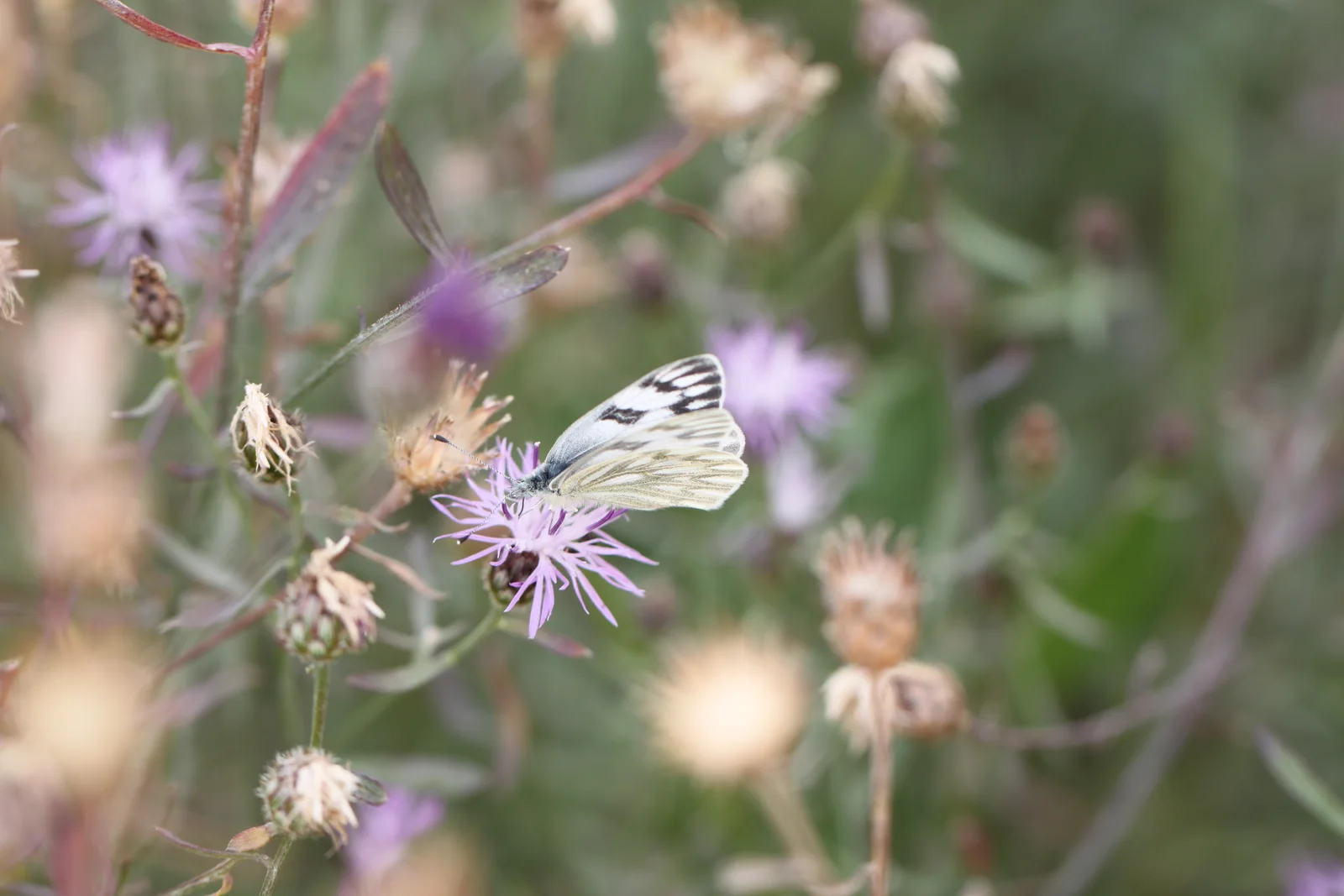
Checkered Whites can look cabbage-white pale from across a field. At rest, their wings often show a busier network of dark bars, gray-green veins, and mottled lines. The exact amount of pattern varies, so location and multiple photographs still matter.
Sulphurs belong to the same broader butterfly family. Many lean more strongly yellow or orange, yet pale forms can narrow that color gap. A Clouded Sulphur often shows a saturated yellow underside, a small dark forewing spot, and pale-centered spots on the hindwing instead of a cabbage white’s plain greenish wash.
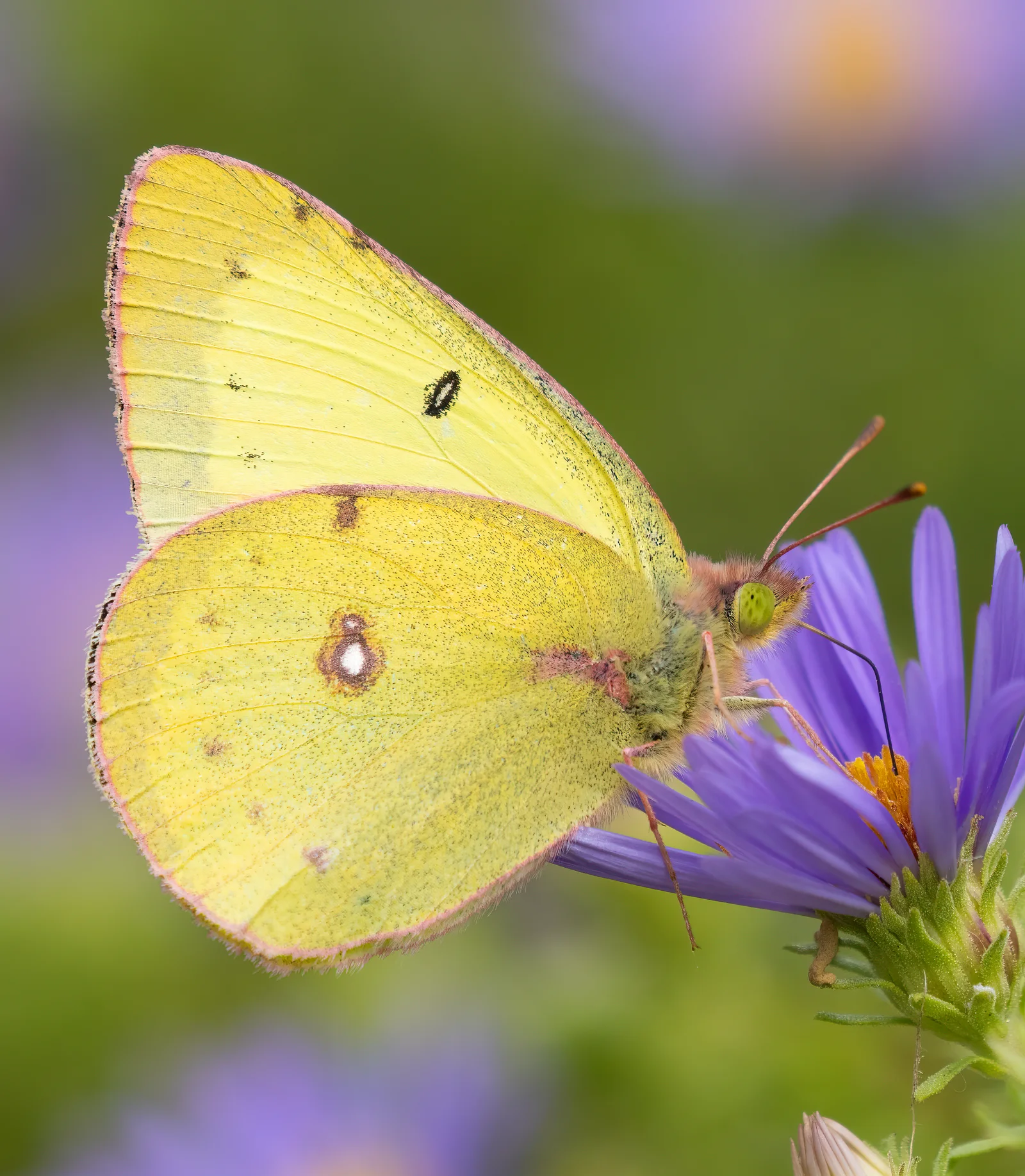
Other whites enter the picture in different parts of North America. In western Massachusetts, for example, Mass Audubon separates cabbage whites from other local whites by the dusky forewing tip and the lack of dark scales below. The comparison changes farther south or west. Geography is a field mark because a photograph can only belong to a species that occurs where the camera was.
Butterfly or moth in the cabbage patch
Names around cabbage can blur two different adults. A cabbage white is a pale butterfly active during the day. Its antennae end in small clubs, and it often holds its wings upright while resting.
A cabbage looper becomes a brown, patterned moth with a small silvery mark on the upper wing. University of Nevada, Reno Extension describes the adult looper as active mainly at night. Both have caterpillar stages associated with cabbage-family plants, yet their winged forms do not share the same white daytime pattern.
Color alone does little here. Time of activity, antenna shape, resting posture, and wing pattern answer the butterfly-or-moth part of the mystery more reliably.
A brief North American history
Cabbage whites are familiar across much of North America, but that familiarity is relatively recent. Government and regional atlas accounts trace an introduction near Quebec in 1860. The butterfly spread quickly through open country and cultivated landscapes, reaching Missouri by the late 1870s and becoming widespread across New England within little more than a decade.
That history now moves through ordinary scenes: a pale adult crossing a lawn, a green caterpillar on a mustard leaf, a chrysalis waiting through a cold season. The butterfly’s range expanded alongside the plants and disturbed open habitats that supported its life cycle.
Season changes the view as well. In many regions, several generations appear from spring into fall. Early and late individuals may be smaller or less strongly marked, while summer adults can show darker tips and spots. Date belongs beside place in any careful identification.
Build a three-frame record outside
Make one wide photograph first. Include the flower patch, lawn edge, roadside, or mustard-family plant so the setting and approximate scale survive. A second frame should aim for an open wing, where the dark tip and central spots can be counted. Let the third preserve the folded underside.
Add the date and general location. Note whether the flight stayed low and fluttering, whether the butterfly visited flowers, and which wing surface appears in each frame. One photograph may hold only a partial clue. Three can show a pattern.
The family bug observation guide extends this same photo-first approach to other small outdoor visitors. Patience does most of the work. The butterfly can keep moving while the camera gathers separate pieces of evidence.
Soon the pale triangle lifts from the leaf and returns to the bright air. What seemed blank now carries structure: charcoal at the tip, a countable spot, greenish color underneath, and a plant relationship running from flower to mustard leaf. The next landing may last one second. That is enough to know where to look.
Sources
- Missouri Department of Conservation: Cabbage White Accessed 2026-08-13
- Alabama Butterfly Atlas: Cabbage White Accessed 2026-08-13
- Mass Audubon Butterfly Atlas: Cabbage White Accessed 2026-08-13
- UF/IFAS Entomology: Imported Cabbageworm Accessed 2026-08-13
- University of Nevada, Reno Extension: Cabbage Caterpillar Identification Accessed 2026-08-13
- Butterflies and Moths of North America: Pieris rapae Accessed 2026-08-13
Image credits
- Top image Simon Fraser University – Communications & Marketing · CC BY 2.0
- After the upperwing field marks John Tann · CC BY 2.0
- After the female upperwing comparison James K. Lindsey · CC BY-SA 3.0
- After the folded-wing clue Charles J. Sharp · CC BY-SA 4.0
- In the pale-butterfly lookalike comparison Bob Danley / U.S. Fish and Wildlife Service · Public domain
- After the Checkered White comparison Rhododendrites · CC BY-SA 4.0
More Field Notes
 Praying Mantis Egg Case: How to Identify an Ootheca on a Twig
  Why Pine Cones Open When Dry and Close When Wet
  Black and Orange Fuzzy Caterpillar: Woolly Bear ID Guide
Read it. Then go find it.
Open Leafari on your next walk and see what has been waiting in plain sight.